Cŵn Annwn
the United Kingdom
Wales: Gwynedd (Cadair Idris) and southern Wales (Brecon Beacons)
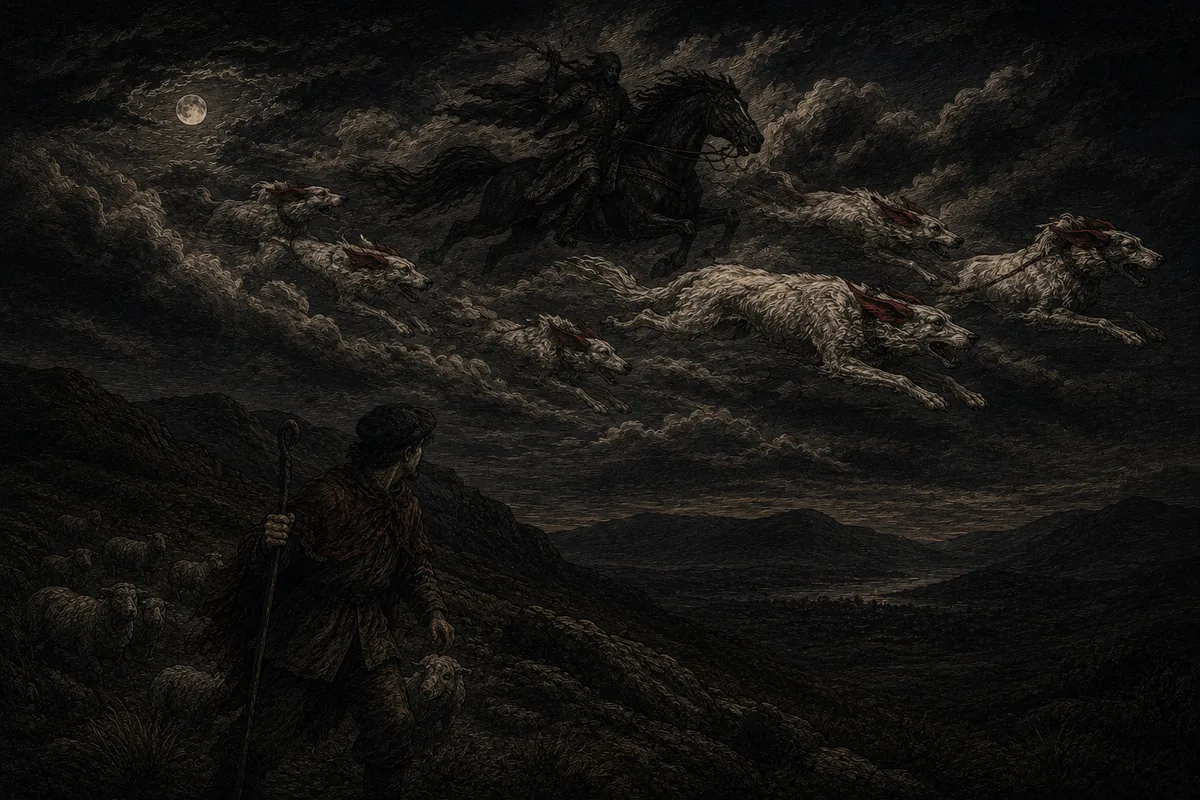
Cŵn Annwn — the pack of spectral hounds of Welsh folklore, white with red ears, that hunts souls in the night.
- Variants and names
- Cŵn Annwn, the hounds of Annwn; variants Cŵn Wybir, hounds of the sky, Cŵn Bendith y Mamau, Cŵn Mamau; British parallels Gabriel Hounds or Ratchets, the Yeth Hounds and Wish Hounds of Devon, the Dandy Dogs of Cornwall
- What is told
- A pack of spectral hounds, often white with red ears, a colour combination that in Celtic tradition indicates the Otherworld and death. They are led by Arawn, king of Annwn, in the First Branch of the Mabinogi, and in later tradition by Gwyn ap Nudd, and they take part in the Wild Hunt. Their most remarkable distinguishing trait is acoustic: their baying is louder when they are far off and fades as they come closer. They work as an omen of death and as an escort of souls towards the Otherworld, and they pursue the wicked.
- What it was forthe author’s reading
- An omen of death for the community, since the cry heard at night announces a decease, and a moral sanction against the guilty. The sources also record the naturalistic rationalisation of the call of wild geese on night migration, a valuable attestation because it shows the perceptual mechanism underlying the belief.
- Where it is attested
- Pwyll Pendefig Dyfed, the First Branch of the Mabinogi, in the manuscripts of the Llyfr Gwyn Rhydderch, about 1350, and of the Llyfr Coch Hergest, about 1382-1410, with narrative material datable to the 11th-12th century; the tradition of Gwyn ap Nudd in the medieval Welsh corpus; Wirt Sikes, British Goblins, 1880; John Rhŷs, Celtic Folklore: Welsh and Manx, Oxford, 1901. Archives at St Fagans National Museum of History, Amgueddfa Cymru.
- Caution
- Annwn is not Hell but an Otherworld of youth and abundance: the equation with Hell and with the Hounds of Hell is a medieval Christian reinterpretation, and treating it as the original meaning is a widespread error. Wirt Sikes, United States consul at Cardiff, is to be used with caution because at times he reworks the material. The etymology of Annwn is debated and unresolved. The contemporary revival of Calan Gaeaf, the calendrical context of reference, is in part a neo-tradition and should be classified B.
The grade says how well the entry is documented, not how interesting it is. How the grades are assigned.