El Familiar
Argentina
Santa Ana, south-western Tucumán, and its colonias; also named are Aguilares, Yerba Buena, Santa Lucía, Famaillá, and the ingenios La Esperanza, Ledesma and San Martín del Tabacal in Jujuy and Salta
El Familiar — not a monster of the woods: a device of the labour relation.
- Variants and names
- el Familiar, el perro Familiar; identified with the devil and, in Andean vocabulary, with Supay (Quechua)
- What is told
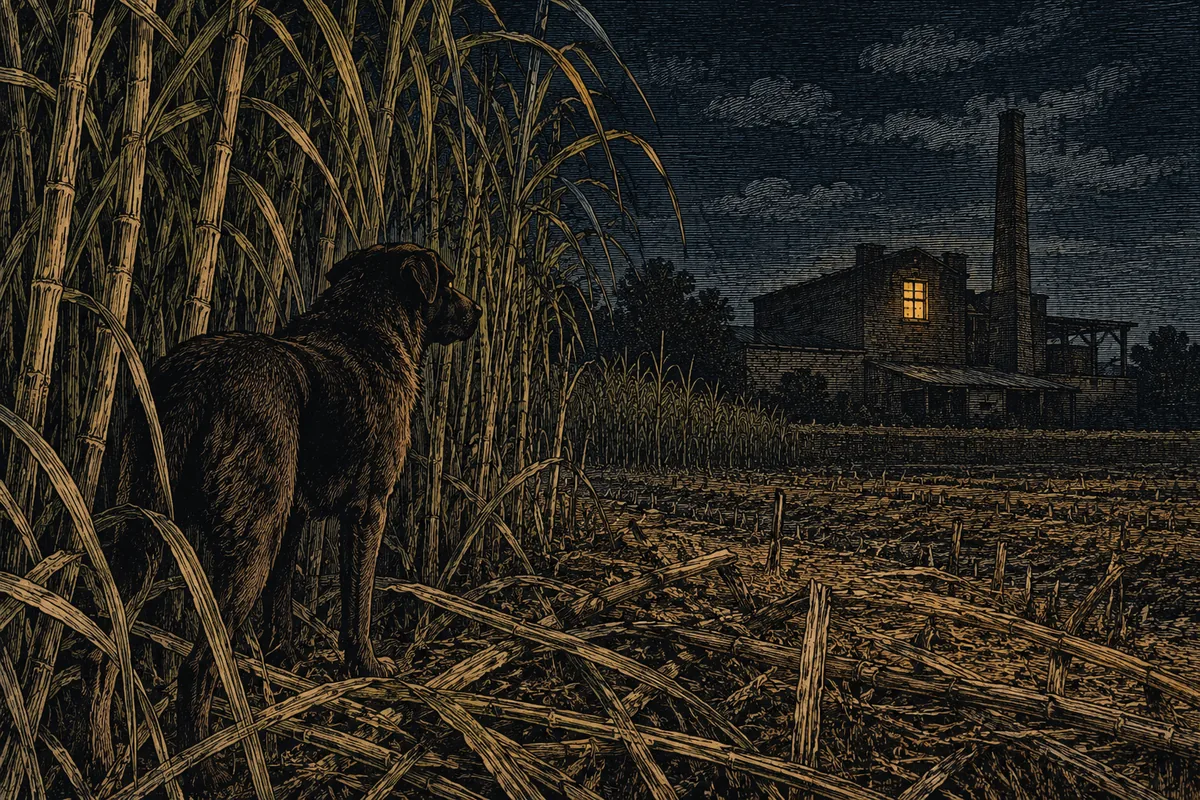
- Not a monster of the woods: a device of the labour relation. A black dog — sometimes a viper, sometimes a human figure — that the owner of the sugar mill keeps under a pact with the devil: in exchange for money and prosperity, the Familiar takes workers, who vanish, and it is said to feed on their blood. What defines it, and what no other entry in the atlas has, is that the pact is attributed to a historical, nameable person — at Santa Ana, to the founder of the ingenio — and that the creature accounts for death at work.
- What it was forthe author’s reading
- To say death in the factory. Where the disappearance of a labourer has neither report nor responsible party, the Familiar supplies both: a name, a contract, a cause. It is an accounting of blood running parallel to the accounting of sugar.
- Where it is attested
- Karina Gabriela Ciolli, «Los ladridos de El Familiar. Configuración simbólica de las relaciones de poder en un pueblo del sur tucumano», Runa (Instituto de Ciencias Antropológicas, FFyL-UBA), vol. 42, no. 2, 2021, pp. 175-192, DOI 10.34096/runa.v42i2.8007. Fieldwork at Santa Ana between 2015 and 2018, more than forty open, in-depth interviews plus observation; the testimonies are cited with month and year — August 2016, August 2017, December 2017 — and with the informants' names replaced by pseudonyms, which must be declared. Behind it, a chain going back to 1973: M. E. Valentié, El Familiar, UNT, 1973; E. Rosenzvaig, Historia social de Tucumán y del azúcar, II, UNT, 1986; B. R. Montevechio, El Familiar. Un mito del norte argentino, GEPMAL, 1990; A. Isla, in Estudios Atacameños 19, 2000, pp. 135-155.
- Caution
- This is the atlas's first Argentine entry, and the gap it closes was the worst: Argentina, Chile, Colombia, Bolivia and Uruguay stood at zero. The caution here does not concern a nineteenth-century novelist but the fact that the bibliography is interpretive before it is descriptive: Valentié, Rosenzvaig, Isla and others read the Familiar as class terror, cannibalism of capital, sacrifice. These are strong readings and perhaps right, but what the informants say is kept separate here from what anthropology makes of it. To be discarded: the figure for workers who disappeared; the two mirror-image theses, «a legend invented by the unions» and «a legend invented by the owners to discipline the peones», which I have seen only asserted; and the date of origin, invariably placed «in the late nineteenth century with the arrival of the ingenios» without a document.
The grade says how well the entry is documented, not how interesting it is. How the grades are assigned.