The fujenti of the Madonna dell’Arco
Campania · The Mezzogiorno
Sant’Anastasia, on the slopes of Vesuvius: the sanctuary of Santa Maria dell’Arco and the associations that climb up to it on Easter Monday from all over the Naples area
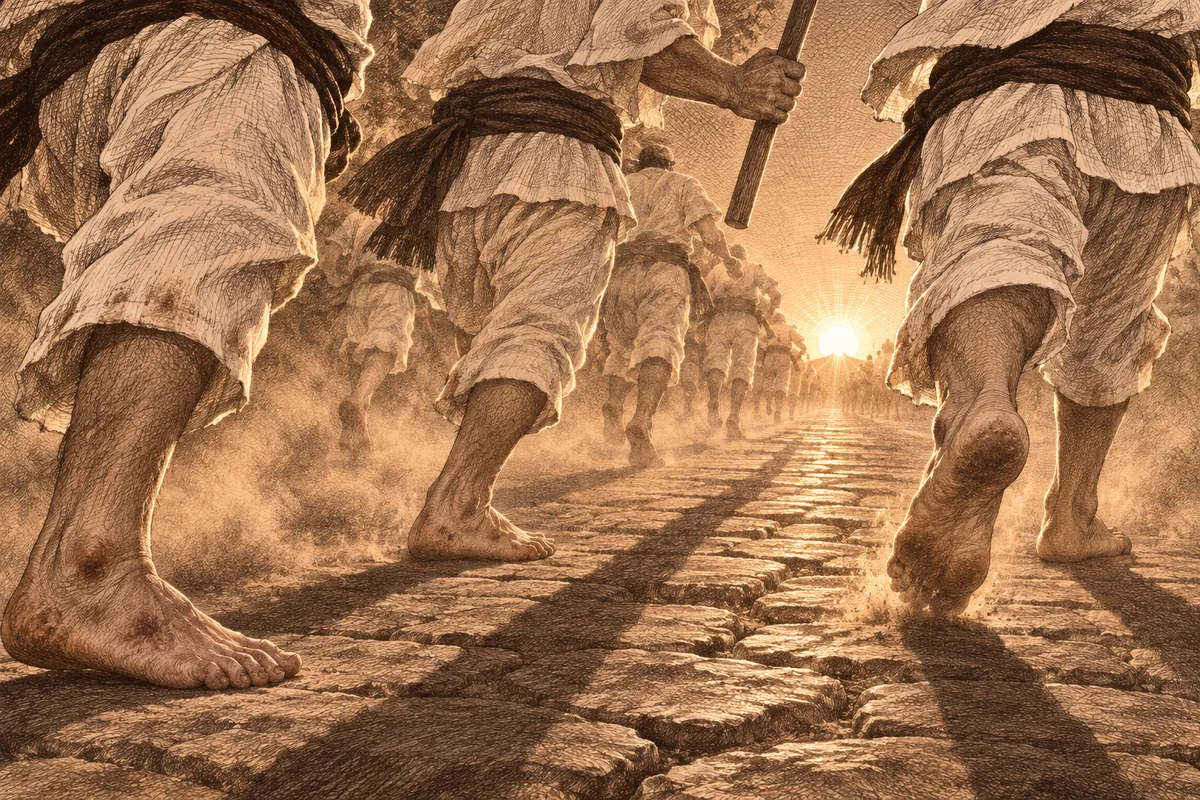
The fujenti of the Madonna dell’Arco — on Easter Monday the squads walk barefoot up to the sanctuary on the slopes of Vesuvius: vattienti does not mean that they beat themselves but that they beat their feet on the ground, and the blood comes from the walk.
- Variants and dialect names
- fujenti and vattienti, and neither name means what it seems to. The first comes from the gait: fujenti are those who run. The second does not come from beating oneself but from the rhythmic beating of the feet on the ground, which the devotees do even standing still. The associations are called squadre or paranze
- What is told
- On Easter Monday the squads walk up to the sanctuary of Santa Maria dell’Arco, many of them barefoot, from across the Naples area. They dress in white with red and blue sashes and carry standards.
Three moments make the rite recognisable. The beating of the feet, standing as well as running, to a devotional chant. The final run towards the church, which ends in the «caduta», the fall: the devotees let themselves drop to the ground before the sanctuary. And the standards, held by boys lined up by seniority beginning with the youngest, who bend their knees and tip the pole until the standard touches the image of the Madonna.
The blood, where there is any, is not inflicted: it comes from the miles walked barefoot. - What it was forthe author’s reading
- To discharge a vow with the body, and to do it as a group. The unit of the rite is not the single penitent but the squad, which has a name, a seat, a standard and an internal order — and the order is the opposite of what one would expect, because the youngest go in front.
It is also why this entry stands beside the one on the vattienti of Nocera Terinese, and should be read with it to hand: there the blood is inflicted, here it is not. Two rites that popular writing lumps together under the word «battenti» are in fact doing two different things, and the whole difference lies in what is being beaten. - Where it is attested
- Three records of the Istituto Centrale per il Catalogo e la Documentazione, MODI type, all by Carminella Bochicchio, 2016, «PCI 500 giovani» project, coordination Roberta Tucci with Fabrizio Magnani and Luisa Vietri. The records have no page numbers: they are cited by number.
ICCD_MODI_4619510004641 (cod. ICCD14954849), Processione dei fujenti a Sant’Anastasia, fieldwork 1998-1999, video of 1998. ICCD_MODI_5303344524641 (cod. ICCD14954826), Ritualità dei fujenti a Sant’Anastasia, fieldwork 1 April 2013: this is the record that distinguishes fujenti from vattienti and ties the second name to the beating of the feet. ICCD_MODI_5036128524641 (cod. ICCD14954851), Ritualità per la Madonna dell’Arco e San Giuseppe Torretta, field data 2011: the record of the standards and of the line-up by seniority.
Plus Jessica Hughes, «The Festival of the Madonna dell’Arco», The Votives Project, 1 April 2016: signed direct observation, academic but not peer-reviewed and unpaginated.
Two works have not been opened, and must be named because they are the ones that would take this entry to grade A: G. Mancini, «Madonna dell’Arco a Sant’Anastasia», in S. Massari (ed.), Feste e riti d’Italia. Sud 1, Rome 2009 — the only bibliography cited by all three ICCD records — and G. B. Bronzini, Storia del culto della Madonna dell’Arco, Olschki 2000, of which only the publisher's record was seen. - Caution
- The flagellation is not documented. Glass, blades, cuts on the legs, an ecclesiastical ban on blood: these are the things most often read about the fujenti, and not one of them was found in a first-hand source. The ministerial records describe bare feet bleeding from the walk, and nothing else. Until Mancini 2009 is opened, that remains the description to use.
De Martino does not come into it, until someone shows that he does. The association with Sud e magia circulates widely; no text by De Martino on the fujenti was found. It should not be written.
No pre-Christian origin. Dionysus, Cybele, the Mater Matuta: nothing, in any source opened.
The dates of the legend are not to be written. The foundation story — the ball that strikes the image, the blood, the hanging from the lime tree — is reported by the records as a historical-critical note, and no sixteenth- or seventeenth-century archival document supporting it was opened. As for Aurelia del Prete and the feet kept in an iron cage, the object on display was seen and described by Hughes in 2016, but the dates in circulation — 1589, 1590 — come from tertiary sources: they are not written.
The number of squads is attributed, not asserted. «About three hundred and fifty associations» is a figure that sits in the ICCD records; no register verifying it was opened. And the fifteenth-century pilgrims’ chant, often cited, has no attestation that could be found.
The grade says how well the entry is documented, not how interesting it is. How the grades are assigned.