The fires of Ampezzo
Friuli-Venezia Giulia · The Alpine arc
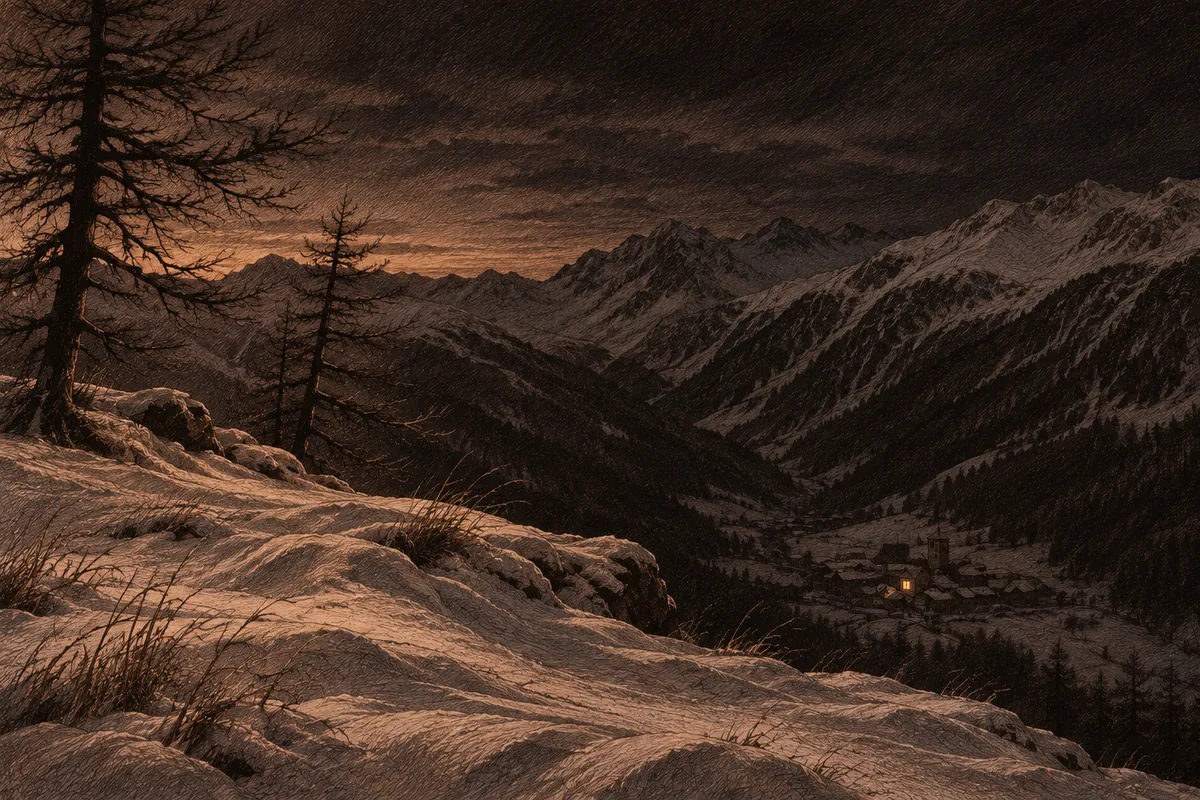
Ampezzo, in Carnia, province of Udine; the fires were lit on the heights above the village, and the testimony comes from an informant born in 1857
The fires of Ampezzo — the young men lit fires on the heights at the end of the year, not at Epiphany, and foretold the year from the direction of the smoke: the source expressly states that Epiphany bonfires were not made there.
- Variants and dialect names
- in Friulian the fires are the fûcs. They are not to be confused with the Epiphany pignarûl, the famous Friulian bonfire: at Ampezzo, according to the source, that was not done
- What is told
- Fires lit by the young men on the heights above the village, and — this is the point — at the end of the year, not at Epiphany.
What makes them a rite and not a bonfire is the reading of the smoke. The source gives it in one line: «Dalla direzione che prendeva il fumo levantesi da questi roghi si pronosticava l'andamento dell'annata» — from the direction the smoke took, east or west, the coming year was foretold. - What it was forthe author’s reading
- To ask the smoke what will happen, in a mountain village, on the night the year ends. But the reason this entry exists is another, and it lies in a sentence that denies instead of asserting: «Nessun [fuoco] sulle alture all'Epifania, come invece si usava e si usa in varie altre parti» — no fire on the heights at Epiphany, as was and is the custom in various other places.
It is a source declaring the absence of the rite in its canonical form, in an area where that rite is the regional emblem. It is worth more than ten confirmations, because a confirmation may be the informant's or the observer's obligingness, and a denial that precise may not. The unbroken continuity of Epiphany bonfires in Carnia, which is taken for granted, is contradicted in writing for Ampezzo. - Where it is attested
- Gianfranco D'Aronco, «Vecchie usanze popolari di Ampezzo», in La Porta Orientale (Trieste), pp. 145-153. From p. 146 come the fûcs lit by the young men on the heights and the sentence on forecasting from the smoke; from p. 147 the denial of Epiphany fires. The informant is named: Osvaldo Termine, born 1857.
One limit must be stated plainly: the year and volume of the journal were not ascertained. The bibliographic record of the title on the University of Trieste repository returned a server error on two attempts, and they are not invented. The PDF was read in full, with page numbers verified against the running heads; the OCR is degraded and some Friulian spellings of place names remain partly illegible.
For comparison with the neighbouring area, Roberto Dapit, «Appunti per una ricerca sui riti di carnevale lungo il confine friulano-sloveno: l'eredità di Niko Kuret», Traditiones 30/1, 2001, pp. 235-251 was opened: p. 238 for the babaci of Resia and for babac as «ugly mask», p. 239 for Uccea, p. 248 for the bile maškire. It serves to say what lies around, not to document Ampezzo.
Never opened, and therefore never cited: Valentino Ostermann, La vita in Friuli, announced as forthcoming in an 1894 note in Pagine Friulane; Deborah Puccio's fieldwork in the Resia valley; Niko Kuret. - Caution
- The rhymed forecasting formula is not documented. The rhyme about the smoke going «a soreli jevât» circulates in newspapers and on websites, and D'Aronco expressly states that he could not ascertain how the forecast was worded (p. 146). What remains is the gesture — one watches which way the smoke goes — without the words. Whoever writes them writes them from somewhere else.
No pre-Christian origin. Verified: none of the sources opened asserts it, and D'Aronco does not propose it. In Dapit the «theory of the spirits of the ancestors» appears as an interpretative hypothesis of Niko Kuret, that is, twentieth-century historiography: it is to be treated as such, not as testimony.
And Sauris is not in this entry. The Carnic Mascarada with the Rölar and the Kheirar is the subject one would expect in a Friulian entry about winter; it was searched for, and no first-hand source was found describing the structure of the roles or saying who assigns them. While that remains so, it is not written.
The grade says how well the entry is documented, not how interesting it is. How the grades are assigned.