The basilisk of San Siro
Liguria · The Po plain and the northern Apennines
Genoa: the well beside the church of the Ss. Apostoli, later San Siro, and the plaque at the corner of via San Siro and via di Fossatello; the beast is driven towards the sea
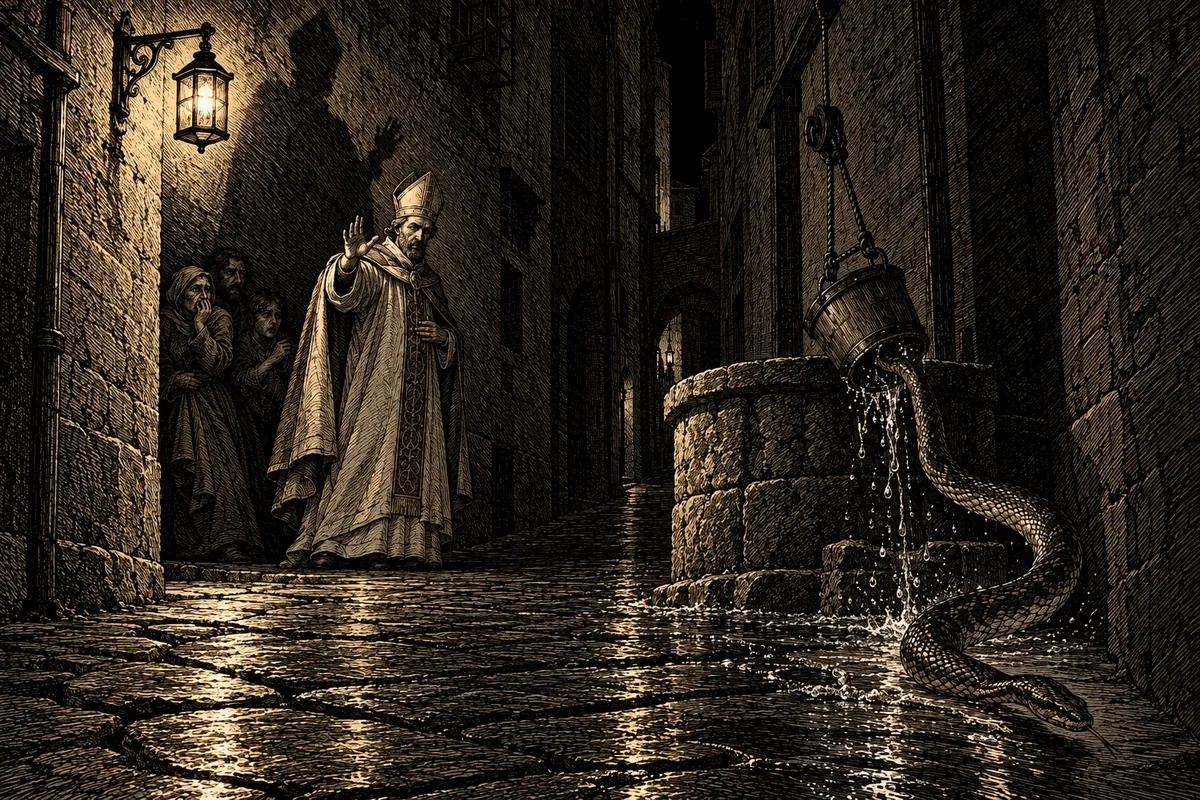
The basilisk of San Siro — the serpent lodged in the well of a Genoese church, which gathers itself into the bucket and darts out of it: bishop Siro calls it out and sends it to the sea, with no duel and no lance.
- Variants and dialect names
- in the oldest hagiographic texts it is serpens, not yet a basilisk; rex serpentium in the bestiary tradition
- What is told
- A serpent nesting in the well of a Genoese church, whose breath poisons the air of the city. Bishop Syrus calls it out and sends it into the sea. What makes the scene, and what the oldest text preserves, is domestic and precise: the beast gathers itself into the bucket — in situlam… se conglomeravit — and from there emicuit serpens, darts out. There is no duel and no lance: there is a well, a bucket and an order.
- What it was forthe author’s reading
- To explain the bad air of a city wedged between sea and hillside, and at the same time to found the bishop's authority over the place. It is an urban miracle, not a wild one: the monster is not in a cave but in a neighbourhood well, where people go for water. The well is documented in the medieval fabric and was closed around the middle of the sixteenth century; the memory stayed attached to the stone, in a late fourteenth-century plaque marking the spot.
- Where it is attested
- Valeria Polonio, «Identità ecclesiastica, identità comunale: la memoria a Genova», in Alle origini del comune di Genova, «Atti della Società Ligure di Storia Patria», n.s. XLII (CXVI), fasc. I, Genoa 2002, the basilisk at p. 453: the miracle is already in the Vita Sancti Syri, which the Bollandists date to the mid-eleventh century, but of which an earlier redaction survives in a Vatican codex of Bobbio origin, probably from the second half of the ninth century; Polonio quotes the Latin of the passage. Rewriting by Jacobus de Voragine, 1293. Valentina Borniotto, «“Rex serpentium”: il basilisco in arte tra storia naturale, mito e fede», «Studi di storia delle arti» 11, 2012, pp. 23-47: the well «beside the church of the Ss. Apostoli» documented throughout the middle ages and closed towards the middle of the sixteenth century, the late fourteenth-century plaque in via di Fossatello, Carlone's fresco in San Siro (c. 1652) and C. G. Ratti's at Nervi (1788-1790). Paolo Giardelli, «Tradizioni popolari in Liguria», in Storia della cultura ligure, ASLSP n.s. XLIV (CXVIII), fasc. II, Genoa 2004, pp. 335-337: the calendrical reading, with Pliny and the birth on Walpurgis night.
- Caution
- Three things circulate as facts and are not. The basilisk as an allegory of Arianism, with the episode moved to the fifth century under bishop Paschasius, is learned conjecture, and Borniotto traces it to G. Ferretto (1907): it is a reading, not an attestation. The date «anno DLXXX» cut into the plaque is incompatible with the traditional chronology of Syrus, and therefore does not prove the event: it is itself a piece of the late construction of the memory. The «vico del basilisco», the alley by which the beast is said to have gone down to the sea, Borniotto gives as tradition and not as a documented place name: before asserting it one would have to look in the cadastral sources. As for the birth on Walpurgis night and the link with the Dog Days, these are Giardelli's reading, of bestiary and learned descent: I have not found it in any Ligurian oral collection, and here I keep it separate from the rest.
The grade says how well the entry is documented, not how interesting it is. How the grades are assigned.