La Siguanaba
Guatemala
Asunción Mita, department of Jutiapa: the río Ostúa and the hamlets round lake Güija, which lies on the border between Guatemala and El Salvador; the figure is found all over Central America, but this is the only place where one source gives at once the name of the place, the names of the informants and the words quoted
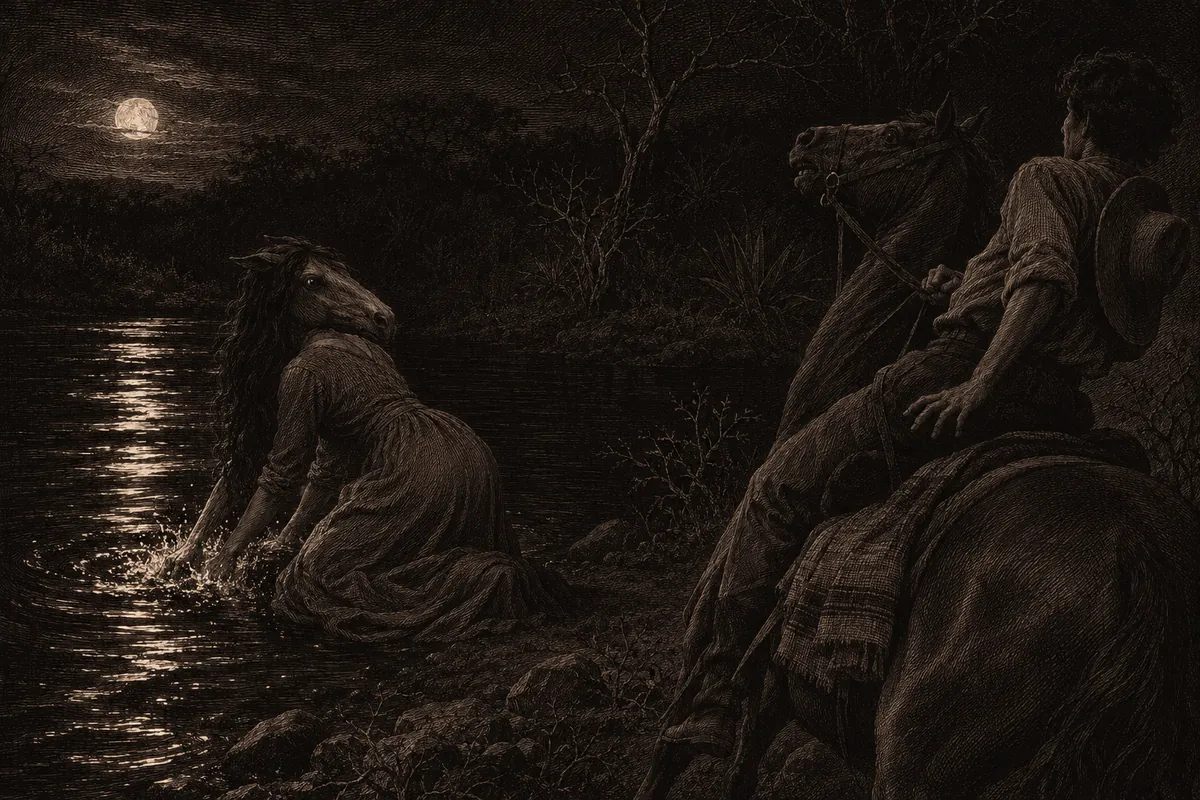
La Siguanaba — the woman who splashes her hands in the river water and who, when the lone young horseman asks her to turn round, shows him a horse’s face: whoever comes out alive is left jugado, and the remedy is to bite the machete.
- Variants and names
- Siguanaba, Sihuanaba; in Costa Rica Cegua, Zegua, Segua, Tzegua; in Nicaragua Ceguanaba. At the finca La Cantiada, near Asunción Mita, she is also called La Leona
- What is told
- What defines her is not the nocturnal female apparition, a type found all over the West: it is a sequence in three moves. The woman is seen from behind, or bent over the water, beautiful and long-haired; she asks, or allows, to be looked in the face; and the face is a horse’s. The request to turn round is the hinge, and it is what separates her from any other white lady.
The noise that precedes the apparition is precise: the splashing of hands in the water — chapalear las manos — at the río Ostúa, in a quebrada, at the zanjón of the Amatal bridge. The victims are the lone young horseman, the man who runs after women, the drunk late at night — and, a datum the common account ignores, children, to whom she appears in the shape of their mothers. Whoever comes out alive is left jugado: «éste está jugado» is said of one left simple. - What it was forthe author’s reading
- To keep watch on the men who go about alone at night, and to give a name to what comes back damaged. Three remedies are documented, and the third is worth the entry on its own: to trace the sign of the cross on her; to bite the machete, which makes her vanish on the spot; and to pull up tufts of escubilla, the broom-weed, because she feels her hair being pulled — and she feels it, the old people say, because when the devil made her «como ya no tenía pelo que ponerle en la cabeza» he set escubilla on her head. Remedy and aetiology sit inside the same tale: it is an internal link, not a collage. The practical advice comes from an informant: «no hay que tener miedo ni sólo valor, se deben ser las dos cosas de acuerdo».
- Where it is attested
- Deyvid Paul Molina (coord.), María Antonieta Cajas Castillo and Luis Felipe Gonzáles Marroquín, Tradición oral y vigencia de los mitos en el lago de Güija, Asunción Mita, Jutiapa, Universidad de San Carlos de Guatemala, Dirección General de Investigación, Escuela de Historia: p. 11 for the municipality and department, p. 23 for the places of collection and the names of the informants, pp. 30-34 for the Siguanaba. The report states that it gives the tales «tal y como las contaron las personas que colaboraron». Two limits must be stated: the document does not print the year — the dating to 2006 rests on the report number, INF-2006-016, not on the title page — and it gives no dates for the fieldwork, nor does it describe recording or an interview guide.
Mainor Elizondo Morales, «Vocabulario del Cantón de San Ramón de Alajuela», Revista de Filología y Lingüística de la Universidad de Costa Rica XXII(2), 1996, pp. 143-178, entry on p. 151: «Cegua f. Figura legendaria que se aparece a los hombres por las noches como una mujer hermosa, pero luego su cara toma la forma de la de un caballo». It is a questionnaire survey of one precise canton, and the entry cites no book source.
Carlos Mántica Abaunza, El Habla Nicaragüense y otros ensayos, San José, Asociación Libro Libre, 1989, p. 49, in the chapter «Nombres Compuestos»: «Ceguanaba (Cihuatl, mujer y Nahualli, bruja)».
Brian Davisson, Káñina XLIX(1), 2025, pp. 1-18, p. 3 n. 4, citing Melgar Brizuela 2003, p. 8 — not opened; Manuel Martínez Herrera, Wímb lu 11(2), 2016, pp. 41-58, pp. 49-51, for the Costa Rican variants and for the skull as an alternative to the horse’s head; Mónica Albizúrez Gil, Cuadernos del CILHA 34, 2021, pp. 1-25, p. 14.
The canonical folklore collections have not been opened, and the list is here for whoever comes next: Miguel Ángel Espino, Mitología de Cuzcatlán, 1919; María de Baratta, Cuzcatlán típico; Celso Lara Figueroa, Leyendas populares de aparecidos y ánimas en pena en Guatemala, 1996 (item identified, restricted access); Elías Zeledón; María de Noguera; Enrique Peña Hernández, Folklore de Nicaragua, 1968. Of Francisco Gavidia not even a verified title was found. That is the reason for grade B. - Caution
- Four of the most repeated traits are not documented. The very long breasts: absent from every source opened and absent on explicit check from the Güija report. Washing clothes at the pila: the river yes, the quebrada yes, the zanjón yes, the pila no. The cross of three sticks as a remedy: not documented. The barranco as the place of perdition: the word does not occur in the field source, where instead children are taken «a lo alto de los cerros para que se precipiten» — summits, not ravines. The barranco comes from the K’iche’ etymology that circulates online with no citation at all.
Descent from Cihuacóatl is a learned association, and its author was not found. The only Nahuatl etymologist who could be opened does not make it: Mántica breaks Ceguanaba into cihuatl ‘woman’ and nahualli ‘witch’, that is woman-nahual and not woman-serpent. And in the same book, twenty-five pages earlier, Mántica names Cihua Coatl among the theonyms surviving in Nicaraguan toponymy — he has the goddess before his eyes and does not connect her. That silence is worth an argument. What the atlas has already established for the Llorona holds here a fortiori: the weld with Cihuacóatl is a modern reader’s operation.
No attestation earlier than 1919. No colonial source, and an instructive datum: the Güija report cites Fuentes y Guzmán’s Recordación Florida, but for the satyrs of the lake, not for her. Two negative checks go on record because they orient whoever searches: Cuadra and Pérez Estrada’s Muestrario de Folklore Nicaragüense, 1978, does not contain her — the authors «no incluyen los espantos» —; and Sergio Cordero Monge, going through Gagini’s Diccionario de barbarismos y provincialismos de Costa Rica, 1892, for popular beliefs, records neither «cegua» nor «zegua», whereas the Cadejo is in Gagini.
And Tláloc is not folklore. The transformation of the unfaithful wife by Tláloc is Espino’s literary version, 1919. The field tradition at Güija says something else: the maker is the devil, and the Sipitío is «hijo de la Siguanaba con el diablo». They are not the same story, and the more often cited is the second.
The grade says how well the entry is documented, not how interesting it is. How the grades are assigned.