The Xtabay
Mexico
Yucatán: the report that attests her is written at Mérida in 1861; the figure belongs to the villages of the peninsula, and appears outside Yucatán only among the Lacandon of Chiapas
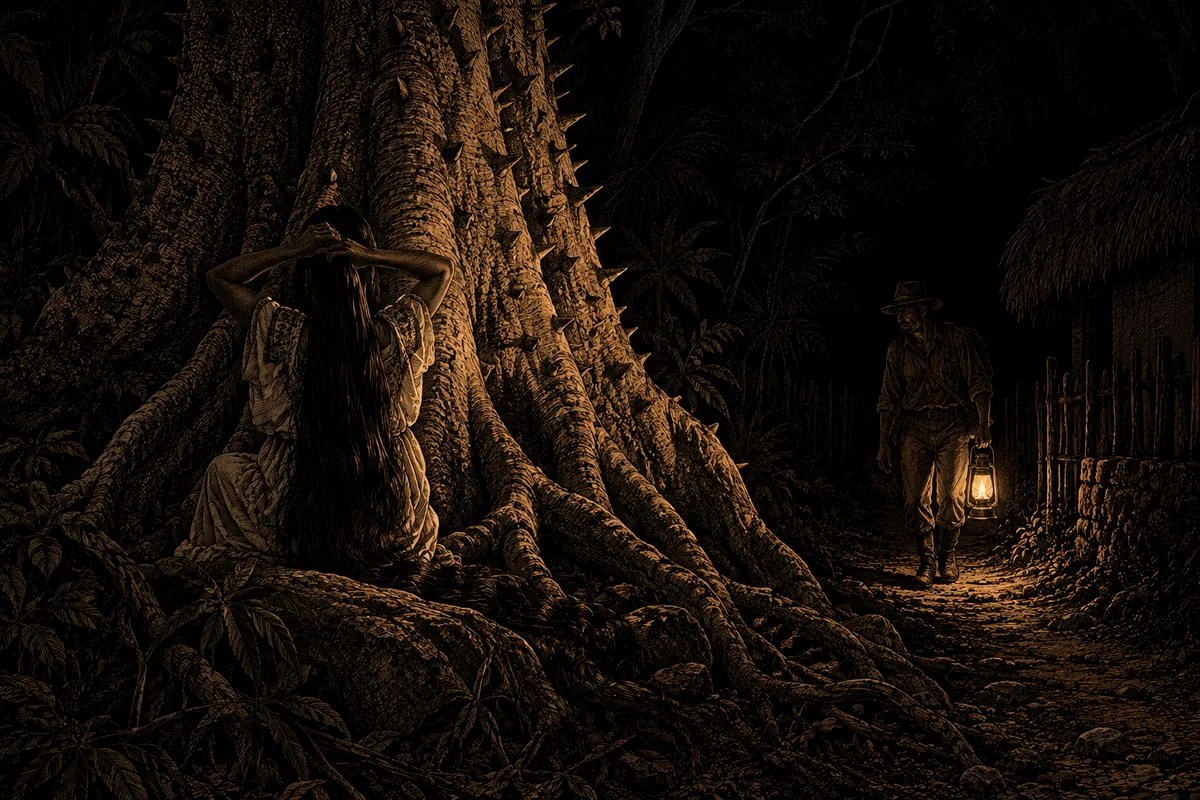
The Xtabay — the woman combing her hair beside a ceiba, in Yucatán: whoever manages to embrace her finds himself holding a bundle of thorns, and comes away with faints and fevers.
- Variants and names
- Xtabay in the report of 1861; X-tabai in Brinton and in Redfield, Xtabai in Basauri, Xtáabay in recent studies. I fix no canonical spelling: the Diccionario Maya Cordemex, which is the instrument that would settle it, I have not opened, and the forms above all come from sources I have read. The same report of 1861 also carries the name of the plant she combs herself with, xache xtabay, which is another word and another plant
- What is told
- A woman dressed as a mestiza, combing her hair, who appears «in the most isolated spots of a village». Whoever follows her loses her; whoever manages to embrace her finds himself holding a bundle of thorns, and comes away with faints and fevers. She comes out at night and stands beside a ceiba, the ya'ax che' tree: she can present herself as a woman, as a serpent or as the tree itself, and the collections say she lives in the hollow trunks of old ceibas.
- What it was forthe author’s reading
- She gives a name and a cure to a syndrome. There is no wound, but there is the fever, and meeting the Xtabay is the idiom in which mal viento is said: the therapy that follows is practised and described — one turns to an hmeen, there are seven or thirteen santiguaciones, there is the exchange rite k'eex. She also forbids the woods at night and, with the ceiba, ties the fear to a precise object in the landscape rather than to a vague space.
- Where it is attested
- Santiago Méndez, «The Maya Indians of Yucatan in 1861», in Reports on the Maya Indians of Yucatan, ed. Marshall H. Saville, Indian Notes and Monographs IX, 3, New York, Museum of the American Indian / Heye Foundation, 1921, pp. 171-172, and the glossary at pp. 219-220. It is the first attestation, and it comes before Brinton: «They also believe in the existence of the “Xtabay,” the “Huahuapach,” and the “Xbolontharoch bokolhahoch.”» The chain must be declared whole, because the dates are three and not one: the text is dated Mérida, 24 October 1861; the first printing is in Spanish, in the Boletín de la Sociedad Mexicana de Geografía y Estadística, 2nd series, II, Mexico 1870, pp. 374-387, and that one I have not opened; the edition I read is the English translation of 1921.
For recent ethnography and for the countermeasures: Berenice Araceli Granados Vázquez, Seres del mal viento. El mundo sobrenatural en las tradiciones orales mayas, LANMO-UNAM repository — the volume declares neither publisher nor year, and the pagination must be re-checked on the original. Félix Báez-Jorge, «La corte de X-tabai. El erotismo numinoso y la demonología sincrética en Mesoamérica», L'Uomo VI n.s., 1/2, 1993, pp. 8-28, which gathers Villa Rojas, Thompson and Rosado Vega. For the plant: José Luis Tapia Muñoz, «La familia Convolvulaceae en la Península de Yucatán», Desde el Herbario CICY 3, 30 June 2011, p. 55. - Caution
- Four things circulate as ancient and are not, or do not come out so from anything I have opened.
The flower. It is read everywhere that the Xtabay is born from the xtabentun. In the source of 1861 the plant associated with the figure is a different one: it is xache xtabay, and it serves as a comb. The motif of the flower on the grave belongs to a far later version. The xtabentun exists, it is Turbina corymbosa, it really is psychoactive and it gives its name to a liqueur: but that is a botanical fact, and as an ethnographic anchor it is not documented before the late twentieth century.
The pair Xtabay and Utz-Colel. It is given as ancient oral tradition and as the substance of the myth. Báez-Jorge attributes it to Ermilo Abreu Gómez, 1961, and calls it «a different version» of the origin of the figure — a variant, that is, not the ground. The proof upstream is clear: in Méndez 1861 there is no Xkeban, no Utz-Colel, no flower on the grave. Mediz Bolio 1922 remains to be ruled out, and I have not opened it; until it is opened, the pair is not to be presented as ancient.
The Xtabay and the goddess Ixtab. Here popularisation is to be corrected in two directions, not one. A serious philological argument exists — táab means «cord, snare», and Barrera Vásquez ties Ixtáab to hunting with the snare — but: Báez-Jorge devotes twenty pages to this very figure and does not name Ixtab even once; no colonial source I opened ties the seductress to Ixtab, and in the 1921 volume, which also prints Sánchez de Aguilar (1639) and Hernández (1545), the Xtabay is in neither of them; and the identification of the hanged figure of the Dresden Codex with Ix Tab is neither dated nor attributed to a first author. The colonial continuity does not hold; and «who did it first» remains unanswered.
The meaning of the name. One reads «she of the cord», or «of the hanged woman». The glossary of 1921 gives another etymology: x-, feminine prefix, plus tabal, «to deceive» — she who deceives. The two proposals are rivals and the atlas does not choose: it declares them.
The grade says how well the entry is documented, not how interesting it is. How the grades are assigned.