The casacce
Liguria · The Po plain and the northern Apennines
Genoa and the two rivieras; the Genoese urban rite ends with the suppression of 1811, the casse are still carried at Savona, Ovada and Varazze
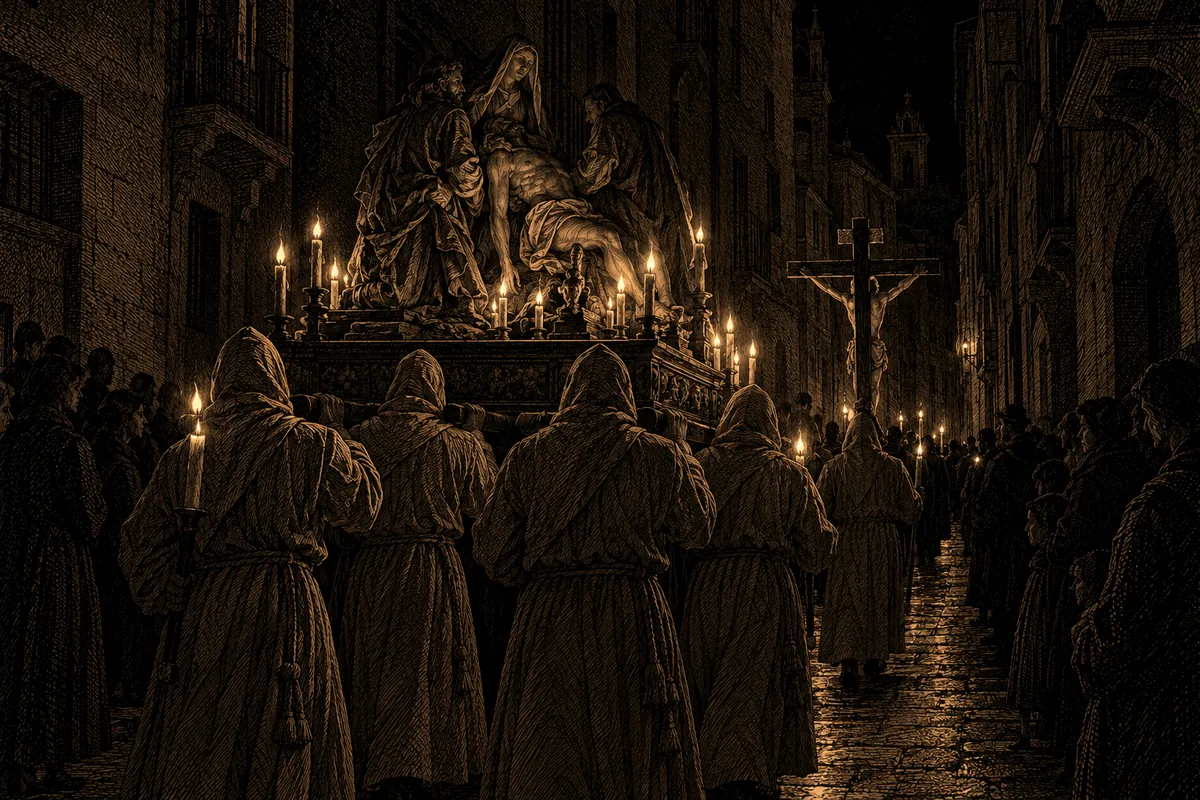
The casacce — the Genoese confraternities of Maundy Thursday: the crucifix turned towards the processioners and not towards the crowd, and the casse, carved groups of full-length figures carried on the shoulders.
- Variants and dialect names
- casaccia (pl. casacce); the brothers are disciplinanti or battuti; the full-figure wooden groups carried on shoulders are the casse
- What is told
- On the night of Maundy Thursday the processions of the confraternities crossed the quarters of Genoa. Two traits set them apart from any other Italian procession. The first is the crucifix turned towards the processants and not towards the crowd, by a privilege granted to the Genoese by the Holy See. The second are the casse: carved groups with full figures, not single statues, carried on shoulders — those by Anton Maria Maragliano (1664-1739) are the most celebrated, and one is dated 1708-09.
- What it was forthe author’s reading
- Penance and, at the same time, a contest between quarters. The casacce gathered several confraternities tied to the guilds, and the emulation between them was measured in casse: whoever had the finer ones processed better. It is Cambiaso himself who records that by the eighteenth century penance had given way to spectacle — and this, more than a decline, is the transformation that explains why today the objects survive and the flagellants do not.
- Where it is attested
- Domenico Cambiaso, «Casacce e confraternite medievali in Genova e Liguria», «Atti della Società Ligure di Storia Patria», vol. 71, 1948, pp. 79-111: the oldest mention of disciplinanti at Genoa is of 1232, at San Domenico; then 1263 Chiavari, 1266 Savona, 1306 the earliest surviving statutes, 1410 the list subscribed by the representatives of all nineteen confraternities then existing in the city, 1442 the capitular cartulary of S. Lorenzo; and the privilege of the crucifix turned towards the processants. Danilo Zardin, «Prerogative della Chiesa e prestigio della Repubblica», in Il cammino della Chiesa genovese, ASLSP n.s. XXXIX (CXIII), fasc. II, Genoa 1999, from p. 266: the Maundy Thursday procession through the quarters (p. 278) and a census of 134 Genoese confraternities between 1480 and 1582. Valentina Fiore, «The Casse Processionali of Genoese and Ligurian Brotherhoods», Acta historiae artis Slovenica 23/2, 2018, pp. 123-138: the suppression of 1811 and the state of things today — at Savona the casse go through the streets every two years on Good Friday, at Ovada and Varazze they are kept and still carried.
- Caution
- Not to be taken as attested: unbroken continuity from the thirteenth century to today. Between the urban rite and the processions one sees now there is the break of 1811, and the living processions are outside Genoa. To be treated as uncertain: the etymology of «casaccia» from «fare casaccia», that is from gathering in a common place, which is read online without references. The same caution for the Genoese derivation of the Sicilian casazze and for the participation of the duke of Osuna in 1611, phrased with «it seems» and without a source. For Savona, the date of 1530 as first attestation and today's timing and route circulate without a single note: they would have to be re-verified before being written down.
The grade says how well the entry is documented, not how interesting it is. How the grades are assigned.