The Scoppio del Carro
Tuscany · The Po plain and the northern Apennines
Florence, piazza del Duomo, between the Baptistery and the cathedral, on Easter morning; the fire sets out from the church of Santi Apostoli, in piazza del Limbo; the cart is kept in via il Prato
The Scoppio del Carro — the new fire of Easter in Florence, carried from Villani's Holy Saturday to the Pazzi cart and the colombina: a rite documented since the fourteenth century, a legend of Pazzino written four centuries after the events.
- Variants and dialect names
- Scoppio del Carro, the explosion of the cart; the cart is called the Brindellone; the dove-shaped rocket is la colombina; in Villani the Pazzi privilege is that of the faccellina, the great torch; the flints are called the «stones of the Holy Sepulchre»
- What is told
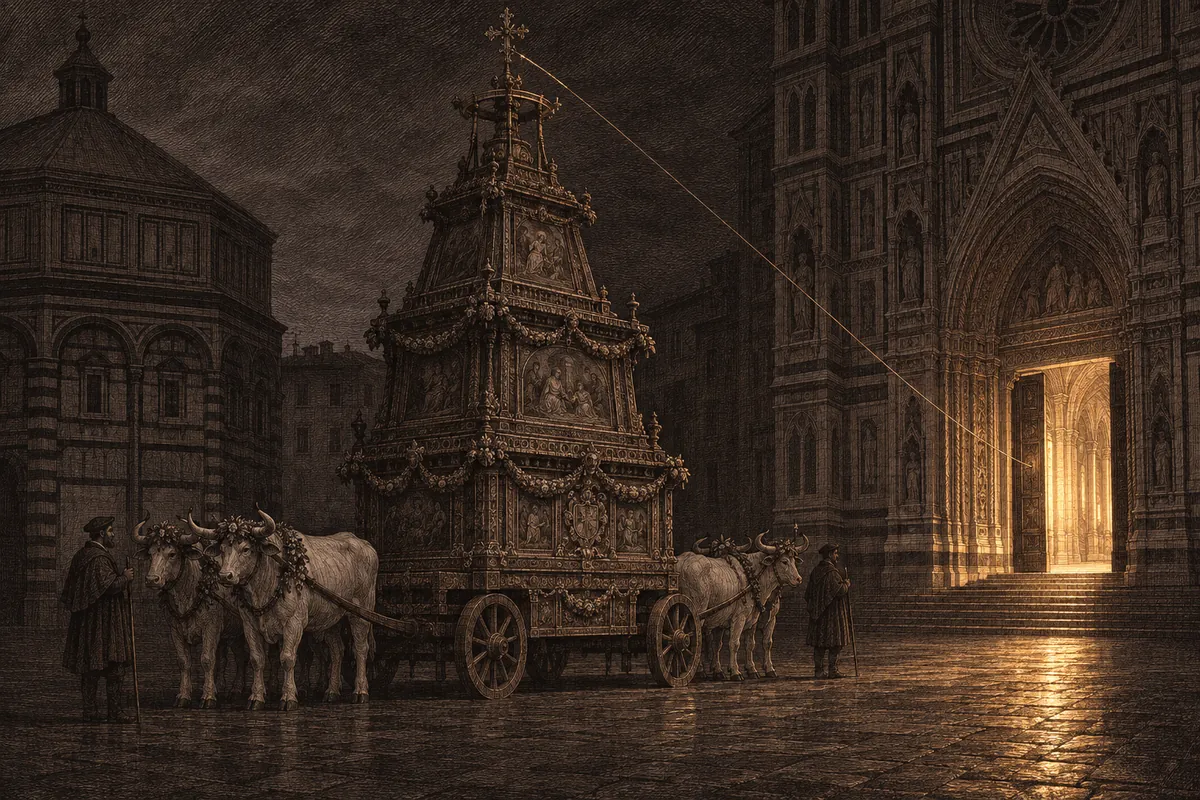
- On Easter morning a painted wooden cart, eleven and a half metres high and loaded with fireworks, is drawn by white oxen to the space between the Baptistery and the Duomo. Inside the cathedral, at the Gloria, a dove-shaped rocket is lit with the new fire and runs along an iron wire from the altar to the cart, sets it off and comes back: if the run succeeds the year will be good. The fire is kindled with flint chips kept in the church of Santi Apostoli, and here the story begins: three stones of the Holy Sepulchre are said to have been brought back by Pazzino de' Pazzi, first on the walls of Jerusalem in 1099, receiving them from Godfrey of Bouillon together with the arms with the dolphins. The family held the honour of the fire until the conspiracy of 1478, regained it in 1494 and handed it over to the city in 1864. The cart seen today was repainted in 1765.
- What it was forthe author’s reading
- It is the new fire of Holy Saturday that all Christendom kindles, carried through the city house by house as, says Villani, «was done in Jerusalem»: a liturgy in which Florence plays the Holy City. On top of it the city writes down who has the right to carry the fire: a family privilege, flaunted with the biggest torch, removed by decree after a conspiracy and restored sixteen years later. The omen on the harvest, today the thing everyone waits for, is attested late and comes from the country crowd, not from the rite.
- Where it is attested
- The first attestation is Giovanni Villani, Nuova Cronica, before 1348: every Holy Saturday the fire is blessed and carried through the city «as was done in Jerusalem», each house sending someone with a «faccellina»; hence «the dignity the house of the Pazzi hold of the great faccellina», for some hundred and seventy years, through an ancestor of theirs called Pazzo «who carried a bigger faccellina than anyone else». No crusade, no stones, no cart. Giuseppe Richa, Notizie istoriche delle chiese fiorentine, III, Florence 1755, pp. 251-255: the tradition rests on a book of Ricordanze written in 1535 by Ghinozzo di Uguccione de' Pazzi, copied from an older one; Richa sets out the two opinions and notes Villani's silence; he describes the procession from Santi Apostoli to San Giovanni with the copper globe full of coals and the «cart full of fireworks». Domenico Maria Manni, Dei fuochi d'allegrezza artifiziati per la famiglia dei Pazzi di Firenze nel Sabato Santo, ed. G. Palagi, Florence 1867, read in full: the provision of 1478 taking the cart from the Pazzi; the Strozzi extracts of 1479-1492 with the payment for the «Cart of the sacred fire of Holy Saturday» by the Arte di Calimala; the reinstatement of 1494; the cart described by Luca Chiari in 1640, lower and unpainted; the cottage rented in 1710 in Borgo Allegri to keep it; the repainting of 6 April 1765; the medal of 1735; the resolution of the Municipality of 30 March 1863 and the contract of 15 April 1864, notary Vincenzo Guerri, by which the family hands the feast over to the city against an annuity of 200 lire. The first mention of Pazzo at Jerusalem is Ugolino Verino, De illustratione urbis Florentiae (1480-1487): it is given as the oldest by Richa, Manni and S. Raveggi, «Storia di una leggenda: Pazzo dei Pazzi e le pietre del Santo Sepolcro», in F. Cardini (ed.), Toscana e Terrasanta nel Medioevo, Florence, Alinea, 1982, pp. 299-315. A. D'Addario, entry «Pazzi», Enciclopedia Dantesca, 1970.
- Caution
- Grade A for the rite, which has an unbroken chain from Villani to the contracts of the nineteenth century. The legend that explains it is another matter: Pazzino at Jerusalem appears in writing four centuries after the events, in a poem of 1480-87 and in a family book of 1535; Villani, who does celebrate the Pazzi, knows nothing of it; Richa in 1755 doubts that Florentines were at the taking of Jerusalem; Manni rejects the mural crown and the date of 16 July, which comes from Gamurrini in the seventeenth century; the Enciclopedia Dantesca says that «critical history considers this tradition baseless» and that the arms with the dolphins were granted only in 1388. To be discarded, as having no source upstream: «Pazzino (1050-1113)», the return of 16 July 1101, the «2,500 Florentines», the cart «from the late fourteenth century», the design by Bernardo Buontalenti — asserted in 2025 by the same institution that in 2019 dated the cart to 1765, and contradicted by the different cart Chiari saw in 1640 — and the colombina «introduced by Leo X», which is a sentence of Manni's without a document. The omen on the harvest I find attested for the first time in 1863, when the government delegates feared the discontent of the «country crowd» who drew from the colombina «indications on the abundance of the harvests»; then in E. V. Lucas, 1912. The «1622» date of the cart comes from Lucas and from plaques I have not seen. Limits: Richa and Villani I read in OCR extracts, not whole pages; the Provisions of 1478 and 1494 I know from Manni and not from the State Archive; Raveggi 1982 I have not opened and cite through P. Sergi, Eurostudium 2023; the Davidsohn-Ristori controversy of 1909 I have not verified.
The grade says how well the entry is documented, not how interesting it is. How the grades are assigned.