El Matharól
the Veneto · The Alpine arc
The Belluno mountains: the Agordino for the marks left on trees, the Cansiglio for the rhyme; the place name «Trói del Matharól»
El Matharól — a very old little man the height of a child of five or six, wrinkled face, long tangled hair and beard, red clothes and cap.
- Variants and dialect names
- Matharól, Matharòl; Mazzaról in a Cansiglio rhyme; in current literature also Mazarol
- What is told
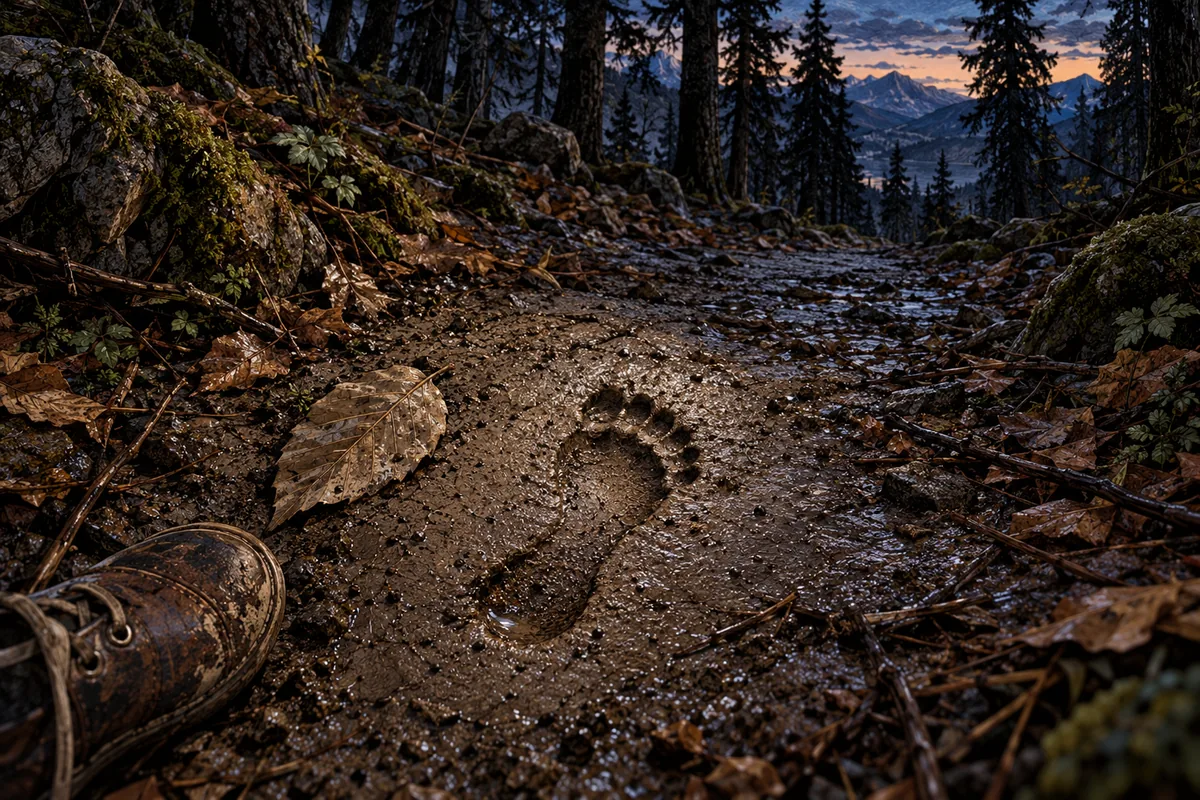
- A very old little man the height of a child of five or six, wrinkled face, long tangled hair and beard, red clothes and cap. He lives in mountains, woods, rocks, caves and mines, announces himself with knocks, whistles and laughter, and marks trees by striking them. What separates him from linchetti, mazapégul and assorted red caps is topographical: whoever sets a foot inside one of his footprints is compelled to follow him — usually a child or a girl alone at dusk — and loses the sense of time and place. To his captives he gives polenta and milk in a dàlmeda.
- What it was forthe author’s reading
- To explain getting lost in the mountains by blaming the ground rather than inattention: it is the footprint that takes hold. He helps shepherds by moving and milking the animals at night, and turns nasty if rewarded with clothes or with other food.
- Where it is attested
- The reference collection is Daniela Perco and Carlo Zoldan (eds), Leggende e credenze di tradizione orale della montagna bellunese, Museo Etnografico della Provincia di Belluno, Quaderno 16, Feltre, 2001, vol. II, pp. 13-44 and 67. What I read is the teaching booklet derived from it, Serenella Bergamini and Tatiana Zanette (eds), Òm selvàrech, Anguane e Matharól, CAI Scuola.
- Caution
- Grade B, declared: I have not opened the museum collection, I have no informants' names or collection dates, and the source I read is a museum teaching aid, that is, an intermediary. One negative check worth printing: Maria Savi-Lopez, Leggende delle Alpi, Turin, Loescher, 1889, is cited everywhere online as the source for the Mazarol, and does not contain it — I opened it; it has chapters on sprites, Alpine fairies, demons and witches of the Alps, and names neither Mazarol, nor Salvanel, nor Anguane, nor Belluno. Also to be discarded: that he makes you lose your memory (the sources speak of disorientation in time and space, which is another thing), the identification with the Ladin Salvanel and the Friulian Mazariol, and the etymology from mazza, repeated without any linguistic reference.
The grade says how well the entry is documented, not how interesting it is. How the grades are assigned.