Churel
India
North-Western Provinces of British India, today Uttar Pradesh; Crooke's survey in the Etah area
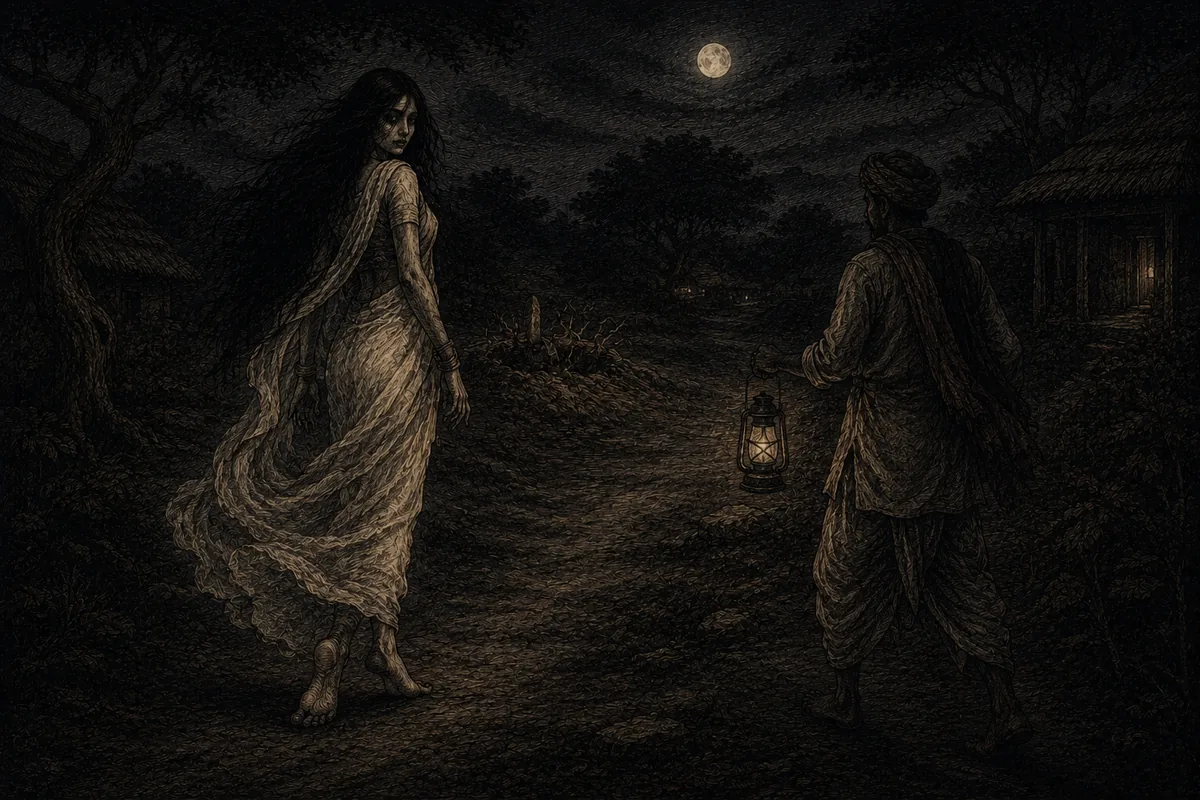
Churel — the ghost of a woman who died in pregnancy, on the day of childbirth, or within the prescribed period of ritual impurity.
- Variants and names
- Hindi चुड़ैल chuṛail, today commonly chudail; Urdu and Punjabi with their respective scripts; in the colonial spelling churel. Western equivalents recorded by Crooke: Jakhai, Jokhai, Mukai, Navalai; in Bengal petni and shakchunni; among the Indo-Guyanese of the Caribbean churile. To be kept distinct from the dayan (डायन), who is not a ghost but a living woman accused of witchcraft
- What is told
- The ghost of a woman who died in pregnancy, on the day of childbirth, or within the prescribed period of ritual impurity. In the description collected in the field she sometimes appears light in front and black behind, and she invariably has her feet turned round: the heels in front and the toes behind; she may present herself as a very beautiful young woman or as a little girl dressed in white. She targets the males of her own family — she is «particularly malignant towards her own» — and young men travelling alone at night.
- What it was forthe author’s reading
- In the current reading it is a device for managing grief and obstetric risk: it gives ritual form to a frequent death for which there was no remedy, and at the same time sanctions the threshold of puerperal impurity, which in the domestic system was a real and policed boundary. It is a functionalist interpretation, and should be taken as such.
- Where it is attested
- The standard source is William Crooke, The Popular Religion and Folk-Lore of Northern India, second enlarged edition, Constable, London 1896, volume I, pages 309-314, with a subsection devoted to the ways of repelling the churel at page 312; the first edition, An Introduction to the Popular Religion and Folklore of Northern India, is Allahabad, 1894. Parallel material in North Indian Notes and Queries, from 1891, and in Crooke in Anthropos, 1909, for the funeral rites. An earlier but literary attestation is Kipling's gloss in My Own True Ghost Story, 1888. Modern studies: Janet Chawla, Child-bearing and Culture, 1994; Sarah Pinto, Where There Is No Midwife, 2008, an ethnography of birth in Uttar Pradesh.
- Caution
- The defences described by Crooke are not literary folklore: they are practices observed and noted down on the spot, and they are worth listing because they show how concrete the fear was. Cremation, or else burial face down; the child removed before burial; the grave filled with thorns and covered with heavy stones; iron points driven in under the nails; and the ground scraped where the woman had died, with mustard seed scattered on the spot and all along the road taken by the bier — because the churel «sees the tiny grains scattered and stoops to pick them up», and the count never ends. Some things in circulation need correcting: the churel is not the dayan, who is a living person and can be accused; she is not «the Indian vampire», a category that comes from the English-language vampire encyclopaedias; the Persian origin one reads on Wikipedia is not documented; and the backward-turned feet are not exclusive to her, because Crooke attributes them also to the fairy companions of Airi in Kumaon. Finally, the attested definition does not concern only death in childbirth: it includes pregnancy and the period of impurity.
The grade says how well the entry is documented, not how interesting it is. How the grades are assigned.