Dokkaebi
South Korea
Korean peninsula; documentary anchorage at Gyeongju, where the figure touches writing for the first time
Dokkaebi — the Korean spirit born from a worn-out household object: not a dead person and not a demon, but a thing that has taken on spirit.
- Variants and names
- Korean 도깨비 dokkaebi; the attested early form is 돗가비 dotgabi, in 1447. Dialect variants 도채비 on Jeju, 도째비, and local honorific appellations. The most accredited etymology, not demonstrated, breaks the word into dot — fire, or else seed and hence abundance — and abi, «grown man»: «the man of fire»
- What is told
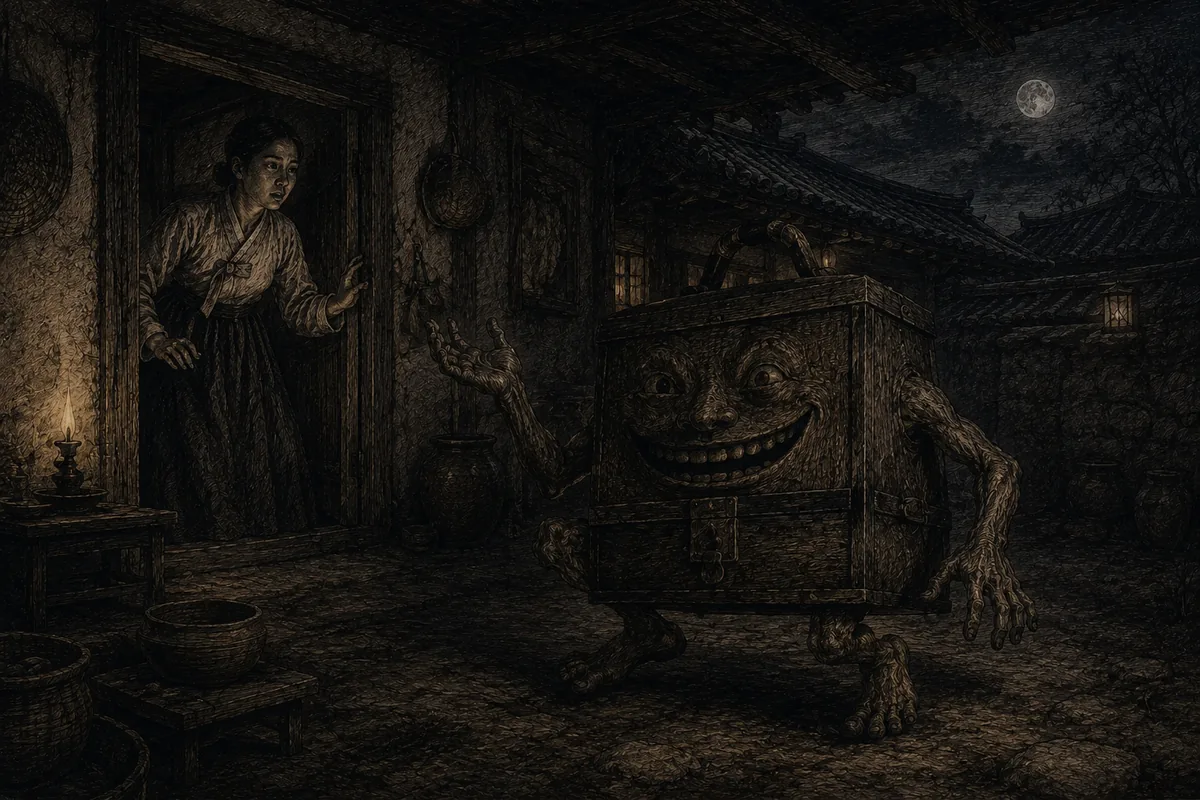
- It is not a dead person and it is not a demon: it is an object that has taken on spirit. It is born by the animation of worn-out and abandoned household things — brooms, pokers, broken bowls, straw sandals — with a predilection for those stained with human blood. It is a prankster, touchy, capricious: it steals the rice, shifts the walls, challenges night travellers to a wrestle or to arm-wrestling. And it can be beaten, because it is strong only on the left: one pushes it or trips it from the right side. It possesses the dokkaebi bangmangi, the club that makes appear whatever is named, and it announces itself with the dokkaebi bul, a bluish light. It hates horse blood, it loves buckwheat.
- What it was forthe author’s reading
- In the current reading it is a figure of the threshold between refuse and wealth: it explains unexplained gains and sudden losses in an agricultural economy, and on the coasts it was invoked for an abundant catch. Its morality is weak and for that reason interesting: it punishes greed and rewards cunning, not merit.
- Where it is attested
- The oldest antecedent is the tale of Bihyeongnang in the Samguk yusa, late 13th century, on materials of the Silla period; and mention should be made of the cult of Dudduri, a wooden idol venerated at Gyeongju from Silla to Joseon. The certain lexical attestation is 돗가비 in the Seokbo sangjeol, 1447, one of the very first texts written in hangul. The modern collections begin with Takahashi Tōru in 1910 and continue with the great South Korean campaigns of oral collection of the later twentieth century. The standard scholar is Kim Jong-dae, of Chung-Ang University.
- Caution
- Grade B distinguishes two strata: the term and the cult are attested with certainty — 1447 for the word, the 13th century for the narrative antecedent — but the physiognomy of «spirit of objects» is known above all from twentieth-century oral collections, and the iconography is demonstrably contaminated. To be corrected: the dokkaebi is neither a ghost nor a demon; the decorative tiles called «dokkaebi tiles» are an improper modern label; and the protagonist of the 2016 drama that made the word known outside Korea is a recent narrative invention.
The grade says how well the entry is documented, not how interesting it is. How the grades are assigned.