Huldufólk
Iceland
The whole of Iceland, with known concentrations in the capital region, in particular Hafnarfjörður
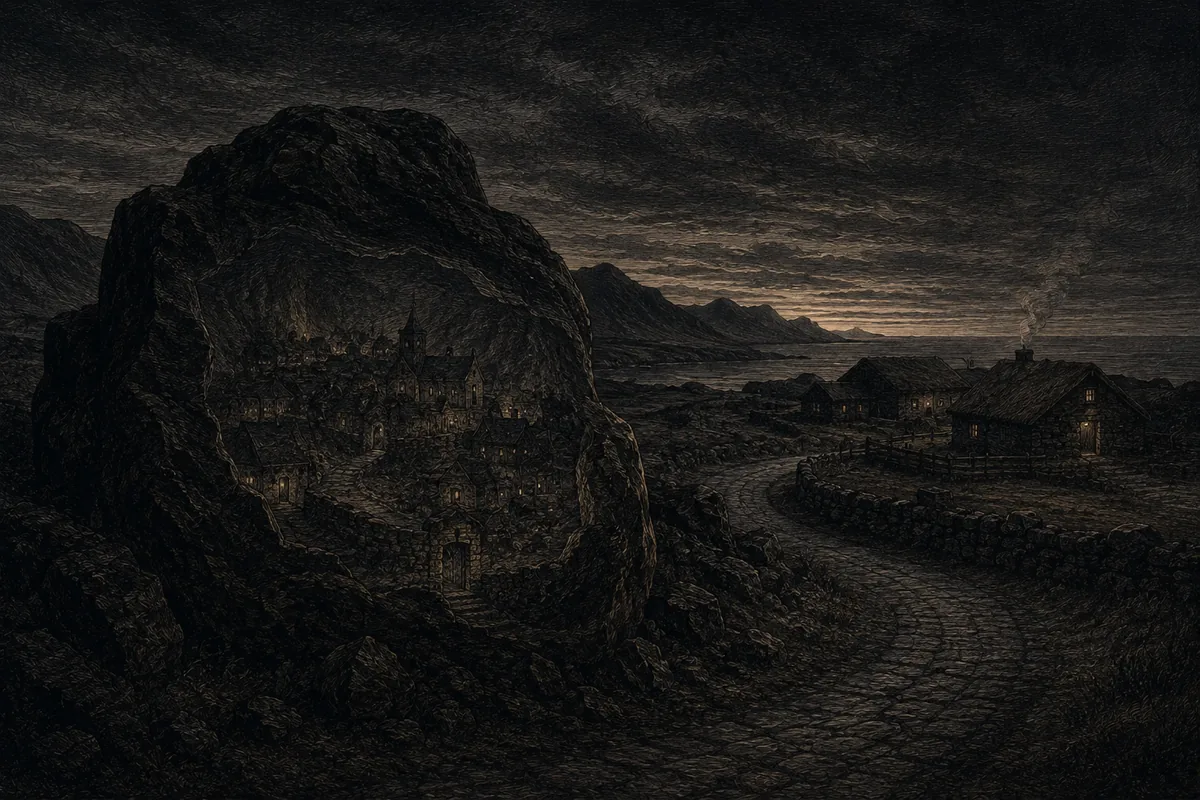
Huldufólk — a parallel community, human in every respect: they have farms, churches, flocks, marriages and conflicts, and they live inside rocks, erratic boulders, hills and lava outcrops.
- Variants and names
- huldufólk, hidden people, singular huldumaður and huldukona; huldufólk also in the Faroes; ambiguous relationship with álfar, elves; places called álfhólar, álfasteinar, álfakirkja
- What is told
- A parallel community, human in every respect: they have farms, churches, flocks, marriages and conflicts, and they live inside rocks, erratic boulders, hills and lava outcrops. The physical distinction reported by the nineteenth-century Icelandic sources is that the philtrum is convex rather than concave. The relationship with humans is contractual: whoever respects their dwelling, not moving the stone and not ploughing that hummock, prospers, while whoever damages it suffers accidents, sickness among the livestock and machinery breakdowns. The aetiological tales are Christianised: Eve hid her unwashed children from God, or else they are the angels who stayed neutral in Satan's revolt.
- What it was forthe author’s reading
- It regulates land use and the relationship with a hostile volcanic landscape, imposing respect and limiting intervention: it is the only case in this survey in which the belief has documented legal and administrative effects. It also works as a marker of national identity, as the projection of an idealised Icelandicness, and as a children's schooling in fear of and respect for nature.
- Where it is attested
- Jón Árnason, Íslenzkar þjóðsögur og æfintýri, Leipzig, 1862-64, the great national collection on the Grimm model; medieval background of the álfar in the Poetic Edda and in Snorri Sturluson's Prose Edda, 13th century; Árnastofnun and the Icelandic folklore archive, with Terry Gunnell's research on contemporary beliefs; a quantitative study of the distribution of the sites in «Patterns in Icelandic Elf Hills», Folklore, 2024. Documented administrative cases: the breakdown of a bulldozer at Kópavogur in 1971, the protest at the NATO base in 1982, the certification required of Alcoa in 2004, the Álftanes-Garðabær road diversion in 2013. Festivals: New Year with the álfaflutningur, Þrettándinn on 6 January with the álfabrennur, Jónsmessa on 24 June, Christmas.
- Caution
- The belief figures are the ones most abused by the international press: the 1974 survey gave only 7 per cent as certain among those born between 1904 and 1944, later surveys give 7-8 per cent certain and about 45 per cent who consider the existence possible or probable, but Icelandic scholars insist that a great many respondents are expressing cultural assent and not literal conviction, on the lines of «I don't believe in them, but I wouldn't deny them». The distinction between huldufólk and álfar is today uncertain for Icelanders themselves: in the 2006 survey 54 per cent made no distinction, 20 per cent did, and 26 per cent were unsure.
The grade says how well the entry is documented, not how interesting it is. How the grades are assigned.