Jiangshi
China
Western Hunan, the old prefecture of Chenzhou, hub of the routes of «making the corpses walk»
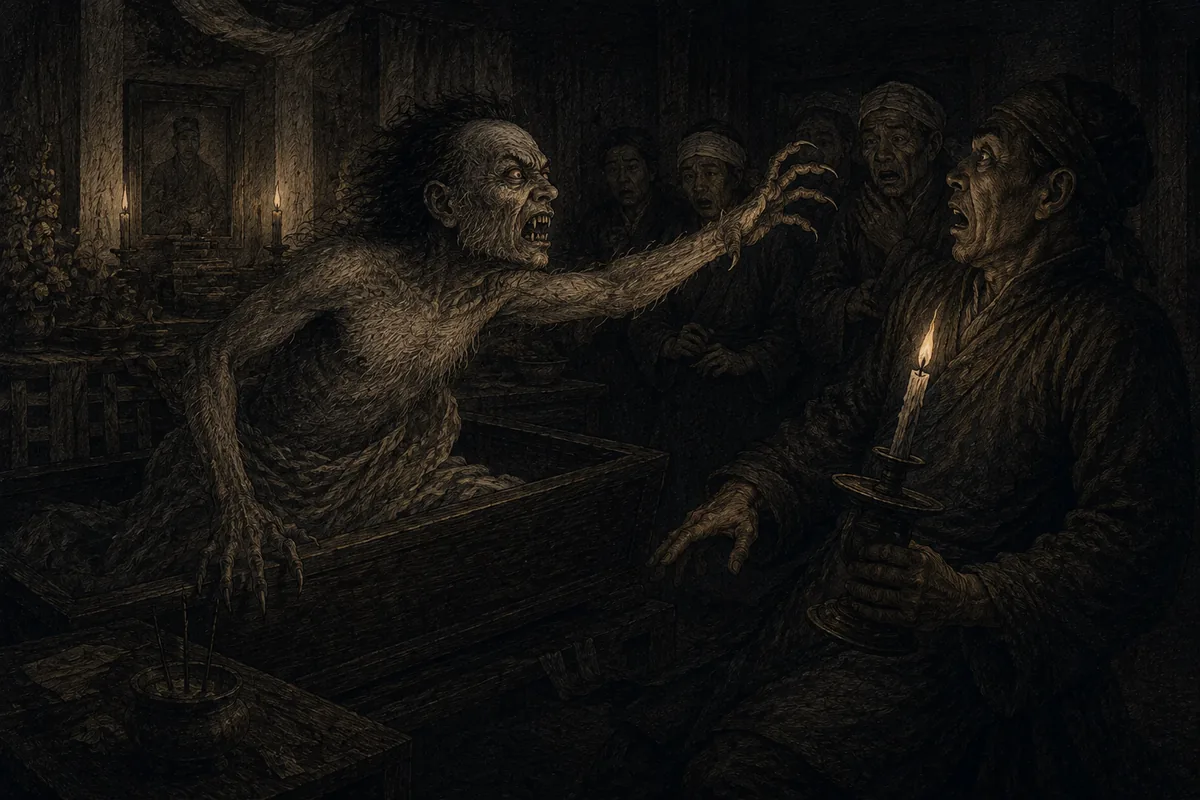
Jiangshi — in the Qing texts the undecomposed corpse goes out at night to wander, or else — if it is fresh and not yet laid out — springs up suddenly and attacks those keeping vigil.
- Variants and names
- Chinese 僵尸 / 殭屍 jiāngshī, literally «stiff corpse»; Cantonese goeng sī, Korean gangsi, Japanese kyonshī. The technical term in the Qing collections is not, however, this one, but 尸变 shībiàn, «transformation of the corpse». The practice of Hunan is 湘西赶尸 xiāngxī gǎnshī, and the one who carries it out is a gǎnshījiàng
- What is told
- In the Qing texts the undecomposed corpse goes out at night to wander, or else — if it is fresh and not yet laid out — springs up suddenly and attacks those keeping vigil. It has white down over the whole body, eyes red as cinnabar, hooked nails, teeth that come out over the lips like blades. In the Ming period the figure merges with the drought demon: the one who has white down prevents the rain, and hence a real practice, criminally prosecuted in the Qing period, that of disinterring and burning corpses to bring rain.
- What it was forthe author’s reading
- The shibian codifies the anxiety over the corpse badly buried or not buried at all: delayed burial was extremely common, while awaiting the geomancer or the money, and death far from home was the worst case in a culture of «returning to the root». The jiangshi is a dead person without rite, not an autonomous monster.
- Where it is attested
- The two standard collections are Ji Yun, Yuewei caotang biji (閱微草堂筆記), written between 1789 and 1798 and gathered in 1800, with about twelve hundred entries, where the classification of the shibian is in the tenth juan; and Yuan Mei, Zi bu yu (子不語), first printed 1788, which adds a chromatic taxonomy of corpses. The Liaozhai zhiyi too opens with a tale of shibian. On the practice of Hunan: testimonies collected in the field, the local archive of Luxi, Xu Ke, Qingbai leichao, 1916, and above all Shen Congwen, who questioned a practitioner in person; the standard modern ethnography is that of Lu Qun of Jishou University, who interviewed disciples of the last gǎnshījiàng.
- Caution
- The grade must be broken down. The jiangshi as a literary figure is of grade A: Ji Yun, Yuan Mei and Pu Songling are sources of the first order. The practice of ganshi is B: a real core, but late, oral and mediated recording. The «hopping Chinese vampire» that everyone knows is C, and it is cinema. Because the central point to be corrected is precisely that: no Qing source describes a hopping gait. The leap that Ji Yun describes is an attacking lunge, not a way of walking. The hop as locomotion arises from twentieth-century rationalisations and is fixed by the cinema of Hong Kong — Encounters of the Spooky Kind by Sammo Hung, 1980, and above all Mr. Vampire by Ricky Lau, 1985, which codifies the whole repertoire: Qing mandarin robe and hat, yellow talisman on the forehead, glutinous rice, holding the breath. And the jiangshi does not drink blood and does not seek immortality: it is not a vampire, and the equation «Chinese vampire» is a Western translation.
The grade says how well the entry is documented, not how interesting it is. How the grades are assigned.