Parì
Iran
Iranian plateau; the Alborz massif and mountain springs as typical places
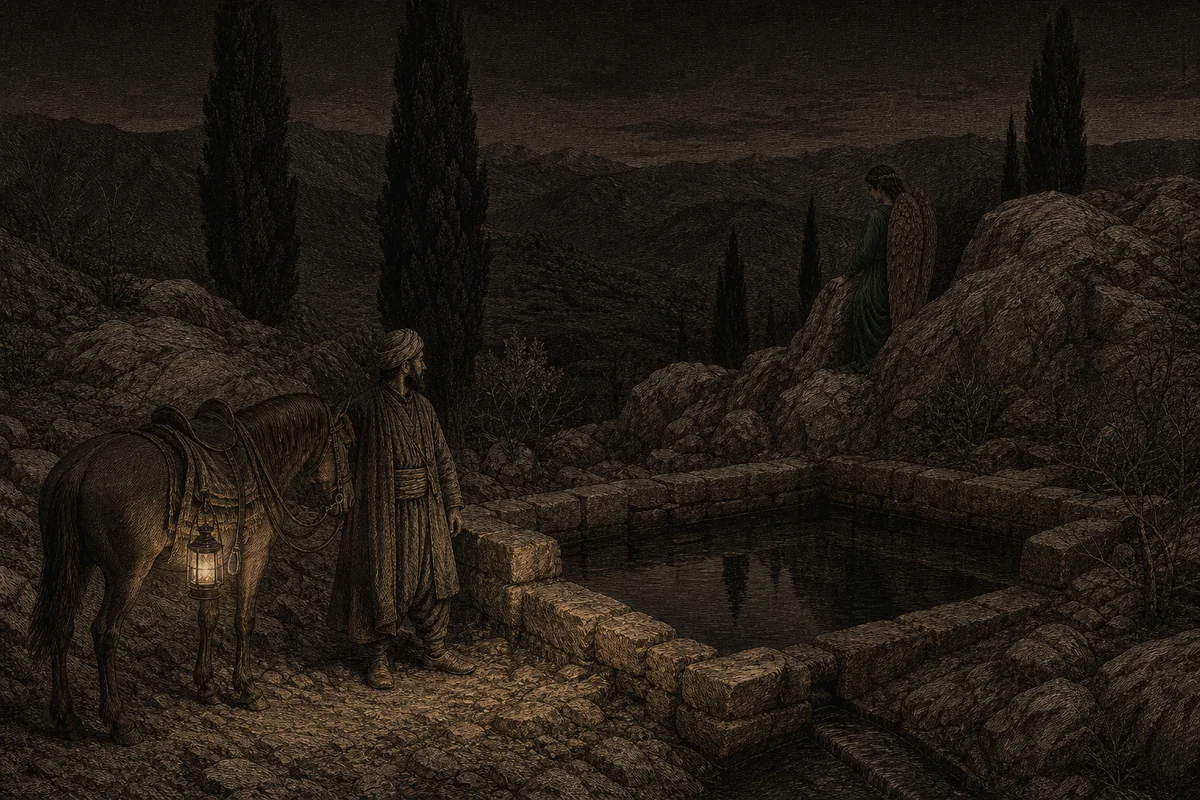
Parì — non-human beings, often but not necessarily female, endowed with wings and magical powers.
- Variants and names
- Persian parī (پَری), from Middle Persian parīg; Avestan pairikā. From this word descend Turkish peri and, by a literary route, European peri. Their realm is the Parīstān.
- What is told
- Non-human beings, often but not necessarily female, endowed with wings and magical powers. They appear near water — springs, pools, bathing places — and in wild and mountainous spots. Towards men they exert a fascination that the sources openly call erotic: seduction, abduction, marriages celebrated in their realm, possession. In Turkish folklore they fly in green garments like clouds, or take the form of a dove.
- What it was forthe author’s reading
- The parì is the clearest case of how a moral judgement can be reversed while the figure itself stays the same. In pre-Islamic Iran the Avestan pairikā in all probability denotes a class of maleficent entities, bound up with sexuality and with sexual rites. After Islamisation the same word takes on a positive connotation: immense beauty, morally complex beings, and in the 10th century assimilation to the ḥūr of the Arabic tradition. The being did not change: the person telling of it did.
- Where it is attested
- Persian literary sources of the Islamic period, beginning with the Šāh-nāmeh of Ferdowsī; for the etymology and the pre-Islamic phase, the entry pairikā in Avestan studies. The overall picture, with the primary sources cited, is summarised in the entry Parī of the Encyclopædia Iranica and in the literature on Central Asian shamanism, where the parī are consulted for the purposes of healing and protection.
- Caution
- The wings are attested, and this distinguishes the parì from the European fairies, where the wing is almost always a nineteenth-century overlay: the Persian sources of the Islamic period describe winged beings, and one of the proposed etymologies links the name to par, «wing» — although it is not the only one. I have not consulted the Persian sources directly: this entry rests on the secondary literature and remains grade B until I have checked the passages of the Šāh-nāmeh. It should also be noted that the image of the parì as a benevolent and graceful «oriental fairy» is a late construction, and in the West it comes through Romantic poetry: the oldest documented phase is the opposite.
The grade says how well the entry is documented, not how interesting it is. How the grades are assigned.