Tengu
Japan
Mountains of Shugendō: Kurama and Atago near Kyoto, Takao at Hachiōji, Akiha in Shizuoka, Iizuna in Nagano
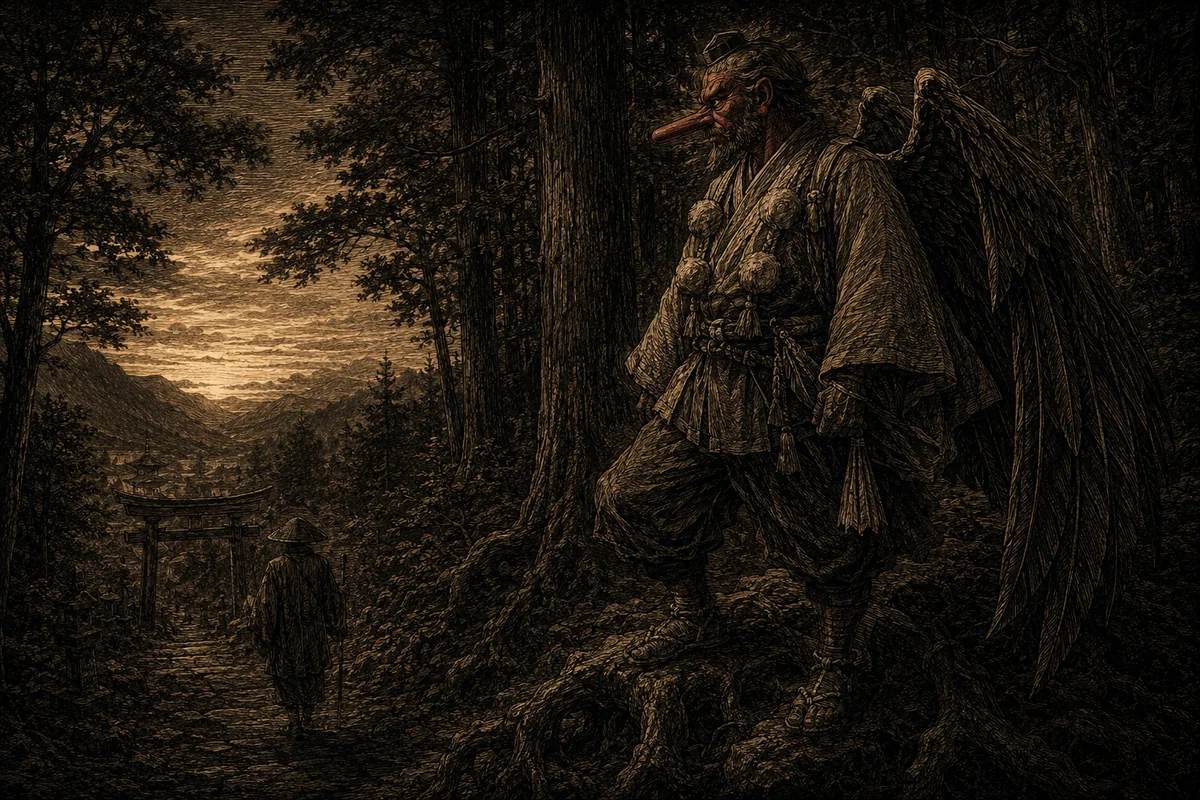
Tengu — for seven hundred years the tengu has no long nose: it is a bird of prey.
- Variants and names
- 天狗 tengu; archaic reading glossed アマツキツネ amatsukitsune, «celestial fox». 烏天狗 karasu-tengu, crow-like; 大天狗 daitengu; 鼻高天狗 hanataka-tengu, «with the high nose»; 山伏天狗; 是害房 Zegaibō, the tengu come from China
- What is told
- For seven hundred years the tengu has no long nose: it is a bird of prey. In the Konjaku monogatarishū, 12th century, its «true form» is that of a kite, and its business is to harm the Dharma — it displays false Buddhas, abducts monks, plunders temples. Between the 13th and the 14th century it becomes something else again: the tengu-dō, that is the destination in which arrogant religious are reborn, those who have sought fame and profit. Hence the yamabushi costume — the tokin headgear, the yuigesa stole — which is its uniform in the iconography. Only between the late Kamakura and the Muromachi does the beak humanise into a long nose, the face turn red, the figure become hierarchised into great and small and end by being venerated as a kami protector of the mountain.
- What it was forthe author’s reading
- It is the mirror in which medieval Japanese Buddhism looks at its own faults: the tengu is the monk who has gone wrong, not the demon who comes from outside. For this reason its history is also the history of a polemic internal to the clergy, and for this reason it is transformed when those who tell it change.
- Where it is attested
- Nihon Shoki, book 23, year 9 of Jomei (637), compiled in 720. Konjaku monogatarishū, book 20, after about 1120. Tengu zōshi, scrolls dated 1296, seven scrolls all Important Cultural Properties, held between the Tokyo National Museum, the Nezu Museum and private collections. Nō play Kurama tengu. Hayashi Razan, Honchō jinja kō, 17th century, for the classification of the daitengu. Decree of the Dajōkan no. 273 of 1872. Standard study: Haruko Wakabayashi, The Seven Tengu Scrolls, University of Hawai'i Press, 2012.
- Caution
- The name comes from the Chinese tiāngǒu, «celestial dog», but of the dog nothing survives: neither the form, nor the function, nor the cult. It is a loan of characters with integral substitution of the referent. As for the first attestation: the passage of the Nihon Shoki describes a bolide, not a creature, and the gloss that reads a tengu into it is a later interpretative addition, applied in the Shōtoku Taishi denryaku of 917 — almost three centuries afterwards. Between 637 and the tales of the 11th century there is a documentary gap of about four hundred years. The derivation of the nose from Sarutahiko, or from the gigaku masks, is rejected by specialists for want of evidence: they are convergent parallels, not a filiation. And the Meiji decree of 1872 did not «abolish the tengu»: it dissolved Shugendō as an autonomous sect, absorbing its branches into the Tendai and the Shingon and forcing about a hundred and seventy thousand shugen into lay status. The tengu survives as a folkloric figure precisely because it was deprived of the institution that generated it.
The grade says how well the entry is documented, not how interesting it is. How the grades are assigned.