El Tío of the mine
Bolivia
Cerro Rico of Potosí, on which every source converges; the first-hand ethnography cited here, however, comes from Huanuni, in the department of Oruro, on Cerro Posoqoni, and from a rite documented in May 2009
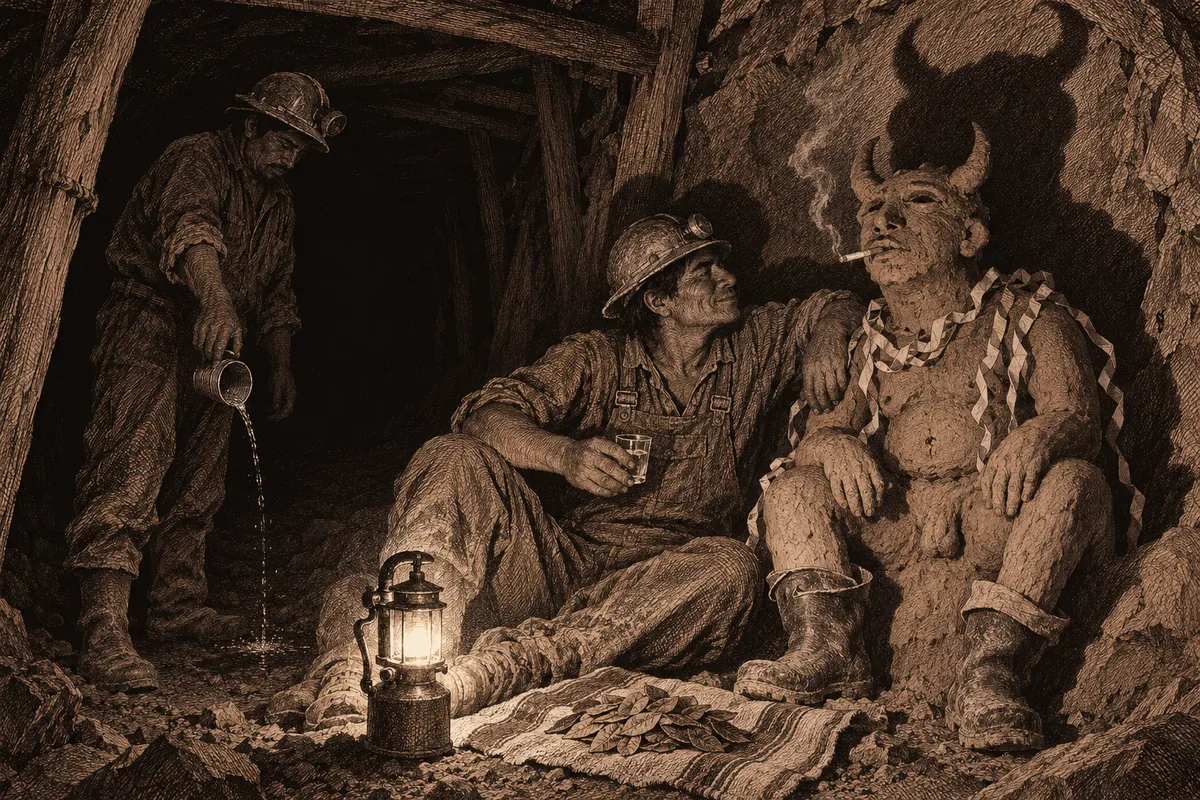
El Tío of the mine — the owner of the ore in the Bolivian mines: he is not prayed to, one sits down beside him on Tuesdays and Fridays to share coca, pure alcohol and a lit cigarette set in the statue’s mouth.
- Variants and names
- el Tío, «the uncle». Beside him stand la Vieja, associated with the Pachamama, and, in the parallel Peruvian case, the Muqui. At Huanuni the statue in the main gallery has a name of its own, Tío Ilaco
- What is told
- He is not a devil to be driven off: he is the owner of the ore, and what separates him from every European or North American mine spirit is not the iconography — horns, hooves, erect phallus are common stock — but the regime of exchange. The Tío is not prayed to: one sits down beside him. The ch’alla is made every Tuesday and every Friday, inside the mine: an akulliku of coca and a glass of pure alcohol are shared with him, and the cigarette is put lit into his mouth. Each glass is preceded by a libation poured on the ground to the cry of «¡Jallalla maestros!».
The statue stands at the end of a gallery, in a niche cut into the rock: seated, in mineralised clay taken from the mine itself, sometimes life-size, with the miner’s boots badly put on. It is made by the most skilled worker of the gang. - What it was forthe author’s reading
- To give the underground an owner, and death at work a procedure. When the Tío «is hungry» the qaraku is performed: the canonical date is midnight on 31 July, to open August, «el mes del diablo». At Huanuni, after a fatal accident in mid-May 2009, seven llamas were killed — four inside the mine, one at the ingenio, one on the adjoining hill, one in the tailings section — the blood was sprinkled and buried at the place of the accident with the bones tied with red thread, and the meat was cooked without salt, as in funeral practice. The next day mine and plant stayed shut. The reason the workers gave was one sentence: «El Tío tiene hambre».
- Where it is attested
- Rodrigo Ruiz Arrieta, «El Tío de la mina», (con)textos 5, 2011, pp. 63-77 — fieldwork at Huanuni, and the text the gestures, the days and the 2009 case come from: p. 64 for the Tío Ilaco, about a metre and a half tall, in the main gallery of Cerro Posoqoni; p. 65 for the tin torito ch’allado every Friday with dark beer and not pale «so that the vein should paint»; p. 67 for the change of clothes at Carnival; pp. 72-74 for the qaraku; p. 75 for the coexistence with the Virgen del Socavón.
Gerardo Fernández Juárez, AIBR 8(3), 2013, pp. 303-322: p. 311 for the Tuesday-Friday rhythm, the akulliku of coca, the alcohol, the lit cigarette in the mouth and the mineralised-clay statue; p. 311 n. 10 for the dating.
Carmen Salazar-Soler, Anthropologica XXVIII(28), Suppl. 1, 2010, pp. 183-215: p. 210 for the absence of references to the Tío before the second half of the nineteenth century, p. 191 for the rite inside the socavón at Julcani with joint invocations to Pachamama and the Virgin.
Enrique Orche García, Revista de Medio Ambiente y Minería 9(1), 2024, pp. 25-52, §6.3: for the explicit statement that in the Inca and viceregal chronicles «no se conocen citas concretas referentes a la existencia del Tío de la mina».
Four works anyone would expect to find here have not been opened, and that must be said: June Nash, We Eat the Mines and the Mines Eat Us, 1979 (the Internet Archive copy is access-restricted); Michael Taussig, The Devil and Commodity Fetishism in South America, 1980; Pascale Absi, Los ministros del diablo, 2005 (the publisher’s site under maintenance); Olivia Harris, Chungara 11, 1983, pp. 135-152. The pages of Nash that circulate online — 123 for the llama offering, 137 for the ch’alla, ix for the sentence that gives the book its title — do not come from the book here: they come from Vaughn and Tripcevich, Mining and Quarrying in the Ancient Andes, Springer 2013, ch. 1. That is the reason for grade B. - Caution
- The etymology «Tío from Dios» is repeated by everyone and demonstrated by no one. Its first proponent could not be identified. The argument put forward — that Andeans, lacking the letter D, pronounced «Tios» for «Dios» — would in any case concern the pronunciation of the Christian God’s name, not the name of the mine’s owner: the step from one to the other is somebody’s inference, not a datum. And there is an argument that makes it unnecessary: in Aymara lari and in Chipaya tulu mean both ‘maternal uncle’ and ‘devil’, that is, the semantic pair that «tío» realises in Spanish already exists in the local languages.
He is not the survival of a pre-Columbian Supay. Orche García calls it improbable and records the absence of concrete colonial citations. The three things that are found in period sources are other things and must not be confused with the Tío: Solórzano’s gallery demons, 1647, which are European duendes extended to America; the «bailes de Demonios» recorded at Potosí in 1682, which are dances and not a cult of a statue; and the huacas described by Cobo and Villagómez, which resemble the Tío — and a resemblance is not an attestation.
«Underground you do not invoke the saints» is false. It is one of the most repeated sentences and the documentation contradicts it: the Tío «convive con la Virgen del Socavón», a chapel stands in the former Pie de Gallo mine, the tataq’achus — crosses of the patron saints — stand in the first metres of the gallery, and at Julcani the joint invocations are made inside the socavón. What emerges is not a prohibition but a threshold: Christianity holds the mouth of the mine and the surface, the Tío owns the deep interior, and the two do not exclude each other. It is a better trait than the one that was being looked for, and a documented one.
Four more things are not attested. That whoever carves the statue goes mad once it is finished: reported as a «se dice», with no field source. That pure alcohol is «the Tío’s urine». That Tío and Pachamama form a sexual couple whose union generates the veins: found only in an unpublished text. And that June Nash’s field was Siglo XX at Llallagua: none of the sources opened establishes it, and until it is established it is not written.
The grade says how well the entry is documented, not how interesting it is. How the grades are assigned.