The Steri graffiti
Sicily · The islands
Palermo, the Chiaramonte-Steri complex in piazza Marina; the prison of the Penitenziati is on the vicolo Sant’Uffizio side and can be visited
The Steri graffiti — on the walls of the Holy Office cells in Palermo the prisoners wrote with soot, ground brick and the rust of their chains: 264 inscriptions in six languages, the oldest of 1606, and they can be gone and read.
- Variants and dialect names
- the cells are called the carceri dei Penitenziati; the palace is the Steri, from hosterium, fortified palace, and bears the name of the Chiaramonte family. It was the seat of the Holy Office of Sicily
- What is told
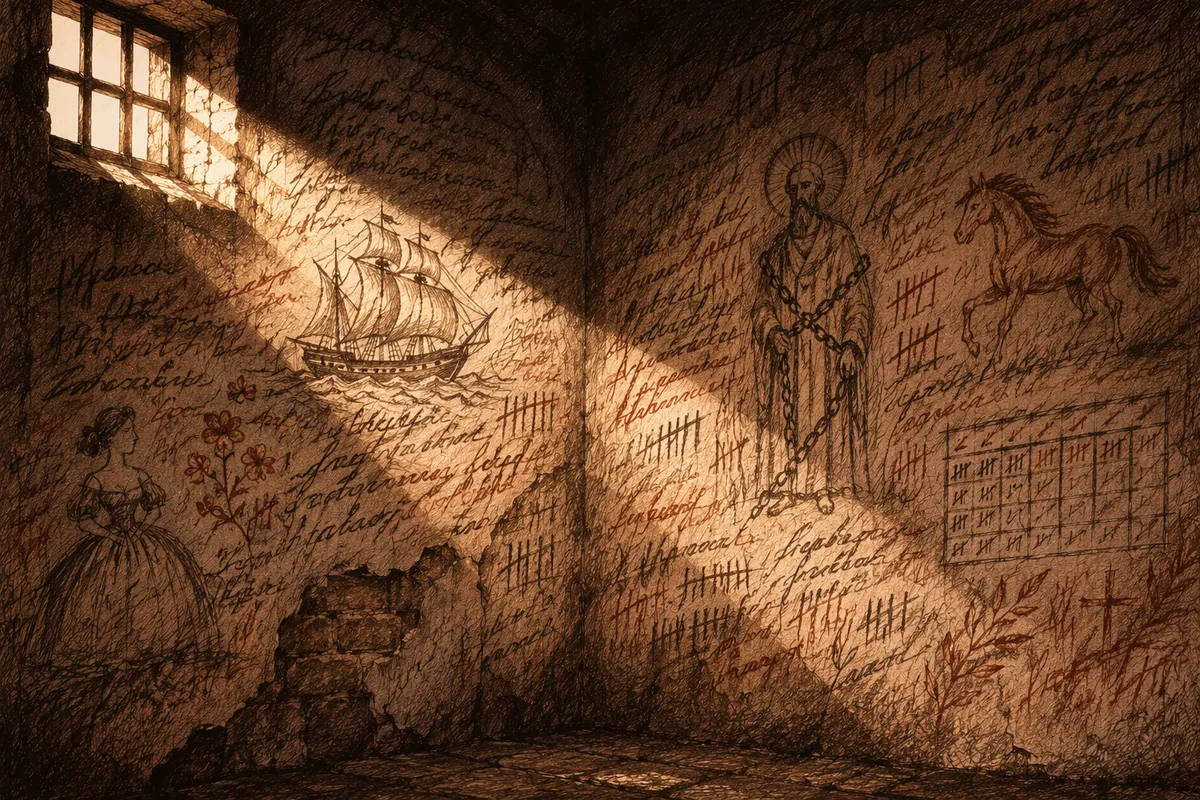
- The walls of the cells are covered with writings and drawings made by the prisoners, with what they had: soot, ground brick, iron oxide got from the rust of the chains. The most recent inventory counts 297 figurative subjects and 264 inscriptions, almost half of them in Latin.
There are at least six languages: Sicilian, Latin, Italian, Spanish, English, and two inscriptions in Hebrew that have not been deciphered. The oldest dated writing is of 1606.
Everything is there, and the tone changes from wall to wall. The chronicle: «Ai 21 di luglio 1646 si fici lo spittacolo in S. Domenico di trentatrè persone tra huomini e donne» — on 21 July 1646 the spectacle was made at San Domenico, of thirty-three persons, men and women. The practical warning to a cellmate, in Sicilian: «Averti chi ccà dunanu tratti di corda», be warned that here they give the strappado. The personal record: «A 30 di agosto 1645 hebbi la tortura e a 9 settembri l'hebbi di nuovo». And the signature of a man from far away: «Ioan Andres Ingles of Pasta Ano 1632», an English sailor of twenty-three, from Padstow in Cornwall. - What it was forthe author’s reading
- None. It is not a rite and it serves no purpose: it is what is left. And that is why this entry belongs in an atlas of documented folklore — because here the source and the object are the same thing, with no informant, collector or editor in between.
The repertory is that of people waiting: prayers, saints, calendars, ships, horses, and short sentences written for oneself or for whoever comes next. «Pacienza. Pane, e tempo» — patience, bread and time. «Pensa beni a la morti». Under a Saint Leonard in chains, the patron of prisoners, someone wrote in Latin «CATTENAE ET VINCULA NARRENT MIRACULA», let the chains and the fetters tell of miracles. And beside the figure of a woman in a crinoline: «Piange la misera perchè il luoco è di pianto», the wretched woman weeps because the place is a place of weeping.
At the entrance, a Dante put into Sicilian: «NEXITI DIS SPERANZA VVI CHI INTRA». - Where it is attested
- Giuseppe Pitrè, Del Sant'Uffizio a Palermo e di un carcere di esso, Rome, Società Editrice del Libro Italiano, 1940, xii+277 pp. It is the founding monograph, and it was read in full in the University of Toronto scan on Internet Archive. From it come: p. 25 for the chronicle of the 1646 auto-da-fé; p. 34 for the Saint Leonard and the CATTENAE ET VINCULA; p. 37 for the woman in the crinoline; p. 38 for «Pacienza» and «Pensa beni a la morti»; p. 39 for the strappado. Caveat: the page numbers are the OCR's, not those of a collated printed copy, and the OCR mistakes the ligatures — it prints «CATTENiE» for CATTENAE.
Giovanna Fiume, «Strepitus silentii. I graffiti dei carcerati del Santo Uffizio a Palermo», Giornale di storia no. 24, 2017, pp. 1-21, open access: p. 5 for the 1606 writing and the measurements of the cells, p. 9 for the Padstow sailor, p. 14 for the torture record, pp. 2-16 for the languages and the two undeciphered Hebrew inscriptions.
Guillaume Calafat, «Enfermement et graffiti…», Annales HSS 78-4, 2023, pp. 735-759, DOI 10.1017/ahss.2024.4: p. 751 for the inventory figures and the pigments, p. 752 for the Sicilian Dante.
It was not opened, and that must be said because it is the source of the figures: Rita Foti (ed.), I graffiti delle carceri segrete del Santo Uffizio di Palermo. Inventario, Palermo University Press, 2023. The 297 subjects and 264 inscriptions are known through Calafat, not from the inventory. Also never opened: Sciascia 1977, Fiume and García-Arenal 2018, La Mantia 1904, Di Vita 1933, Münter 1790.
Searched for and no ICCD record found on the prison: if one exists, it did not come up. - Caution
- Two serious sources contradict each other on the number of cells, and the contradiction is reported rather than smoothed over: Fiume 2017 (p. 5) gives eight cells on the ground floor, 4.65 by 6.85 metres, and six upstairs from 1630; Calafat 2023 (p. 745) gives six on the ground floor and four on the first. There is nothing to decide between them.
How much was destroyed is not quantified. Between Sciascia's survey of the 1960s and the restoration of the 2000s part of the graffiti was lost; none of the sources read says how much.
The pigment analyses cannot be consulted. The Opificio delle pietre dure in Florence carried them out and deposited them with the university, but as of 2017 they were not accessible to researchers. The pigments listed here — soot, brick, rust — come from Calafat, not from a laboratory report.
The state of the works today is not known. The university's note on conservation speaks of rising damp, a pilot restoration of cell no. 1 and an executive project of 350,000 euros, but it is not dated on the page: it says «by the month of October next» without saying which year. It was not verified how far they have got.
The grade says how well the entry is documented, not how interesting it is. How the grades are assigned.