The Nogaredo trials
Trentino-South Tyrol · The Alpine arc
Nogaredo, in Vallagarina, with the hamlets of Brancolino and Noarna; the acts are in the municipal library of Rovereto
The Nogaredo trials — the four burnt witches of the popular story are not in the acts: the longest fascicle tries an old farrier for a storm, and two of the women of the legend appear in it as accusers.
- Variants and dialect names
- one speaks of «trials» in the plural because the manuscript is a bundle: eleven separate fascicles, of which five are published. In the depositions the accused women are called streghe, witches; the defendant of the longest fascicle is not a witch but a wizard, and by trade a farrier
- What is told
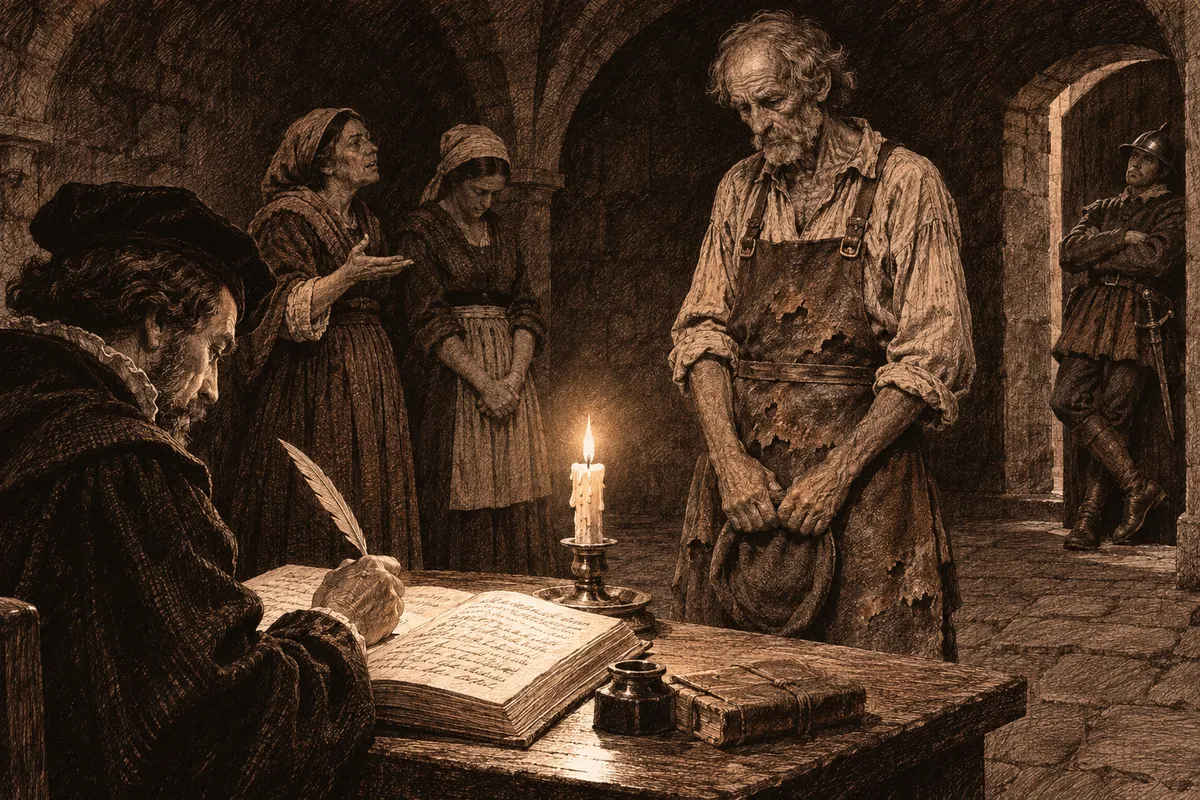
- The fourth fascicle, «the most substantial», tries Santo Peterlini, farrier. There are three charges, and they should be read in the order in which they drop in register: having prescribed medicamenti; having raised a violent storm in 1646 and killed oxen; having had dealings with women held to be witches. To these is added a lesser and very physical one: he is said to have urinated or thrown refuse on the bread of the Thomasetta household.
The defence answers the storm with an alibi that is the finest detail in the whole bundle: that day Peterlini had sheltered under a walnut tree near Daiano. The lawyer is Giovanni Passerini and his Latin memorial is dated «Roboreti 10 maij 1647»; Cosmus de Cosmis speaks for release.
On 3 August 1647 an officer records that the old prisoner «si ritrova amalato, et particolarmente le gambe incominciano ad enfiarsi» — he is ill, and his legs are beginning to swell — and has him moved to another cell. - What it was forthe author’s reading
- To show what a witchcraft trial is made of when it is read instead of retold. In the published pages the burning does not happen: it is remembered. It is a witness who says «quelle son state abbruggiate», those women were burnt, and she who names «la Meneghina Gratiadei» — the fire is in the past of the depositions, not in the acts.
And the reversal that makes the entry: Lucia Cavedana and Domenica Graziadei, mother and daughter, are not defendants but accusers, and the defence works methodically to destroy their credibility; whether Benvenuta Graziadei, a minor, can be believed is argued over. In the other published fascicles: Caterina Pederzini of Castellano, tortured and «shut in the prisons of Nogaredo» after the sudden death of Anna Carbonari of Brancolino, found dead in her room; and Elisabetta Baldessarini of Piazzo, acquitted. - Where it is attested
- Luigina Chiusole, «Processi a presunte streghe, da documenti della Biblioteca civica di Rovereto: [primo contributo]», in Atti della Accademia Roveretana degli Agiati, A, series 6, nos. 16-17 (1976-1977), printed 1978, pp. 101-172.
The shelfmark of the acts comes from there: Biblioteca civica di Rovereto, manuscript 69.7.(4), stated on p. 104 and repeated in a note on p. 131. On p. 101 Chiusole writes that the volume «consists of eleven fascicles of which the first five are reproduced here, for now»: the other six remain unpublished.
The precise references: p. 103 for the charges against Peterlini; pp. 105-106 and 110-116 for the defence witnesses and the Daiano walnut tree; p. 112 for the Thomasetta bread; p. 127 for Passerini's memorial; pp. 129-131 for Cosmus de Cosmis; p. 131 for the record of 3 August; p. 110 for «quelle son state abbruggiate» and p. 116 for Meneghina Gratiadei; pp. 105 and 118-123 for Cavedana and Graziadei as accusers, p. 123 for Benvenuta; p. 102 for Anna Carbonari and Caterina Pederzini.
Two warnings. The PDF was read by text extraction, not page by page: shelfmark and numbers are consistent across two independent retrievals, but the literal quotations should be collated against the original. And Antonio Panizza, Processi contro le streghe nel Trentino, 1888, was not opened: the pages of the online reproduction all return an error. It is not cited. - Caution
- The four witches burnt in 1647 are not documented. It is the version found everywhere — the four surnames, the stake, the year — and it appears in no academic or archival source that was opened: it sits on an online encyclopaedia, on a site of judicial curiosities and on a dozen blogs. In the pages published by Chiusole there is no sentence and no date of execution, for any of the women.
How it ends is not known. Not even for Peterlini: the defence asks for his release, and no act was found saying the trial was concluded. The last thing known of him is that on 3 August 1647 he was ill and his legs were swelling.
Six fascicles out of eleven are unpublished, and their content is unknown. That is almost certainly where the answer to the two questions above lies, and it is why this entry is grade B and not A.
Castel Noarna does not enter this entry. The Castelbarco seat of justice is the place popular writing always attaches to these trials; none of the sources opened attests it. Until a document says so, it is not written here. Also left out are how the manuscript reached the library, which Chiusole does not say, and whether it can be consulted today, which was not verified.
The grade says how well the entry is documented, not how interesting it is. How the grades are assigned.