The pifferari
Lazio · Central Apennines and the Adriatic
Rome, the streets and the shops; the players came down from the mountains, and Sora is the starting place the source names
The pifferari — the novena played for pay before the Madonnas of Rome, nine evenings for about one paolo: and the nineteenth-century canon of English testimonies describing it is one source cited several times.
- Variants and dialect names
- pifferari is the term used by nineteenth-century Roman sources; ciociari is also found. They went in pairs: a pifferaro and a zampognaro, that is a pipe and a bagpipe
- What is told
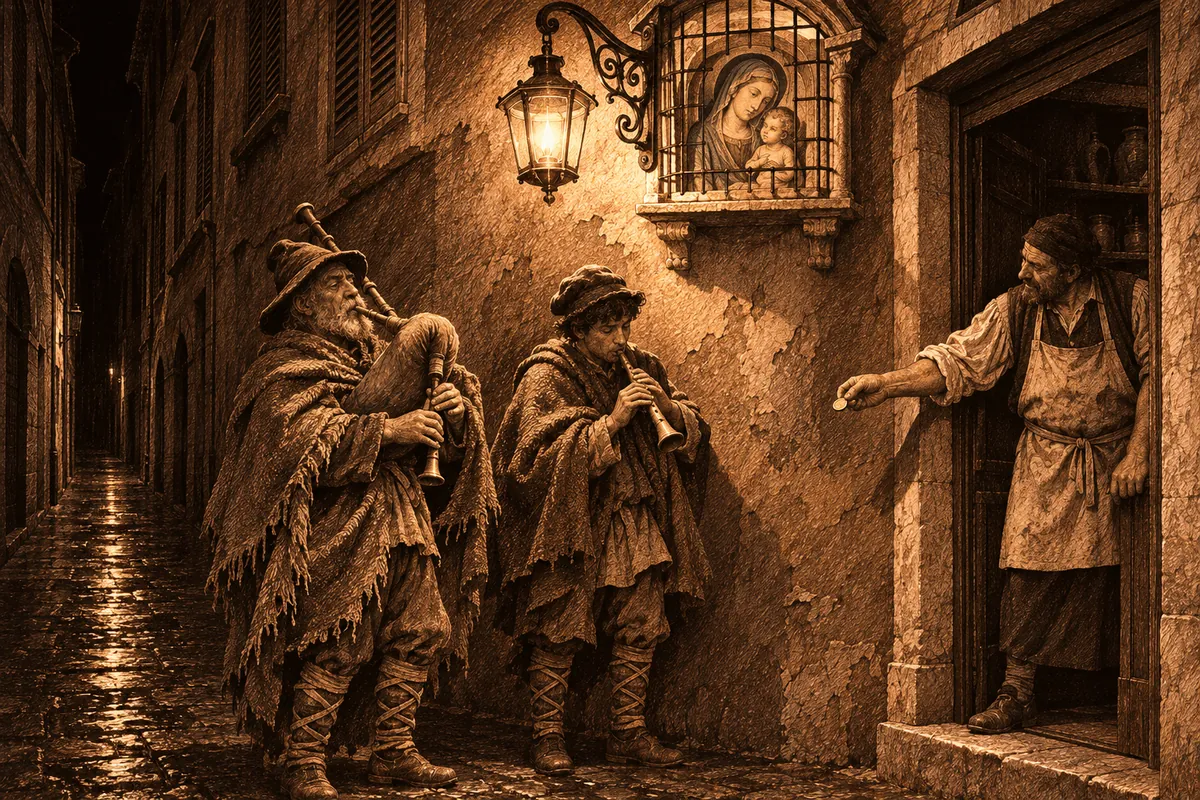
- In the nine days before 8 December and the nine before Christmas, in Rome, two men come down from the mountains played the novena before the images of the Madonna: in the streets, in the shops, on the landings.
And they played it for pay. That is the detail that makes this an entry and not a postcard: the owner of the house or shop that had the image engaged the pair for the complete cycle, and the price the source gives is about one paolo per full novena — the paolo being a papal coin.
So: a client, a tariff, a unit of service of nine evenings. The rite has an account. - What it was forthe author’s reading
- Devotion bought retail. But the most useful thing this entry can do is dismantle its own apparatus of sources.
On the pifferari there exists a small nineteenth-century canon of English testimonies, cited as though they were independent voices. They are not. The text in «All the Year Round» IX (1863), p. 42 — which looks every bit like an independent testimony — refers in a footnote to Story's Roba di Roma, and repeats its vocabulary and data, from the peasants of the Abruzzi mountains to the pipe described as a pastoral bagpipe. Whoever adds up «many nineteenth-century sources» is often counting Story several times.
And the eyewitness accounts that remain contradict each other on who they were. Lady Morgan, in Rome in December 1819, calls them Calabrian; Story calls them Abruzzese, and names Sora as the starting place. They cannot be reconciled, and the discrepancy is reported here instead of chosen between.
There is also something one notices only by looking at an old map. Sora, in 1819 and in 1864, was not in Lazio: it was in the Kingdom of the Two Sicilies, in Terra di Lavoro, until 1861, and passed to Lazio only in 1927. The «Lazio» of this rite is a recent border, and the entry sits here for the city where the playing was done, not for where the players came from. - Where it is attested
- William W. Story, Roba di Roma, 4th ed., vol. I, New York, D. Appleton — London, Chapman & Hall, 1864, ch. II «Street Music in Rome». It is the load-bearing source: from it come the double novena, the Madonna images, the client and the tariff, the costume and the etymology. Read in the volume's full OCR, interrogated twice. Serious caveat: the pages — about 7-12 — are deduced from the OCR's running heads, not read on the page image, and the tool itself warns they may be off by one. Anyone citing this entry must check the pages before printing them.
«All the Year Round», vol. IX (1863), p. 42, on Dickens Journals Online: page opened; the article is unattributed and carries the footnote referring to Roba di Roma. It is the source of the most important fact in this entry.
Lady Sydney Morgan, Italy, vol. II, London 1821, p. 278, for the experience dated to December 1819. The book was not seen: what was read is the record in the Open University's Listening Experience Database, with a truncated excerpt, and the page is the one that record declares.
ICCD, SIGECweb, record S, code ICCD11349097, general catalogue no. 00619683, inv. I00711 (1991): a print, no. 8 of the series Raccolta di cinquanta costumi pittoreschi, subject street musicians, Bartolomeo Pinelli (1781-1835) engraver and draughtsman, 1809; signed and dated lower left; etching, plate 200×296 mm, sheet 205×298 mm; Iconclass 48C75; restored 1998. Compiled 2003 by Monica Scorsetti and Lia Brambilla; responsible official Ione Belotti. The record's bibliography: Mariani 1948, p. 49 pl. VIII; Alborghetti 1991, p. 171 no. 1030; Corradini 2003, p. 52. To be said: the print is kept at Chiari, in the province of Brescia, not in Lazio.
Not opened: Story's first edition (1862) and the page images of ch. II, which would be needed to fix the real pages and transcribe the passage; Morgan's volume in print; the original ICCD record on the general Catalogue; the three bibliographic entries of that record in full. And no archive was consulted: neither the papal police records in the State Archive of Rome nor the Capitoline Historical Archive for licences and urban policing. No inventory was checked, so no shelfmark is written. Looked for and not found: an ICCD MODI record on the Lazio novena rite. - Caution
- No quotation is printed. The readings passed through a tool that truncates and returns fragments away from the page image; Story's OCR even loses the first letter of a sentence. So the facts are attributed and the words are not, and the price of the novena is given as «about one paolo», which is the source's approximation and not a figure.
On the origin there is nothing to write. No open academic source was found attributing to the pifferari a pagan, pre-Roman or Arcadian origin; and the one institutional page checked does not assert one at all. So neither «ancient origin» nor «the origin is said to be ancient» is written here: the gap is left, because the gap is the datum. Story himself makes no claim of classical antiquity: his comparison with Pan concerns a pecoraro in the previous chapter, not the pifferari.
The number of shrines is not a datum. Story speaks of over fifteen hundred images of the Madonna and Child in Rome, without indicating where the figure comes from: it is an author's estimate and must be attributed as such.
The etymology of «ciociari» remains open. Story derives it from the leggings, which he calls cioce; the current definition gives ciocia as a shoe, a leather sole tied between ankle and knee. It was not settled against a historical dictionary.
The calendar does not match. Story describes two novenas, of the Immaculate Conception and of Christmas; Morgan speaks of an arrival in the last days of Advent. It is not known whether Morgan ignores the first or Story generalises.
One typographic error not to be propagated. In Story's OCR «Dal Segno» appears for the kingdom of Naples: in all likelihood a scanning error for «Dal Regno», and it must not be printed in any form.
Unknown: Story's exact pages, any archival shelfmark, what the players earned in comparable terms, and when and why the rite ended in Rome. No date of decline or prohibition was verified, and none is written.
The grade says how well the entry is documented, not how interesting it is. How the grades are assigned.