The lobizón and the seventh son
Argentina
North-eastern Argentina: the tales cited come from Misiones, Entre Ríos and Chaco, and the point is set on Misiones because it is the province that recurs most; it is a provisional choice, not a documented place of collection
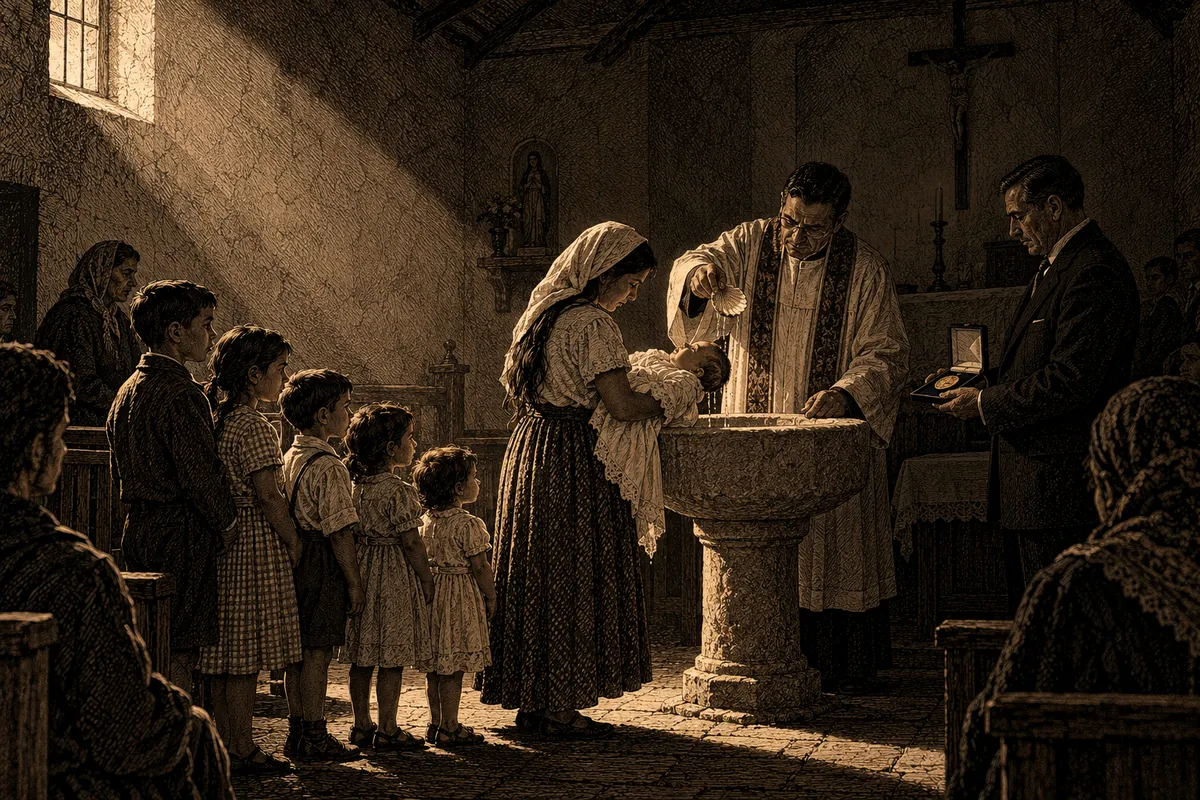
The lobizón and the seventh son — the seventh son who turns at night, and the godparenthood by which the President of Argentina stands godfather to him: a belief, and the decree that answers it without naming it.
- Variants and names
- lobizón, in Brazil lobisomem, in Guaraní country luisón. In the tales it is not always a wolf: it appears as a black dog «almost as big as a calf», with eyes «like live coals», but also as a pig and as a zorro guará. The two forms coexist and are not two different traditions
- What is told
- The seventh son turns on the night of the full moon, and in the collections the moment is Friday or midnight. He eats unbaptised children. The graveyard, which is the most repeated trait, is not in the Argentine tales: it belongs to the Latin literary genealogy of the figure, to Niceros in the Satyricon.
The counterweight to the belief is not a magical countermeasure: it is the State. Since 1907 the President of the Nation stands godfather to the seventh son, and since 1973 he does so by decree. - What it was forthe author’s reading
- It is the entry in which a public apparatus can be seen taking a position inside a belief, and the way it does so is instructive: it neither denies it nor names it. The normative texts speak of «costumbre tradicional» and never mention the wolf. The godparenthood works as a rite of substitution: where the belief marks a child, the State sets beside him the highest godfather there is. And the benefit, over the years, moves from the symbol to the school.
- Where it is attested
- Decreto 848/1973, «Padrinazgo Presidencial», Poder Ejecutivo Nacional, enacted 24 December 1973, Boletín Oficial no. 22834 of 18 January 1974, p. 3. It is the act that turns the practice into law. The considerandos tell the back story: in 1907 president José Figueroa Alcorta granted the first godparenthood, requested by a resident «de nacionalidad rusa», later presidents granted it on request until it became custom, and it is thought fitting to give it legal form and to extend it to women on equal terms with males, at the request of the Government of the Province of Tucumán. Art. 3 provides a commemorative gold medal; art. 5 says expressly that the godparenthood creates neither rights nor benefits.
Ley 20.843 grants free schooling, and Decreto 964/1976, Buenos Aires 12 March 1976, Boletín Oficial of 18 March 1976, no. 23366, p. 2, is its regulation: it creates the «Comisión de Becas Ley Nº 20.843», monthly grants to ahijados presidenciales without means, forfeiture for unsatisfactory school results. The text of the law I have not opened: the official site answered with a server error on two attempts, and what I know of the law comes from its regulation and from the bills that amend it.
Decreto 1416/2009, which replaces arts. 2-6 of 848/73: it admits seven sons or seven daughters, establishes that a child of the opposite sex born in between does not break the series, counts adopted children, admits non-Catholic faiths registered with the Registro Nacional de Cultos and the unbaptised adult seventh child, and moves the administration to the Secretaría General.
For the folklore: Norma N. Porto de Farías and Olga N. Trevisán, «El mito del hombre en lobo: del versipellis latino al lobisón en cuentos argentinos contemporáneos», Universidad Nacional del Nordeste, pp. 7-23 — volume and year not legible in the PDF. It is a study of other people's collections, hence second-degree testimony, and the traits above come from it. The primary folklore sources have not been opened: of Granada, Reseña histórico-descriptiva de antiguas y modernas supersticiones del Río de la Plata, Montevideo 1896 — indicated by the literature as the first written notice of the legend in Argentina — the digitised copy is mutilated and stops halfway through chapter II; of Ambrosetti, Supersticiones y leyendas, Buenos Aires 1917 I have only the catalogue record. That is the reason for grade B. - Caution
- Three things repeated everywhere that the documents do not support.
First: that the rule was made to stop the killing of seventh sons. In ten sources opened — two official decrees, three parliamentary bills with their fundamentos, five press articles — the word infanticide never appears. What the texts say is another and soberer thing: the 2017 bill writes that the godparenthood «servía para evitar el abandono de esos niños» and attributes it to Russian tsarist tradition, not to an Argentine problem; the press speaks of abandonment and of social stigma. The documentary register is abandonment and stigma, not killing. I could not date the appearance of the «infanticide» version, and I say so: it may live in a circuit, probably English-speaking, that I did not reach. One hypothesis I do make, and mark as hypothesis: an infanticide is in the tales, but as a narrative motif — in one collected version the father kills the son to spare him the transformation — and the step from the motif to the historical cause of the law is exactly the slippage that produces these chains.
Second: that there is a decree of 1907. No source opened shows a normative act of that year, and there is a strong negative proof: the 1973 decree, which is the act that turns the practice into law, cites no earlier numbered rule. Had a decree of 1907 existed, that was the place to cite it. 1907 is a single case that became custom.
Third, and the easiest to check: that the 2009 amendment extends the benefit to seventh daughters. It is false. The extension is already in the 1973 decree, whose considerandos declare the intention to introduce it at the request of the Province of Tucumán and whose art. 2 speaks of seven children of the same sex. The 2009 decree does different and precise things, listed among the sources. The error, among the sources I opened, is generated by a newspaper that attributes the extension to law 20.843.
And the sentence that makes the entry attractive must be reformulated too. «The Argentine State legislated on a superstition» is imprecise: the normative texts never mention the lobizón, nor the wolf, nor any superstition, and justify the institution as traditional custom. Lycanthropy appears in the preparatory works and in the commentary — a bill of 2002 writes that the institution «nace de la supersticion de licantropia» — not in the rule. The State legislated on a custom; the superstition is in the minutes.
The Guaraní luisón. The series of the seven children of Tau and Keraná, with the luisón seventh, goes back to a printed text of 1929, which I have not opened. If that is the date, it is later than Granada 1896 and contemporary with or later than Ambrosetti 1917: the printed Guaraní cosmogony cannot be taken as the origin of the Argentine belief, and the direction of the borrowing is undetermined. It is to be established, not presupposed.
The grade says how well the entry is documented, not how interesting it is. How the grades are assigned.