The plat-eye
the United States
Coastal Georgia: the pine barrens about five miles from Eulonia, McIntosh County. It is the only place the source names, and it is neither Sapelo nor St. Simons
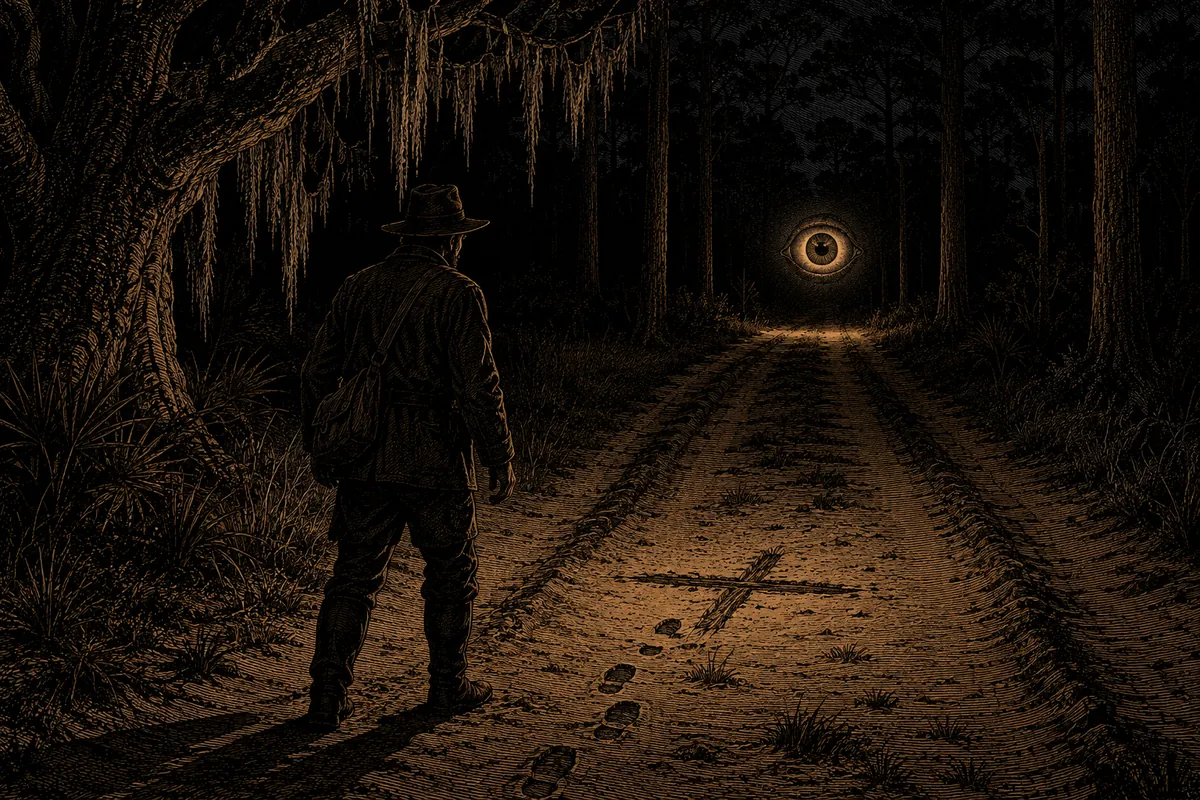
The plat-eye — the spirit of the Georgia coast with one eye only, large, hanging out in front: it does not enter the house and rides nobody, it appears on the road and is avoided.
- Variants and names
- plat-eye, plateye, platt-eye — three spellings, and all three must be searched, because searching only one is the commonest way to miss the first attestation. The glossary of Drums and Shadows defines it as «especially dreaded ghost», and in the same glossary the generic ghost is another word: shadduh
- What is told
- In the description collected in 1940 from an informant with a name and a surname, the plat-eye has one eye only, large, hanging out in front — «Dey calls em plat-eye, cuz dey hab jis one big eye hangin out in front», says Ben Washington in the pine barrens near Eulonia. It does not attack, does not ride the sleeper, does not come into the house: it appears, outdoors, in a determined place. It brings bad luck, and the right relation to it is avoidance: «I dohn fool roun wid sech tings fuh dey's sho bad luck».
- What it was forthe author’s reading
- It governs movement outdoors at night. It is what sanctions the crossing of a certain place at a certain hour, within a system the same source documents in full: the cross-mark on the road, which one goes round rather than across; bad luck as an operative category; avoidance as a rule of conduct.
- Where it is attested
- Georgia Writers' Project (WPA), Savannah Unit, Mary Granger district supervisor, Drums and Shadows, 1940, chapter «Pine Barren Near Eulonia», p. 128, and the glossary. It is the description, and it carries the informant — Ben Washington — and the place. I read it in transcription and not on a scan: the passage falls between the markers of p. 127 and p. 129, and the page must be confirmed on a facsimile; of the glossary entry I did not determine the page, so I do not give one.
Ambrose E. Gonzales, The Black Border: Gullah Stories of the Carolina Coast (With a Glossary), Columbia, S.C., The State Company, 1922: the table of contents carries «The Plat-Eye 183». It is the oldest printed occurrence I have opened, and it must be declared for what it is: I read the index, not the story. The text of p. 183 and the glossary lie beyond the point at which the extractor truncates the volume, and the line is verified on two independent copies which agree on the pagination. Of the content of that story, therefore, I know nothing.
Puckett 1926 and Parsons 1923 have not been opened, and they are the South Carolina texts: they are the ones that would settle the question raised in the note. - Caution
- The most important correction concerns the atlas itself. This entry is born beside haint and haint blue and boo hag, and the triad with which we described the system — hag on the sleeping body, haint on the threshold of the house, plat-eye on the road — is not the triad of the sources. The division of domains holds; the names do not. In Drums and Shadows the word hag does not appear at all, neither in the chapters I read nor in the glossary, which does not even have haint or hant as entries: it has plat-eye and shadduh. On the Georgia coast in 1940 the one who rides the sleeper is called witch — «Witches come in at night an ride yuh too» — and the one on the threshold is called hant, against whom the horseshoe is set. The documented triad is therefore witch / hant / plat-eye, and hag belongs to another area or another period, probably South Carolina — which is precisely the area I could not document.
Three things that circulate and that the sources do not say. The plat-eye as a shapeshifter: in the text of 1940 the form is fixed and single. Beware the contamination, because the shapeshifter is there in the same pages and is another thing — it is the witch, who turns into a buzzard and slips off her skin. The plat-eye as a headless black dog: not found in any source opened. The plat-eye as a guardian of pirate treasure: not found, and the context of the 1940 page is free of it.
The etymology. One reads plait, «braided», and plate, «the eye large and flat as a plate». No source opened proposes either, and the lexicographical repertories consulted do not have the entry. The only explanation of the name in a period source is the informant's, and it is the single eye. The other two are modern conjectures whose author and date I have not found, and they are not to be put on the same footing.
The geography. Sapelo, Harris Neck and St. Simons circulate as the places of the plat-eye. The only place the source names is Eulonia; in the chapters on St. Simons, Darien and Possum Point, which I read, the plat-eye does not appear; the chapter on Sapelo did not open, and so about Sapelo I say nothing.
Countermeasures: none. In the plat-eye passage no specific countermeasure is reported. Those found in the same chapter belong to other threats and are not to be decanted across: the horseshoe is against the hant, the salt on the shed skin and the benne seed are against the witch.
The grade says how well the entry is documented, not how interesting it is. How the grades are assigned.