U'tlûñ'tä, Spearfinger
the United States
Southern Appalachians: Nantahala, Whiteside Mountain and the middle Little Tennessee, between western North Carolina and eastern Tennessee
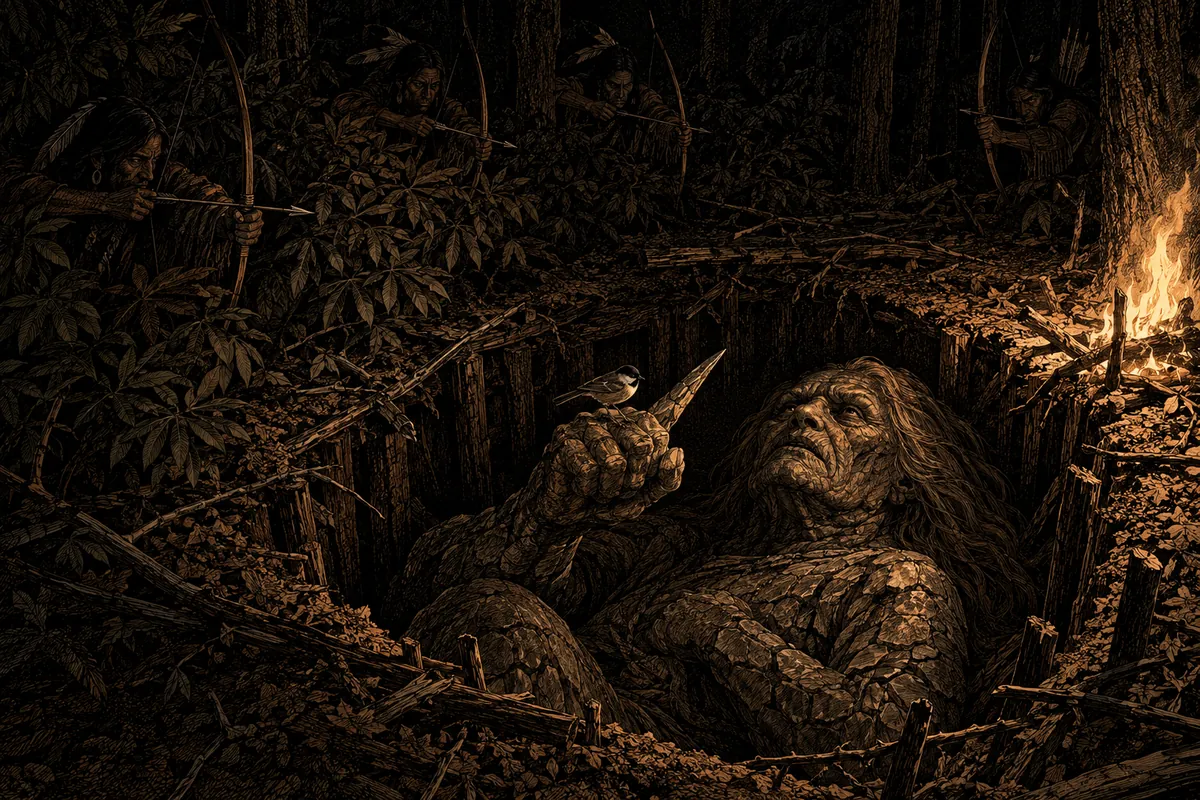
U'tlûñ'tä, Spearfinger — the Cherokee ogress with the stone skin and the finger of bone, who stabs without leaving a mark and eats the liver: the victim goes home and wastes away for days.
- Variants and names
- Cherokee U'tlûñ'tä, which Mooney translates literally as «he (or she) has it sharp»; in English Spearfinger. In the story she also bears a second name, Nûñ'yunu'ï, «Stone-dress» — which is almost the same as Nûñ'yunu'wï, the Stone Man, and the likeness is a trap (see the note). In the first printing, of 1889, the name is rendered Uilata
- What is told
- An ogress who eats human livers. She can take any form, but her own is that of an old woman, with two differences: her whole body is covered by a skin as hard as rock, which no weapon pierces, and on her right hand she has a long forefinger of stony bone, «like an awl or spearhead», with which she stabs. She keeps the hand closed in a fist under her blanket.
What makes the scene is not the monster but the wound: it leaves no mark and does not hurt. She comes to the children gathering strawberries as a grandmother, offers to comb their hair, runs her fingers through it until the child falls asleep, and then strikes. The victim gets up, goes home, goes on with her occupations; then she feels weak, wastes away and dies, because the liver is gone. Whoever meets her in the woods hears her singing softly: Uwe'la na'tsïkû'. Su' sä' sai' — «liver, I eat it».
She lifts enormous boulders and cements them by striking one against another. She tried to build a bridge of rock in the air from the crag of Nûñyû'-tlugûñ'yï, on the Hiwassee, to Whiteside Mountain: the lightning struck it, and the fragments scattered along the ridge can still be seen. - What it was forthe author’s reading
- The aetiology of a wasting disease. It is the function the sources make explicit instead of leaving it to be inferred: in 1892 James W. Terrell published his version under the title The Demon of Consumption, and the victim «would gradually pine away and die» with the wound closed «leaving no outward mark»; at the monster's death «for a long time the wasting sickness was stayed». Zeigler and Grosscup, in 1883, hook the same plot to a smallpox epidemic. Two independent branches read the creature as the personification of a disease.
Beyond that it is explanatory geology — the fragments on the Whiteside ridge are the remains of the lightning-struck bridge — and it is a prohibition: the child who strays from the village for strawberries is exactly the child who meets her. - Where it is attested
- James Mooney, Myths of the Cherokee, Nineteenth Annual Report of the Bureau of American Ethnology, Washington 1900: myth no. 66, «U`tlûñ'tä, the Spear-finger», pp. 316-319, notes and parallels pp. 466-468. This is the field collection, and the only one with named informants. Mooney writes, at p. 466, that the version published comes from John Ax, «with some corrections and additions from Swimmer, Wafford (west) and others», and that the myth «is one of the most noted among the Cherokee myths, being equally well known both east and west».
Three printed attestations precede it, and they must be kept apart because they do not tell the same story. Wilbur G. Zeigler and Ben S. Grosscup, The Heart of the Alleghanies, or Western North Carolina, Raleigh-Cleveland 1883, p. 24: here there is no Cherokee name, no stone skin and no woman — it is «a devil in human form» who during a smallpox epidemic is run to earth in a cave at the head of the Tusquittee, and of whom a bird reveals that «their enemy was invulnerable, except one finger which, if hit, would cause his instant death». H. ten Kate, «Legends of the Cherokees», Journal of American Folk-Lore II, 4, January-March 1889, pp. 53-55: the first printing of the name, collected in the autumn of 1883 at Tahlequah from William Eubanks, a mixed-blood Cherokee and then a senator. James W. Terrell, «The Demon of Consumption. A Legend of Cherokees in North Carolina», JAFL V, 17, April-June 1892, pp. 125-126: the finger becomes iron and the bird a wren.
A negative check worth as much as the positive ones: the collection Mooney published in JAFL I, 2, July-September 1888, pp. 97-108, does not contain it — I have scanned it in full, and of liver, spear, finger, titmouse and chickadee there is no trace. Myth 66 appears in Mooney only in 1900. - Caution
- First of all, what this entry is for. The atlas has an entry on the wampus cat, grade C, which takes apart the «Cherokee woman punished for spying on the rites»: it is not documentable before 2003 and there is nothing like it in Mooney. But taking apart leaves a gap, and the gap is where inventions come back. This is the real Cherokee creature, collected in the field, with the myth number and the informants: it is the stone-skinned monster the wampus cat pretends to be.
Five things that circulate and that the sources do not say.
The finger of obsidian or flint: Mooney says stony bone. Iron and steel come from the Terrell-ten Kate branch — and ten Kate prints «of sharp-pointed steel (?)», the question mark his own.
The bird as a jay: that is ten Kate's error, and Mooney corrects it by name at p. 466, where he writes that in that version «the tomtit is incorrectly made a jay». In the field version there are two birds and they do the opposite: the titmouse gets it wrong, cries «heart», the arrows bounce off the stone coat, and they cut out its tongue — ever since it is short and everybody knows it is a liar; then the tsï'kïlilï', the chickadee, alights on the right hand, and the heart is there inside, in the closed fist. The wren is Terrell's.
The weak point in the chest: that is the mistake which, in the story, costs the arrows. The killing shot is at the wrist, where the awl is set in.
«She lived on Whiteside Mountain»: Whiteside was the far end of the bridge. Her own places are the heads of the streams, the dark passes of Nantahala, the gap where Chilhowee Mountain comes down to the river, and U'tlûñtûñ'yï, «Sharp-finger place», on the Little Tennessee almost opposite the mouth of Citico Creek — that stretch of river is now under the Tellico reservoir.
«She is always female»: not in the oldest branch. Zeigler and Grosscup 1883 and Terrell 1892 have a male subject, and it is not an error to be corrected: Mooney explains why, at p. 467, where he records that according to some myth tellers the two stone-clothed monsters were husband and wife and lived together, «the only difference being that the husband waylaid hunters, while his female partner gave her attention to children».
Mooney distinguishes U'tlûñ'tä from Nûñ'yunu'wï, the Stone Man, and he does it twice. They are two numbered myths, 66 and 67, on different pages; and inside 66, at p. 317, stands the line «There was another stone-clothed monster that killed people, but that is a different story». But he also records the real overlap: the husband-and-wife pair, and the fact that Swimmer dictated 67 to him in fragments «for the reason that he confounded it with the somewhat similar story of U'tlûñ'tä». The confusion is onomastic too, because the ogress's second name, Nûñ'yunu'ï, is almost identical to his. Whoever takes the two figures for one is wrong; whoever takes them for strangers loses something the informant was saying.
The grade says how well the entry is documented, not how interesting it is. How the grades are assigned.