The trial of Julia Carta
Sardinia · The islands
Siligo (Sassari), in the Logudoro-Meilogu; the tribunal and the public reconciliation at Sassari
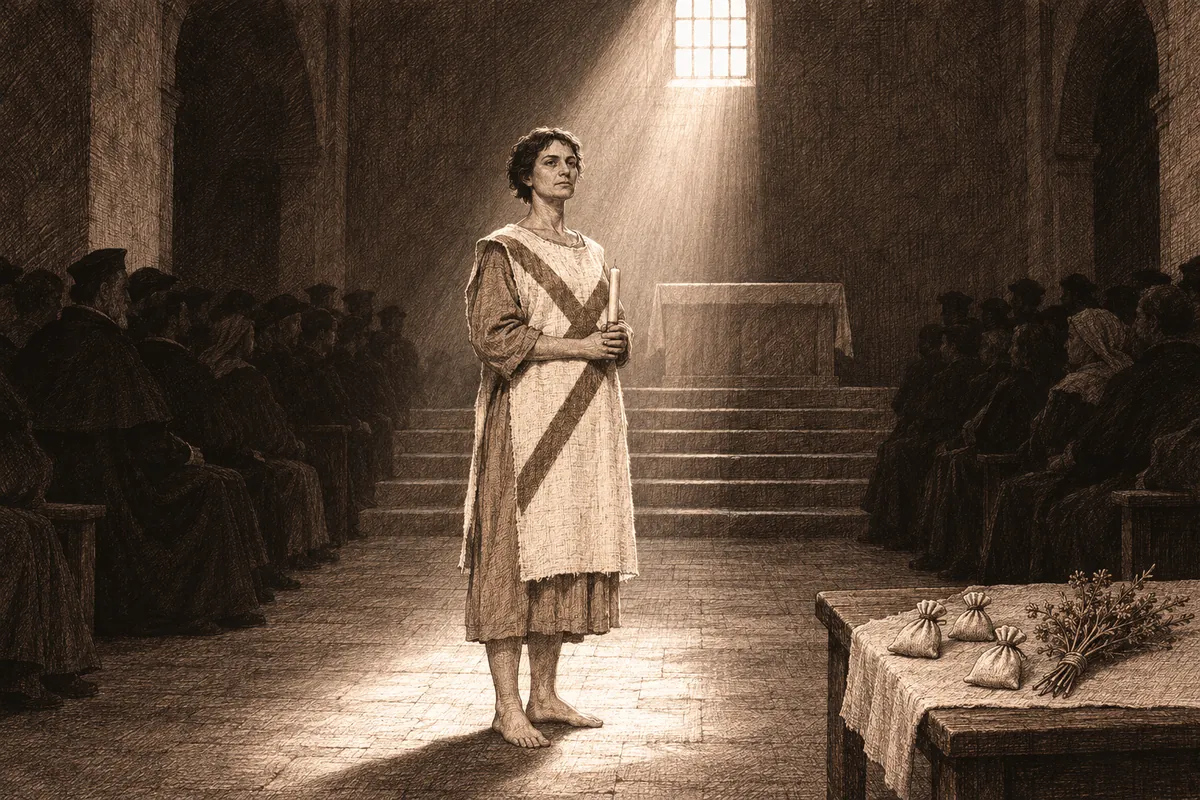
The trial of Julia Carta — tried twice by the Inquisition at Sassari, reconciled in 1597 and called a backslider in 1605: the outcome of the last request to the Suprema is unknown, and in 1614 Julia is still alive.
- Variants and dialect names
- Julia Carta; in the acts she is said to appear also as Julia Casu Masia Porcu. In the local received version she is the witch of Siligo. No open source gives a Sardinian form of the name. The Sardinian terms that appear in the acts are the names of the objects: nóminas and pungas, that is amulets
- What is told
- A woman of Siligo, in the Logudoro, tried by the Inquisition twice: 1596-1597 and 1604-1606.
What is charged against her is not an imaginary, it is practices and objects. The prosecutor lists nóminas and pungas, fumigations, herbs, curses, and the death of a person. The devil Julia describes has a proper name: Señor Domán. Among the practices is a prediction called «bringing down the moon».
And the transmission of the knowledge is declared in stages, with names: her grandmother Juanna Porcu, then Tomayna Sanna, then a gypsy woman, and finally the devil.
April 1597: condemned to torture with the garrucha, confession, torture broken off. 26 October 1597: public reconciliation in the church of Santa Caterina at Sassari, with the sambenito, three years of compulsory residence at Siligo and the rosary on Saturdays. - What it was forthe author’s reading
- The reason this entry exists is what happens afterwards.
Between 1604 and 1606 there is a second proceeding. The prosecutor calls her relapsa, a backslider, and asks that she be handed to the secular arm — the formula by which the Inquisition passes a convict to the civil power for execution. The inquisitor asks the Suprema, in Madrid, for a definitive judgment.
Of that request no open source knows the outcome. And Julia Carta reappears in 1614, in a district visitation. So: there is no stake, no sentence, no end. The entry stops where the sources stop, and does not build her a death — which is the natural temptation of every story about a witch, and the easiest way to lie.
There is also a datum of modern reception that shows how warm the case still is: in 2012 the authorities blocked the naming of a street after her at Siligo. - Where it is attested
- Attilio Mastino, «Magia e inquisizione nella Sardegna del Cinquecento secondo Tomasino Pinna», Ozieri, 20 July 2017, published on the author's site. Read in full, in two passes. From it come all the precise dates in this entry. It must be taken for what it is: a commemorative talk, not a refereed text, which summarises Pinna's book and gives neither pages nor shelfmarks.
Massimiliano Carta, review of T. Pinna, La inquisición en Cerdeña. El proceso de Julia Carta, Institución Fernando el Católico, 2019, in Memorias, year 18, no. 46, January-April 2022, pp. 201-206, ISSN 1794-8886, DOI 10.14482/memor.46.945. Read in full. It contains the only page reference this entry possesses: Pinna 2000, p. 331. From it also the biographical data — about thirty-five at her arrest, married at twenty-five to a widower, seven children of whom only Juan Antonio survives, her cellmate Perditta Basigheddu, the denouncer Barbara de Sogos — which could not be checked against Pinna.
Tomasino Pinna, «Il viaggio del signor inquisitore», Bollettino di Studi Sardi, pp. 42-63, open access. Read in part: it is Pinna himself citing the documents he transcribed at the Archivo Histórico Nacional. The volume and year are not verified: the first page of the PDF carries no journal header and the metadata pages were blocked.
Not opened, and it is the book everything depends on: Tomasino Pinna, Storia di una strega. L'Inquisizione in Sardegna. Il processo di Julia Carta, Sassari, EDES, 2000. It has at least 331 pages; pp. 109-113, which Pinna himself cites, are to be checked, and the introductory note on the sources, where the shelfmark should be. Nor was the Spanish edition of 2019 opened, whose translator, series and pagination remain unknown.
Looked for and set aside: S'Ardia of Sedilo, the Sartiglia of Oristano and the Candelieri of Sassari. On the Candelieri and the vow of 1582 the search returned only institutional tourist material and local press: no open historiography, and no trace of the document of the vow. That is a datum in itself, but not enough for an entry. - Caution
- No quotation is printed. The reading tool refuses transcriptions beyond a few dozen characters and rephrases the rest. Fragments of the charges and of the confession exist, but they are notices of existence, not transcriptions, and must not be printed between quotation marks until the paper is read.
The dossier's shelfmark is unknown, and is not deduced. This is the most important rule in this entry. The shelfmarks that are known — AHN, Inquisición, lib. 783, ff. 227r-279r for the Relación of the 1640 visitation, with a copy in legajo 16342 fasc. 7; the sambenitos renewed in 1621 in legajo 16322, ff. 32v-33r; the relaciones de causas of individual magic cases in books 782 and 783 — concern other Sardinian material, and are shelfmarks written by Pinna, not checked by this entry against the inventory of the fonds. Extending them by analogy to Julia Carta's dossier would be inventing a source. The inventory of the Cerdeña tribunal on PARES is needed.
No stake. The outcome of the 1604-1606 proceeding and Julia Carta's fate are not known. Anyone who tells this story with an ending should be checked.
Nothing Nuragic. In nothing that was opened are these practices connected with a pre-Christian Sardinian magic or a Nuragic continuity. That interpretative frame, extremely common in island popular writing, has no support in any of the sources read: the only Nuragic thing in the documentation on Siligo are the nuraghi of the district, with no relation to the trial.
Four contradictions, reported and not smoothed over. Who starts the proceeding: six accusers interrogated by the parish priest of Siligo between 25 September and 5 October 1596, or the neighbour's denunciation after the death of the brother Julia had treated. The charge: a doctrinal heresy, an idea of hers about confession, or generically heresy and witchcraft — and that is not a detail, it changes the nature of the case. The chronology: two distinct trials plus an appearance in 1614, or a continuum between 1596 and 1614. And the discovery: a «forgotten» dossier found in Madrid, or documents consulted at the AHN in 1998.
It is not written that the acts are in Sardinian. One source asserts it, and it is an interesting notice, but it is not confirmed elsewhere and must be verified against Pinna.
No island-wide figure. The review speaks of «more than a thousand» women tried in Sardinia without indicating a source: it is not reported.
The coordinates are the village's, taken from general geography and not from an open source: they need rechecking. Neither the building of the Holy Office prison in the Castello of Sassari nor the former church of Santa Maria de Banzos by the cemetery of Siligo was located; a weak source says the latter is named in the acts, and that too must be verified against Pinna.
Unknown: the identity and procedural role of Tomayna Sanna and of the gypsy woman, and the fate of the prison building.
The grade says how well the entry is documented, not how interesting it is. How the grades are assigned.