The Tables of Saint Joseph
Apulia · The Mezzogiorno
Southern Salento, the Otranto belt: Giurdignano, Minervino, Specchia Gallone, Uggiano la Chiesa, Giuggianello, Cerfignano; in the Taranto area Montemesola and Monteiasi, in the Brindisi area Erchie
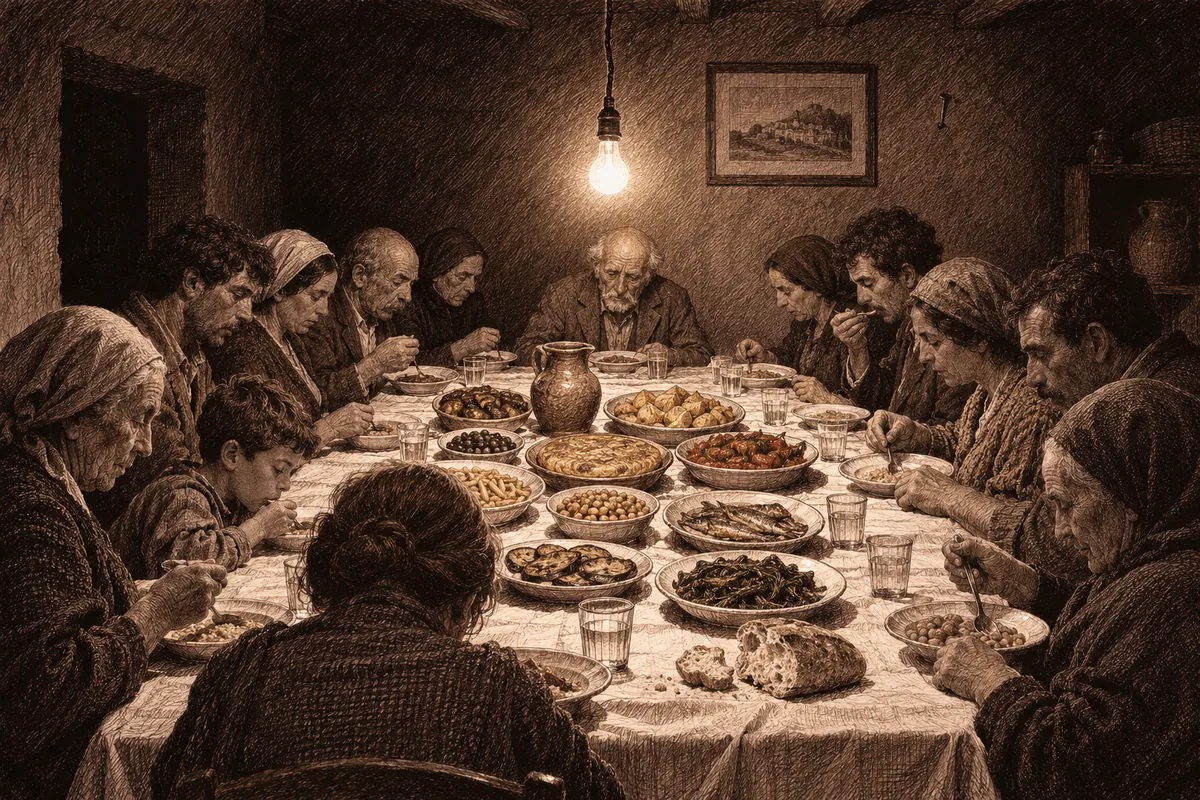
The Tables of Saint Joseph — on 19 March a family lays the table for the «saints», who are living people: from three to thirteen guests and thirteen dishes, one per figure — and in Salento the food is now handed over raw instead of being eaten together.
- Variants and dialect names
- Tavole or tavolate di San Giuseppe; the guests at table are called «santi», saints, and they are living people impersonating the Holy Family and the rest. In the Taranto area the central act has a name of its own, the pranzo dei santi, the saints' lunch
- What is told
- A table laid in a private house for 19 March, in discharge of a vow, and a number that holds the whole thing together: the «saints» invited are between three and thirteen — at the least the Holy Family, then the Virgin's parents and some apostles — and the dishes are thirteen, to match the number of figures. The menu is Lenten and recognisable: pasta e ceci — the laina, the làgana, the trìa —, tassel hyacinth bulbs, macaroni with fried breadcrumbs and honey, vermicelli with mussels.
And here the rite splits in two along a sharp geographical line. In the Taranto area the saints really do sit down: Saint Joseph is at the head of the table, says the prayer, tastes and carries the dishes away. In southern Salento the commensality is emptying out: much of the food stays raw and is handed out to the saints on the morning of the feast, after the priest's blessing — «they will not sit at table, but they will receive the share that is theirs». - What it was forthe author’s reading
- To pay a vow with food, and to do it before witnesses who for one day are no longer themselves. The mechanism is the gift: the table is not offered to an image but to people of flesh and blood, chosen and called by name, who agree to be treated as the saints they represent.
It is here that the social change shows, and the source says so without circling round it: until after the war the saints were chosen from among the poor of the village, today «normally among relatives and friends». The table was a redistribution, and it has become a family celebration. The Salentine emptying of commensality — raw food handed over instead of eaten together — is the next step of the same transformation. - Where it is attested
- Eugenio Imbriani, «Il dono e l'offerta», M@GM@. Revue Internationale en Sciences Humaines et Sociales, vol. 22 no. 2, May-August 2024, pp. 160-165, ISSN 1721-9809, DOI 10.17613/z0snr-8kg88, issue edited by Bernard Troude. The part on the rite is the Offerta section, pp. 163-165: p. 163 for the thirteen guests and thirteen dishes, for the Lenten menu and for the Taranto pranzo dei santi; p. 164 for the distribution of raw food in Salento, for the quotation «non siederanno a tavola…», for the saints chosen from among the poor until after the war, and for the names of the Otranto-belt villages (n. 7).
This is the entry's only first-hand source, and that is worth saying plainly: six pages, recent, by an ethnographer of the University of Salento. The PDF was read by text extraction, not as page images.
Two names that appear only as references inside Imbriani and that were not opened: G. Ranisio on food questing (p. 164) and any text by Saverio La Sorsa, of whom only catalogue records were seen. Attribute nothing to them on this entry's word.
Negative checks useful to whoever searches: ICCD record 11972873 on a church of San Giuseppe at Manduria is an architecture record and documents no rite; Mario Spedicato's studies on Joseph of Cupertino concern the friar, not the Tables; and the chapter by I. Zilli and M. Giagnacovo on the tavolate is listed as «in press», with no file, and is centred on Molise. - Caution
- No ancient origin. Ceres, Demeter, a pre-Christian continuity: not one first-hand source was found connecting the Tables to a pagan rite. If the claim circulates, it circulates without support.
No historical dating of the rite. No archival document, no pastoral visitation, no nineteenth-century chronicle was opened. The only depth in time the source gives reaches back to the post-war years, when the saints were chosen from among the poor. Before that threshold this entry knows nothing.
No demo-ethno-anthropological catalogue record on the rite: it was looked for and not found. That is a sharp difference from the other two entries in this series, the fujenti and Polsi, which rest precisely on ministerial records.
The fate of the leftovers is not described. The source says only that in Salento «one tries to avoid waste» (p. 164). Anything more precise would be invented.
The formulas, prayers and songs were not read in any source. It is known that Saint Joseph says a prayer before tasting; which prayer is not known.
Finally, a note to keep the papers straight: a rite of the same name, much studied, exists in Sicily, and another in Molise. This entry describes Apulia, and the traits reported here hold for Apulia.
The grade says how well the entry is documented, not how interesting it is. How the grades are assigned.