The pagliara maje maje
Molise · Appennino centro-meridionale
Fossalto (province of Campobasso), Molise; the begging song is attested in almost identical form throughout Molise, the pagliara only here
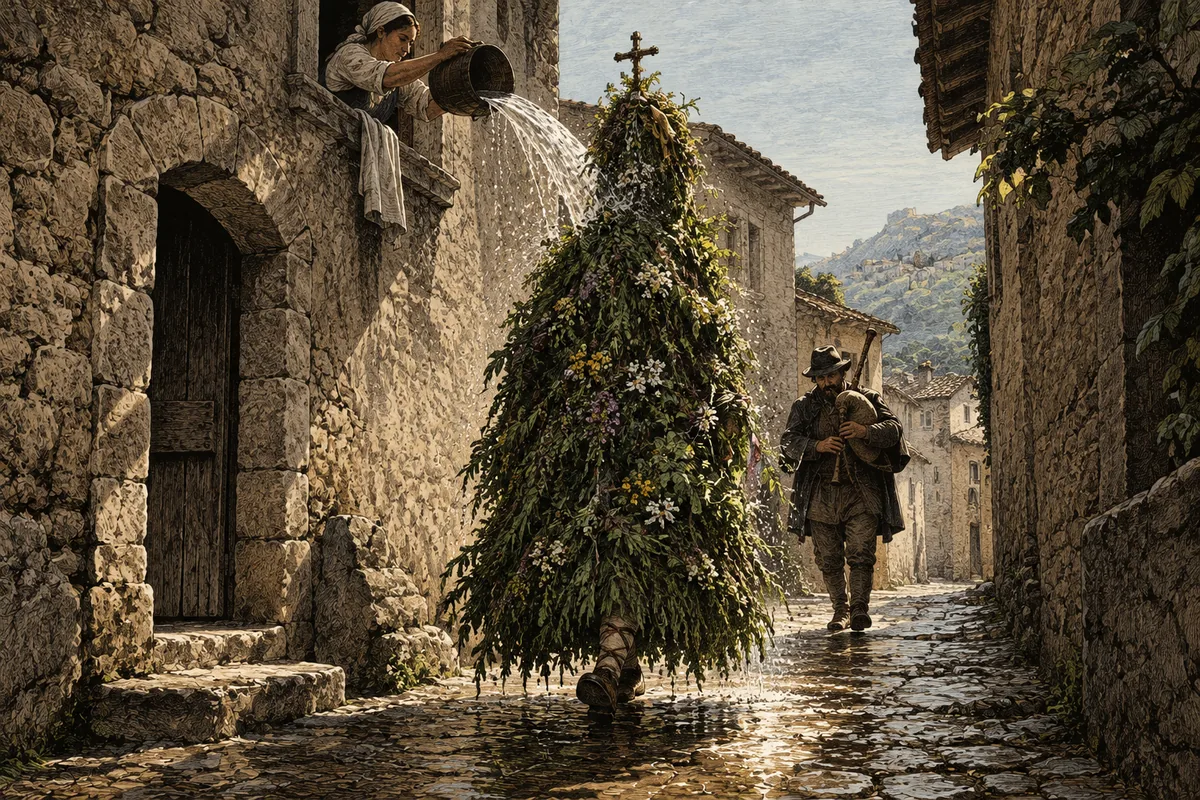
The pagliara maje maje — a cone of light wire mesh, covered in flowers and greenery and topped with a cross, which a young man wears and animates.
- Variants and dialect names
- pagliara maje maje; Cirese's spelling pagliara maie maie; the object is la pagliara, la pajara
- What is told
- A cone of light wire mesh, covered in flowers and greenery and topped with a cross, which a young man wears and animates. On 30 April the greenery is gathered; on 1 May the parish priest blesses the structure and the procession crosses the village with a begging song accompanied by the bagpipe. From the houses they throw water over him, and the wet trail marks his route on the ground. In the square the bearer slips the cone off, the priest hands the cross to the mayor, and the bufù sound.
- What it was forthe author’s reading
- To announce May and to beg, with a portable vegetal mask rather than a planted tree. The difference from the Maggio of Accettura is the whole distance between two ways of doing the same thing: there the vegetal is a load of tons hoisted in the square, here it is light, worn, and the active element is the water thrown by the inhabitants.
- Where it is attested
- This is the atlas entry with the most precise field record. The song was recorded in 1954 by Diego Carpitella and Alberto M. Cirese; the photographs are dated 1 May 1954 and were supplied by Cirese; the description of the tradition is Cirese's, 1955. Carpitella noted that the melody moves by conjunct degrees over the bagpipe drone. ICPI record (Ministry of Culture), Molise section, 26 October 2021, text by E. De Simoni from Patrimonio immateriale del Molise.
- Caution
- Cirese's 1955 piece is cited by the ministerial record without a place of publication, and I have not been able to establish where it appeared: until I open it the reference stays incomplete, and I say so. The reading of the pagliara as a «spirit reborn from the carnival fire» appears in the ICPI record but as interpretation, not as field data, and is kept separate here. To be discarded: the «Oscan» or «Samnite» origin, the water as a «three-thousand-year-old rain rite», and the medieval first-attestation dates repeated by tourist sites without a document.
The grade says how well the entry is documented, not how interesting it is. How the grades are assigned.