Lucida Mansi
Tuscany · The Po plain and the northern Apennines
Lucca: the family palace, today a national museum; Villa Mansi at Segromigno in Monte (Capannori); the city walls; and, in the most recent versions, the pond of the Botanical Garden
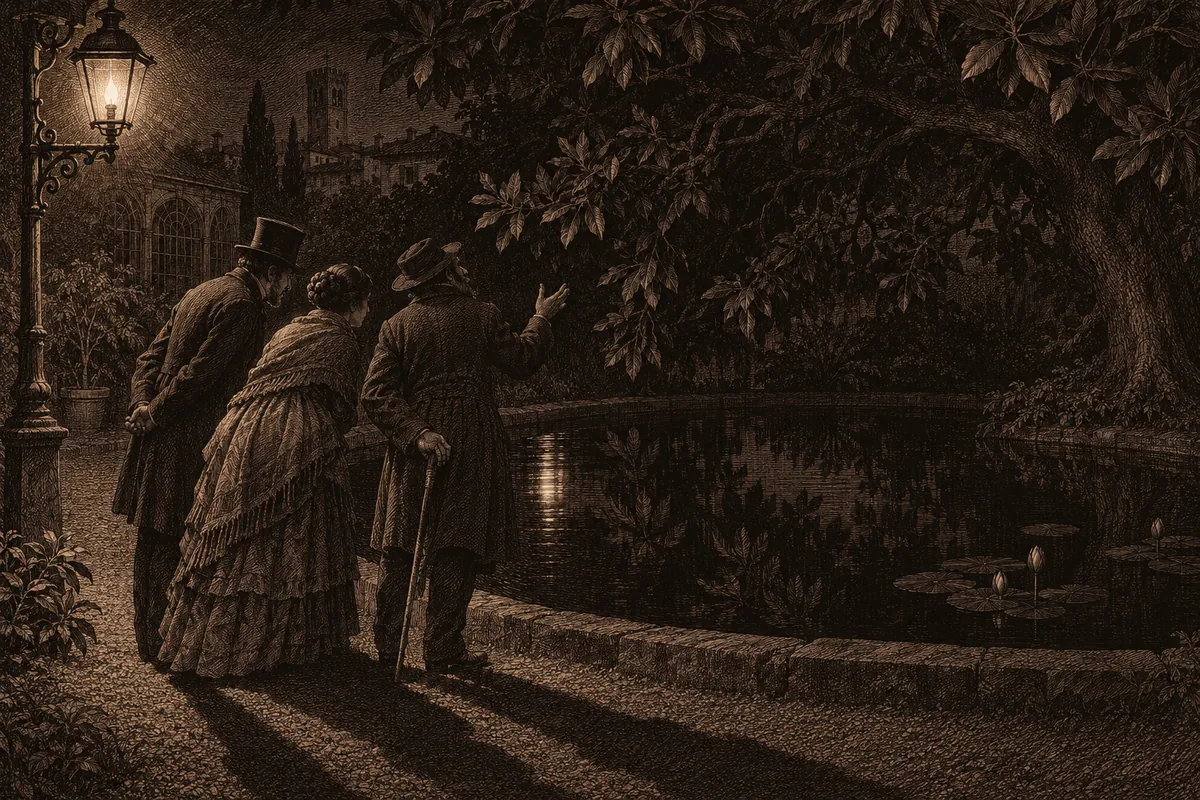
Lucida Mansi — the gentlewoman of Lucca, who really lived from 1606 to 1649, whom the legend damns for a pact with the devil in exchange for youth: the tale is attested in print only from 1930, and the pond into which she sinks postdates 1860.
- Variants and dialect names
- Lucida Mansi, born Samminiati (in the sources also Saminiati); «la bella degli specchi», the beauty of the mirrors, from the title of Tobino's novel
- What is told
- The legend as it is told today: a gentlewoman of early seventeenth-century Lucca, beautiful and vain, makes a pact with the devil at her first wrinkle — thirty years of youth in exchange for her soul — and spends them among the mirrors of her palace and a string of lovers. When the term expires a burning carriage carries her off along the walls and sinks into the pond of the Botanical Garden, where on full-moon nights her face is said still to be seen. Online versions add trapdoors fitted with blades to dispose of the lovers and a room of mirrors at Villa Mansi.
The woman existed. Lucida Samminiati, married Mansi, lived in Lucca in the first half of the seventeenth century, was widowed and remarried a Mansi, and died of plague in 1649: Eugenio Lazzareschi, archivist and later director of the State Archive of Lucca, wrote about her in 1930 in a pamphlet whose very title separates «the legend» from «the history». - What it was forthe author’s reading
- A cautionary tale about vanity and wealthy widowhood, built on the Faustian pattern and hung on a real person: the legend explains, after the fact, why a woman twice married and dead of plague must have been guilty of something. The geography of the tale is that of the town walk — the walls, then the pond — and has shifted over time towards the places a visitor can see: it is a legend that today serves above all those who show Lucca to others.
- Where it is attested
- The key text is Eugenio Lazzareschi, Lucida Mansi nella leggenda e nella storia, Lucca, Scuola Tipografica Artigianelli, 1930, offprint from a «Miscellanea lucchese», some fifty pages with a portrait; copies at the National Library in Florence and the State Library of Lucca; reprinted Lucca, Maria Pacini Fazzi, 2006. It is recorded in the Archivio storico italiano 1930, p. 454, and in the Catalogo generale della libreria italiana 1921-1930, suppl. 3, p. 756; the index of the Rassegna Nazionale for 1926 already carries his «Lucida Mansi nella storia e nella leggenda». Lazzareschi served at the State Archive of Lucca from 1906 and directed it from 1931 until his death (L. Giambastiani, Actum Luce XLI, 2012). National circulation is post-war: Georgina Masson, Italian Villas and Palaces, 1959, and Italian Gardens, 1961 («the very merry widow Lucida Mansi»); L'Espresso, 30 August 1959, 23 April and 30 July 1961; Guida all'Italia leggendaria, misteriosa, insolita, fantastica, Milan, SugarCo, 1966. Then Mario Tobino, La bella degli specchi, Mondadori, 1976, and Carlo Lapucci, Le leggende della terra toscana, Florence, Sarnus-Polistampa, 2011, who collects it «in Lucca» together with a separate entry on «the haunted pond of the Botanical Garden». On the Mansi side: Renzo Sabbatini, «Una famiglia mercantile lucchese ed il suo feudo padano», in Tra rendita e investimenti, Bari, Cacucci (proceedings of the Turin conference, 1996), n. 32, from the Archivio Mansi and Archivio Notarile holdings of the State Archive of Lucca.
- Caution
- Grade B, and not A, for a precise reason: I have not opened Lazzareschi's pamphlet, neither the original nor the reprint, and every biographical datum in circulation — birth on 7 March 1606 to Vittorio Samminiati and Laura Marchiò, the first husband Vincenzo Diversi, the second Gaspare di Nicolao Mansi, death on 12 February 1649 and burial at the Capuchins — I have seen only at second or third hand, in texts that point back to him. They will do as hypotheses, not as data. Of the legend I have found no printed attestation before 1926-1930: it is not in Nieri's Cento racconti popolari lucchesi (1906-1908), of which I read the index and the first part, and full-text search on the Internet Archive yields nothing earlier. In the attestations of 1959-1992 the carriage runs along the walls and the ghost is at Villa Mansi or at the Torre delle Ore; the pond appears, in the sources I have read, only from Lapucci 2011 onwards. The variant of 13 September, the night of the Luminara di Santa Croce, I have found in no source at all. Finally, if the Gaspare di Nicolao Mansi who made his will in 1682 leaving his brother Raffaello as heir (Sabbatini, n. 32) is Lucida's husband, as every telling says, he outlived her by thirty-three years: the version in which she kills him does not hold, but the identification is an inference of mine and I say so. To be discarded: the trapdoors with blades, the «room of mirrors» as a historical datum, and any «1623» date for the damnation.
The grade says how well the entry is documented, not how interesting it is. How the grades are assigned.