Mari, the Lady of Anboto
Spain
Biscay and Gipuzkoa, on the massifs the attestations name: Anboto, Murumendi, Aloña, Atxorrotx; villages of collection including Eskoriatza, Abadiño, Berriz, Ataun, Oñati, Zaldivia, Lazcano, Errezil, Amézqueta, Azpeitia, Ormaiztegui, Muxika
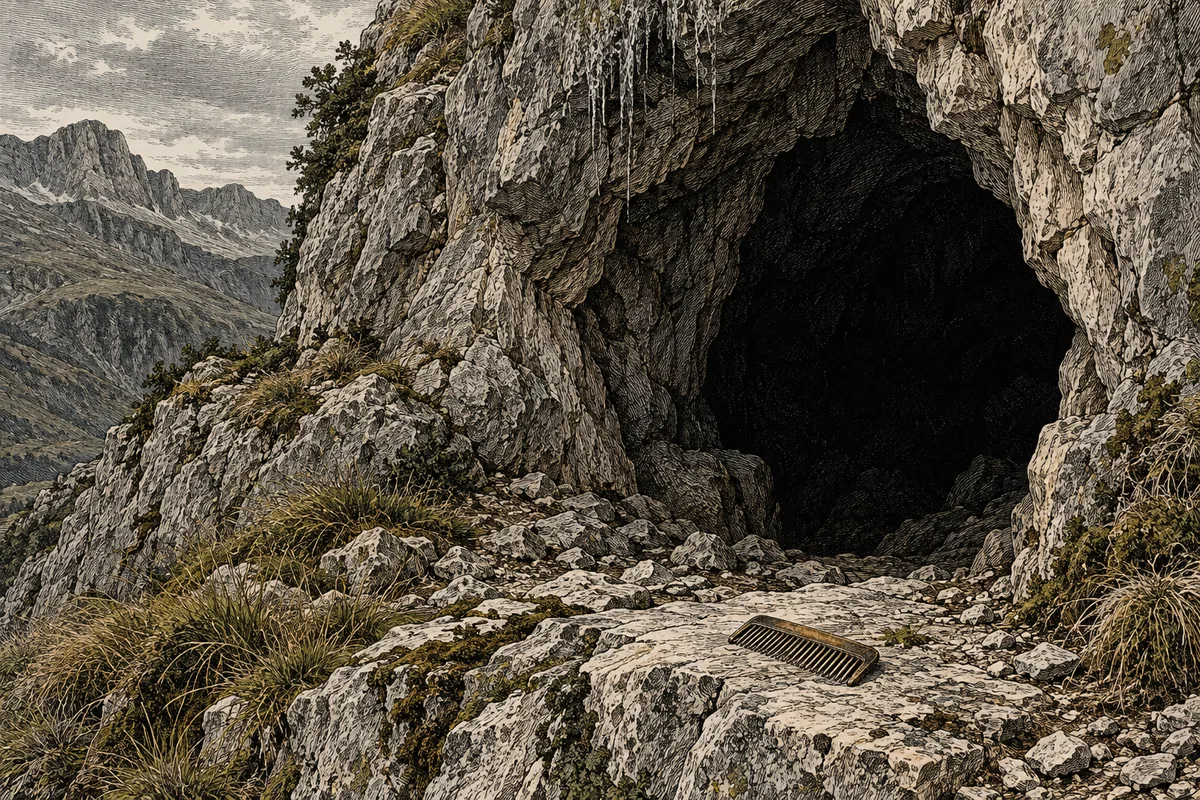
Mari, the Lady of Anboto — a lady who inhabits caves inside named mountains and moves between them.
- Variants and names
- Basque Mari, Anbotoko Dama; local forms attested Mariurrika (Abadiño), Mariburrika de Sarrimendi (Berriz), Dama de Muru; Castilian la Dama de Amboto, la Señora
- What is told
- A lady who inhabits caves inside named mountains and moves between them. She governs hail and weather, pays in gold — the comb, the cattle — and punishes the broken promise and work done on a forbidden day. What defines her is not the supernatural feminine, which is a common genus: it is the topography. Every massif has its dwelling and the story rests on the journey between dwellings. This is what separates her from the lamiak, who belong to water and to the comb, and from any procession of the dead.
- What it was forthe author’s reading
- To tie the weather to a precise and walkable geography: not «the sky», but that summit and that cave, and the passage from one to the other as an omen. Around it are organised prohibitions on work, exchanges, and an accounting of promises.
- Where it is attested
- José Miguel de Barandiarán, «Tradiciones y leyendas», Eusko-Folklore. Materiales y cuestionarios, 3rd series, Year 35, nos 2-5, 1955, pp. 42-264, and the continuation, Year 36, nos 6-8, 1956. The attestations carry informant, village and year: Escoriaza, 1935, José Aramburuzabala, with the Lady of Anboto, the shepherds of Atxorrotx and the golden comb; Abadiano, 1931, S. Gastelu-iturri; Berriz, 1931, Juan Loizate; Ataun, 1925, Juan Miguel de Aguirre aged 63, of the Mendiurkullu farmstead; Urrestilla, March 1926, Josefa Echeverria aged 77; Ormaiztegui, 29 March 1926; Cerain, 4 July 1954; Aloña, 1928 and 1955; and for the Múgica chestnut cycle a letter of 25 April 1921 and a site visit with Telesforo de Aranzadi on 15 September 1924.
- Caution
- This entry also exists to show in public how attestation is separated from systematisation, which is the rule of the house. In the same publication Barandiarán prints the field stories and a text headed «Resumen de la mitología mariana»: the second is the author's synthesis, and the unitary framework of «Mari» as the central figure of a Basque religious system is twentieth-century systematisation, not transcription. To be discarded, because it circulates with no informant, no place and no date and is often attributed to Barandiarán as though he had collected it: Mari as a pre-Indo-European mother goddess; the consort Sugaar or Maju; the sons Mikelats and Atarrabi; Friday as her day; the fixed list of «seven dwellings»; the «matriarchal Basque religion». Azkue, Euskaleŕŕiaren Yakintza, which would be the second independent leg, remains unopened.
The grade says how well the entry is documented, not how interesting it is. How the grades are assigned.