El Nuberu
Spain
Asturias, and only the concejos the attestations name: Ibias (Bao), Teverga (Villanueva), Colunga (Lastres), Somiedo, Cudillero (San Martín de Luiña), Belmonte (Llamosu)
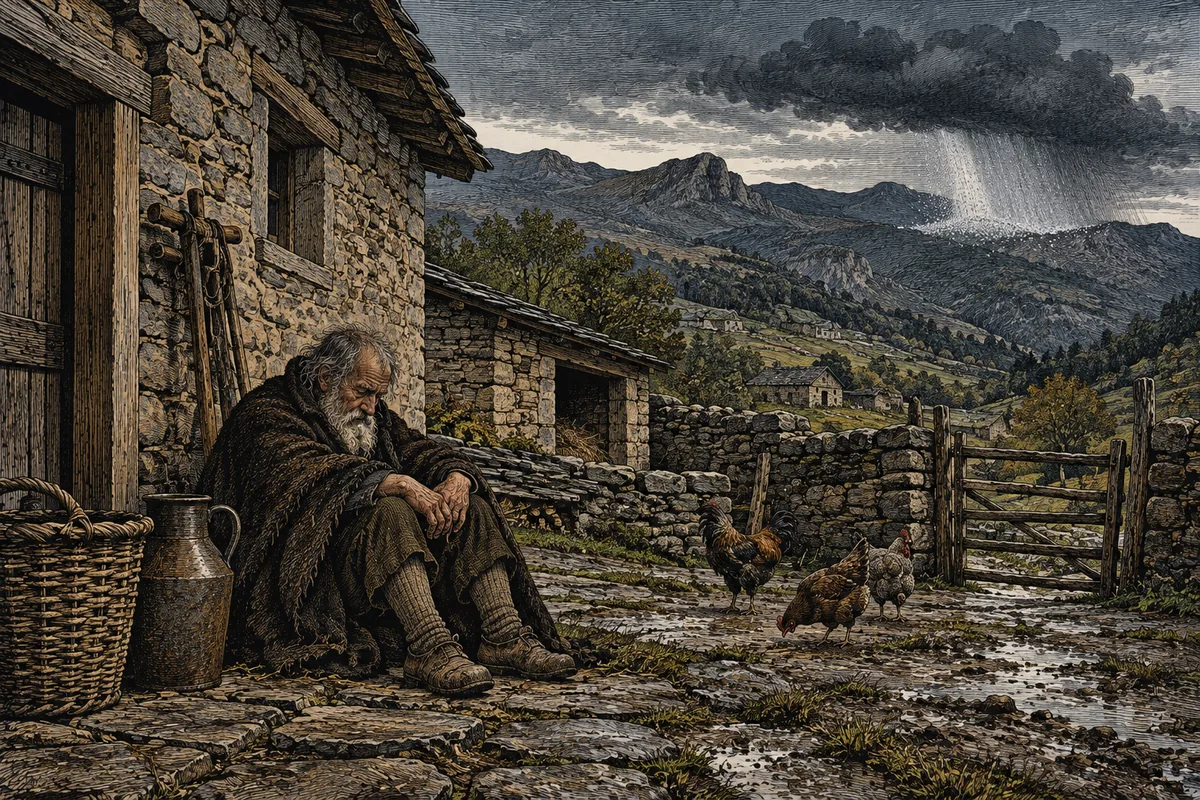
El Nuberu — he is neither a dead man nor a house spirit: he is the driver of the storm clouds, «el director de las tormentas».
- Variants and names
- Asturian el Nuberu; Castilian el Nubero; within one legend collected by Llano he bears the proper name Juan Cabrito
- What is told
- He is neither a dead man nor a house spirit: he is the driver of the storm clouds, «el director de las tormentas». What defines him is a double register no other figure in the atlas has: he is master of the weather and at the same time a traveller open to blackmail, because he can be left on the ground when his clouds escape him, and then depends on the hospitality of farmers. He punishes with hail those who refuse it and makes the fields of those who take him in bear fruit. Against him, the priest's exorcism and the throwing of a shoe at the cloud.
- What it was forthe author’s reading
- To give hail someone to deal with. Weather damage becomes a transaction between persons — a guest badly received, a bill to be paid — rather than an accident, and the farming household gains a procedure where otherwise it would have only the loss.
- Where it is attested
- Aurelio de Llano Roza de Ampudia, Del folklore asturiano. Mitos, supersticiones, costumbres, Madrid, Voluntad, 1922, with a preface by Ramón Menéndez Pidal. The footnotes carry the entry on their own, because they give name, age, village and day: Bao (Ibias), 13 November 1921, among the neighbours the parish priest don Ramón Rodríguez González and the young Luisa Rodríguez (p. 9); Villanueva de Teverga, José López aged 80 and Luis Menéndez aged 81 (p. 10 n. 2); Josefa Villar, 60, of Oblanca, living at Lastres (Colunga), 24 August 1921; Somiedo, 9 April 1921, Indalecio Arias aged 85; San Martín de Luiña (Cudillero), 12 March 1921, Hermenegildo Rodríguez aged 74 (p. 11 n. 1); Llamosu (Belmonte), 21 July 1921, José Patallo aged 60 (p. 11 n. 2). The legend «Si vas a tierra de Egito…» is at pp. 16-17, and there Llano gives neither place nor informant.
- Caution
- Two layers not to be confused, and the entry exists partly for this. Llano theorises on his own account: he writes that the Nuberu's origin «quizá habrá que buscarlo entre los dioses del antiguo continente líbico o asiático», and that is an author's diffusionism of 1922, not field data. And in the preface Menéndez Pidal identifies the Asturian güestia with the Castilian hueste antigua: that is the prefacer's hypothesis. Constantino Cabal, La mitología asturiana (1925), is the systematiser who arranges these figures into an organic body: I have not opened him, and attribute nothing to him here. To be discarded: «Juan Cabrito» presented as the Nuberu's name rather than as a character in a printed legend, and the Egyptian origin given as a belief rather than as a narrative motif.
The grade says how well the entry is documented, not how interesting it is. How the grades are assigned.