Polsi and the incubatio
Calabria · The Mezzogiorno
Polsi, a hamlet of the commune of San Luca (RC), inside the Aspromonte National Park; the feast runs from 31 August to 2 September and is preceded by a novena
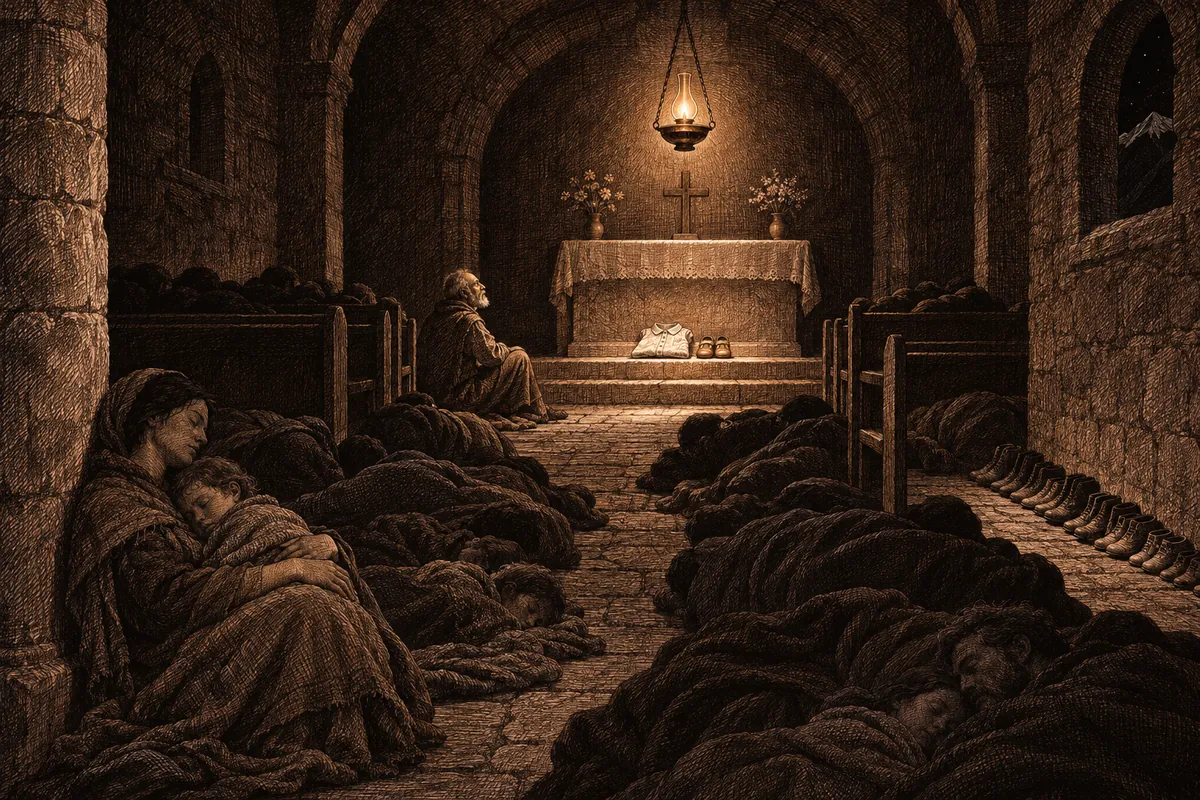
Polsi and the incubatio — on the eve the devotees sleep inside the sanctuary at the bottom of an Aspromonte valley: this is the incubatio, and on the altar parents undress the children who have been healed.
- Variants and dialect names
- the sanctuary is dedicated to the Madonna della Montagna. The State catalogue registers the place as «Contrada Potamia (Polsi d’Aspromonte)»; the name people use is simply Polsi
- What is told
- A sanctuary at the bottom of an Aspromonte valley, reached by a single road, and a three-day feast — 31 August to 2 September — preceded by a novena, with a pilgrimage calendar that gives each village its day.
What makes the entry is neither the crowd nor the procession: it is that on the eve many devotees sleep inside the sanctuary. The ministerial record calls it by its technical name, the rite of incubatio — incubation, sleep in a holy place in expectation of grace or of a dream. None of the other great Calabrian rites in this atlas involves a ritual overnight stay.
The same record notes a second gesture, precise and domestic: parents undress on the altar, before the image, the children who have been healed of grave illness. - What it was forthe author’s reading
- To bring the body to where the grace is asked for, and to leave it there for a night. Incubatio is not a prayer vigil: it is sleeping, that is, handing oneself over defenceless to the place. Around it stands everything else a documented mountain feast has — up to fifty thousand present, the communal meal, dancing to accordion and tambourine — but that is a setting Polsi shares with a hundred other sanctuaries. Sleeping inside the church, and the children's clothes left on the altar, it does not.
- Where it is attested
- Two records of the State catalogue, cited by number and not by page.
ICCD, catalogue record type A (architecture), general catalogue number 00011204, compiler Giuseppe Lonetti, 1980, digital transcription by Viviana Ruberto 2014, revision by Giuseppina Stracuzzi 2014. From it come the location, the current use («pilgrimage destination»), the foundation legend and the historical bibliography — Scaglione 1856, Fera 1895, Capialbi 1895, Alvaro 1912, none of which was opened.
ICCD, MODI form ICCD_MODI_9897413800571, 2025, content by Giustina Aceto (Pontificia Facoltà Teologica Marianum), with the Franco Butera Photographic Archive, the Chancery of the Diocese of Locri-Gerace and the Sanctuary's Historical Archive. This is the record that carries the dates, the novena, the incubatio and the children undressed on the altar.
D. Di Gregorio, A. Picone Chiodo, A. Nicolosi, «Pellegrinaggio religioso in Aspromonte», LaborEst no. 17/2018, pp. 15-20, DOI 10.19254/LaborEst.17.03: p. 17 for the fifty thousand, the calendar by village, the meal and the dancing.
Two negative checks, worth as much as the positive ones. G. Avena, HUMANITIES XVI.29, June 2026, pp. 1-47, read as far as p. 32: it names the celebrations of 2 and 14 September and describes no rite at all. And B. Lavagnini, «Monaci cretesi a Mezzojuso», p. 47 n. 3: it confirms that the acts of Athanasius Chalkeopoulos's 1457 visitation of the Greek monasteries of Calabria exist, edited by Guillou and Laurent, Vatican City 1960, but it does not name Polsi. - Caution
- The goat sacrifice is not documented as people believe. It is the image that circulates most about Polsi — hundreds of goats killed in the torrent, the water running red — and of all the research there remains one single sentence, in the past tense and without a note, in a peer-reviewed article: «sino a pochi anni fa lungo il torrente venivano uccise centinaia di capre il cui sangue tingeva di rosso l'acqua» (LaborEst 17/2018, p. 17). No first-hand source with date, place, number and description of the act. It is reported with its attribution, not asserted.
Norman Douglas does not speak of Polsi, at least not where everyone says he does. Chapters XXX and XXXII of Old Calabria, 1915 — the Aspromonte ones — were opened and Polsi does not appear in them. The whole book was not read: the quotation in circulation remains unverified, and is not to be used.
No continuity with pre-Christian cults. Persephone, Demeter, Pan: the claim recurs everywhere and was found in no source opened.
No foundation date. The 1144 that circulates is not in the records. What the records register is a legend: count Roger seeing «a bull in adoration before a cross». That is a foundation story, not a document.
And one thing this entry does not treat. Polsi is known to the court reporting for reasons that have nothing to do with the cult. None of the sources consulted here deals with it, and this atlas does not write what it has not verified: whoever is after that story must look for it elsewhere, and in judicial sources.
The grade says how well the entry is documented, not how interesting it is. How the grades are assigned.