Il Pianto delle Zitelle
Lazio · Appennino centro-meridionale
Sanctuary of the Santissima Trinità at Vallepietra (province of Rome), on Monte Autore, on the border between Lazio and Abruzzo; the singers are from Vallepietra, the pilgrim companies come from Ciociaria and Abruzzo
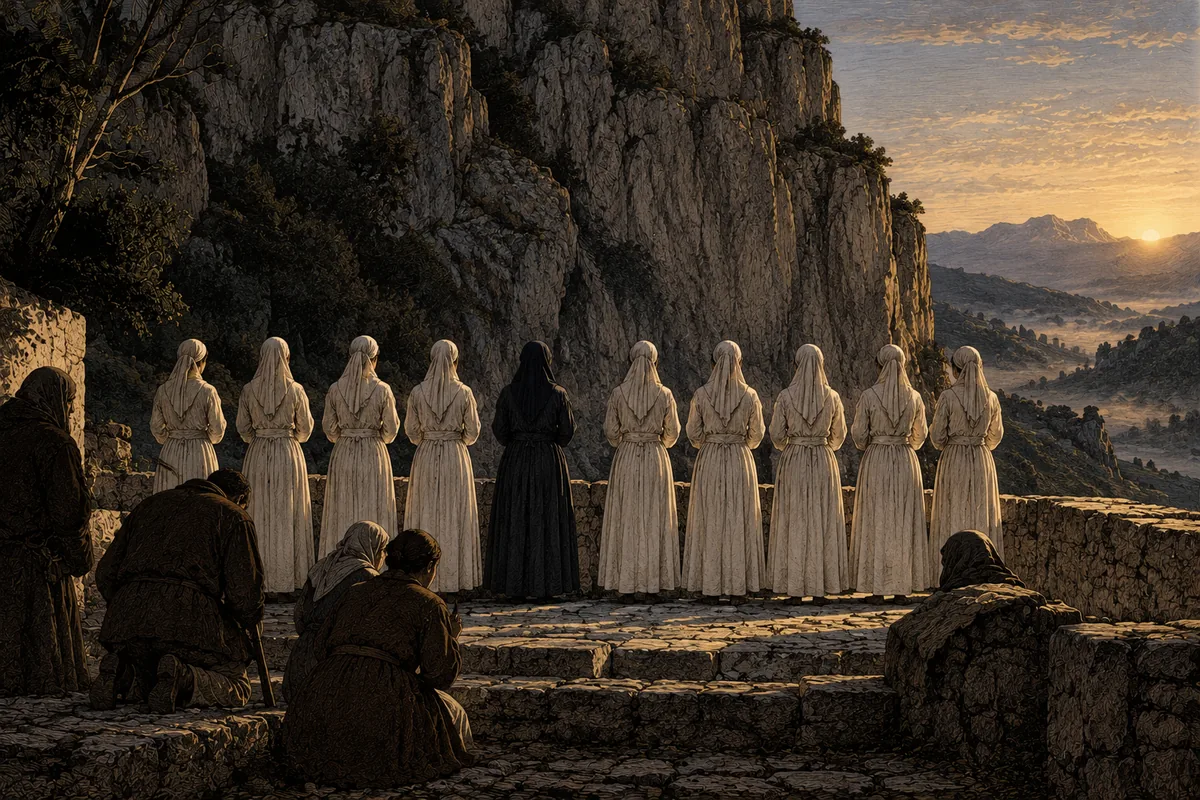
Il Pianto delle Zitelle — at dawn on the Sunday after Pentecost, on the terrace below the Tagliata cliff, unmarried young women in white — one alone in dark dress, the Madonna — sing short solo arias on the Passion, alternating with fragments of a vernacular Miserere performed by a trio.
- Variants and dialect names
- Il Pianto delle Zitelle, the weeping of the unmarried girls; the solo arias are i Misteri; the singers are called zitelle
- What is told
- At dawn on the Sunday after Pentecost, on the terrace below the Tagliata cliff, unmarried young women in white — one alone in dark dress, the Madonna — sing short solo arias on the Passion, alternating with fragments of a vernacular Miserere performed by a trio. What defines it is not the lament: it is the alternation between solo aria and vernacular Miserere, entrusted to singers chosen by marital status and by voice, at dawn and in the open, closing the pilgrimage.
- What it was forthe author’s reading
- To close the pilgrimage with a song the village owns and that outsiders come to hear. Around the song stands a set of gestures: the carrying of boughs, the throwing of stones from the bridges, the comparatico with hands joined in the water, and walking backwards at the start of the path.
- Where it is attested
- The documentary chain is long and can be walked end to end: a manuscript booklet of 1836 with the Misteri and the vernacular Miserere, declared a copy of an original transcribed by Francesco Tozzi around 1700; Luigi Colacicchi, «Il Pianto delle Zitelle», Lares VII, 2, 1936; and the film Il pianto delle zitelle by Giacomo Pozzi-Bellini, 1939, 19 minutes, screenplay by Emilio Cecchi, photography by Angelo Jannarelli, produced by Lumen Veritas (Cineteca di Bologna record). ICPI record (Ministry of Culture), 26 May 2020, text by E. De Simoni; brochure of the Museo della Civiltà Contadina della Valle dell'Aniene, Roviano, 2016.
- Caution
- The 1836 manuscript and the Tozzi transcription are known to me from the Roviano museum brochure, which gives neither shelfmark nor place of deposit: they must be seen. The title of the volume edited by Simeoni appears as 1881-2006 in one source and 1821-2006 in another, and the discrepancy is unresolved. The film's musician is «Luigi Colacchi» in the Cineteca credits and «Luigi Colacicchi» in the brochure: probably a misprint, not verified. To be discarded: the lauda «of the twelfth century» (no thirteenth-century witness is ever indicated), the pre-Christian origin on Monte Autore, the ritual requirement of virginity for the singers — the sources I have read speak of selection by voice, availability and family — and the film «banned by the Fascist regime», which confuses a reworked version with a prize at Venice in 1939.
The grade says how well the entry is documented, not how interesting it is. How the grades are assigned.