Àbíkú
Nigeria
Yoruba area of south-western Nigeria; first documentation from the mission station at Abeokuta
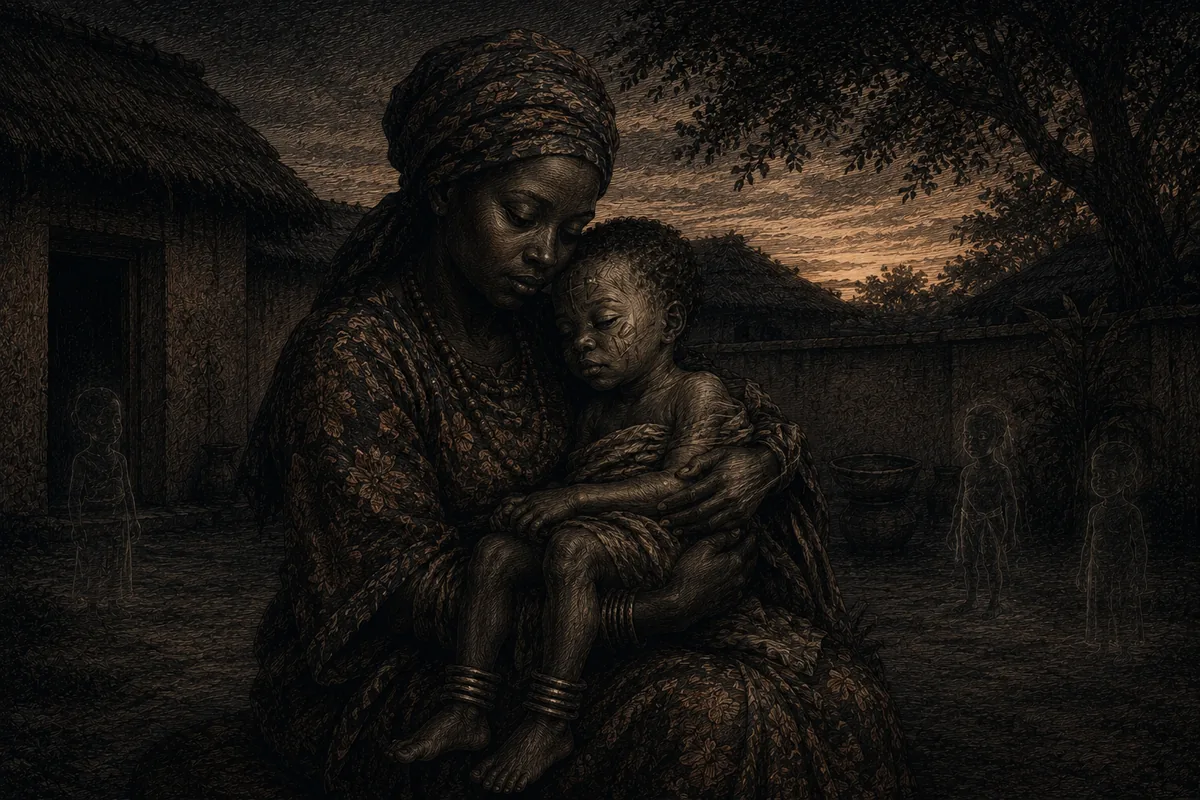
Àbíkú — a child who belongs to a company of spirits with which it has made a pact of early return: it dies small and re-enters the same womb, in order to die again.
- Variants and names
- Yoruba àbíkú, segmented à-bí-kú, «born to die» (bí to be born, kú to die); the alternative etymology proposed in the nineteenth century derived it from abi «that possesses» and ikú «death». Igbo ọgbanje, «who comes and goes». The complex recurs throughout West Africa — Ewe-Fon, Akan and Voltaic areas — with vocabularies of its own
- What is told
- A child who belongs to a company of spirits with which it has made a pact of early return: it dies small and re-enters the same womb, in order to die again. The family answers with names that are public contracts — Málọmọ «do not go away again», Kòkúmọ́ «this one will not die again», Dúrójaiyé «stay and enjoy life», Bánjókó «sit with me», Kòsókó «there is no hoe», that is there is not even the tool to dig your grave. At death there is no funeral, and the body is marked or mutilated: if the mark reappears as a birthmark on the skin of the next child born, it will be him, and he has come back. The marking is not cruelty: it is a criterion of recognition.
- What it was forthe author’s reading
- It gives a name to a bereavement that repeats itself, shifts the responsibility from the mother to the spirit, and supplies a protocol complete with verification. It is at once a popular diagnosis of the chronically ill child and a social structure for families that buried many children.
- Where it is attested
- The term enters missionary lexicography with Samuel Àjàyí Crowther, A Vocabulary of the Yoruba Language, 1843, enlarged edition 1852. The first extended ethnographic description is A. B. Ellis, The Yoruba-Speaking Peoples of the Slave Coast of West Africa, 1894, chapter VI, which records the etymology, the iron rings and the bells at the ankles, the incisions made on the body of the living child and filled with pepper to make the guest spirit suffer, and the marking of the corpse. Modern studies: Timothy Mobolade, African Arts, 1973; Chukwudi Maduka, 1987; Sunday Ilechukwu, 2007. In literature: J. P. Clark, Abiku, 1965; Wole Soyinka, Abiku, in Idanre and Other Poems, 1967; Chinua Achebe, Things Fall Apart, 1958, for the ogbanje and for the iyi-uwa stone; Ben Okri, The Famished Road, Booker Prize 1991.
- Caution
- The current equation between àbíkú and ọgbanje is convenient and imprecise, and it is in part an artefact of English-language mediation: the àbíkú is centred on the child who dies, whereas the ọgbanje extends to adults — often women — who survive while bringing miscarriages and infertility, and possesses a material device, the iyi-uwa, the buried stone that anchors the spirit to the world and that the healer has the child itself dig up: something which in the Yoruba area does not exist. Ellis, it must be said, was a colonial officer and wrote of «superstitions», but the details he reports coincide with later research. Two further corrections: the àbíkú is not a changeling, because it does not replace another child — it is that child, and the European calque belongs to the translators; and it is not extinct folklore, but an active category, today renegotiated between Pentecostal churches and clinics. Okri, finally, reworks: he is not an ethnographic source.
The grade says how well the entry is documented, not how interesting it is. How the grades are assigned.