Black Shuck
the United Kingdom
East Anglia: Norfolk, Suffolk, Essex, with offshoots in Cambridgeshire
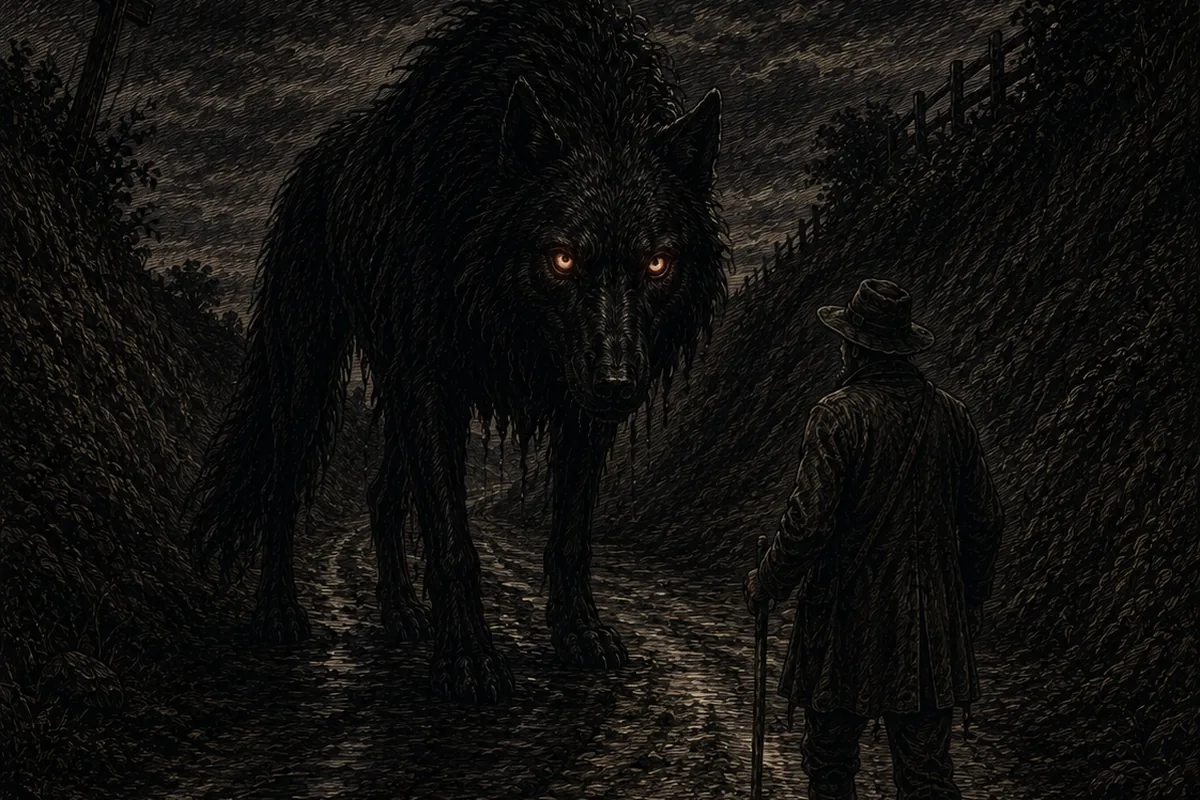
Black Shuck — enormous black dog, often as big as a calf, with eyes burning like coals and in some versions a single eye.
- Variants and names
- Black Shuck, Old Shuck, Old Shock, the Shuck; local variants Skeff in northern Norfolk, Shug Monkey in Cambridgeshire; English parallels Barghest, Padfoot, Gytrash, Church Grim
- What is told
- An enormous black dog, often as big as a calf, with eyes burning like coals and in some versions a single eye. He travels country lanes, embankments, churchyards and the coast, running in silence or with a heavy tread, and to meet his gaze means being marked for death within the year. In a minority of accounts, above all on the Norfolk coast, he is instead benign and accompanies the solitary traveller home before vanishing.
- What it was forthe author’s reading
- An omen of death and a discipline of rural night-time space, with the implicit injunction not to linger on the roads and not to cross churchyards. In the coastal area it carries the anxiety about the sea and about shipwrecks; more generally the black dog is a pan-British category that marks boundaries, parochial ones and those between the living and the dead.
- Where it is attested
- On 4 August 1577 at Bungay and Blythburgh, in Suffolk, during an extremely violent thunderstorm a black dog burst into the church of St Mary killing two of the congregation, and at Blythburgh scorch marks remain on the door, still shown to visitors; the episode is narrated in the pamphlet of the Reverend Abraham Fleming, A Straunge and Terrible Wunder, 1577. East Anglian folklore collections of the nineteenth and twentieth centuries, among them the work of the antiquary Walter Rye and the contributions published in the journal Folklore; classic comparative survey in Theo Brown, «The Black Dog», Folklore, 1958.
- Caution
- Fleming writes a sensationalist printed pamphlet with a homiletic purpose, in which the dog is an agent of divine wrath, not an ethnographic collection, and he does not use the name Shuck: the name is attested in the East Anglian folklore collections of the 19th century, which is when the figure takes firm shape. Treating 1577 as the first attestation of Black Shuck is a very common and inexact shortcut, and for this reason the event receives grade B. I have not been able to confirm in a primary source who first connected the Bungay episode to the name, nor the first occurrence in print of the name itself. The identification with the canine skeleton found in 2014 at Leiston Abbey, widely circulated by the press, has no serious archaeological support.
The grade says how well the entry is documented, not how interesting it is. How the grades are assigned.