Boto cor-de-rosa
Brazil
Middle and lower Amazon, ribeirinha communities; documentary core at Tefé and in the Mamirauá reserve
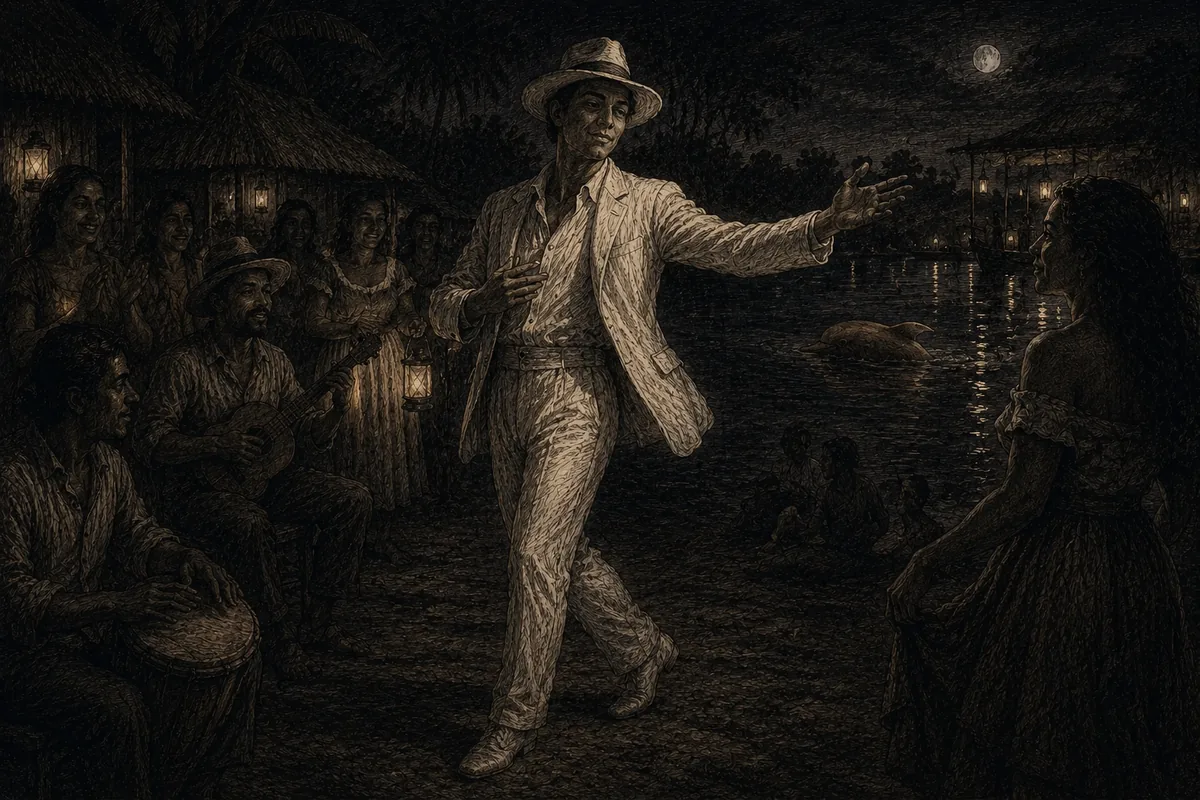
Boto cor-de-rosa — at village festivals a most elegant young man appears, dressed in white, who never takes off his hat — because beneath it is the blowhole.
- Variants and names
- boto, boto cor-de-rosa, boto-vermelho: the river dolphin Inia geoffrensis, not to be confused with the tucuxi (Sotalia fluviatilis), a distinct species. In the tale he is an encantado, and the world beneath the river is the Encante
- What is told
- At village festivals a most elegant young man appears, dressed in white, who never takes off his hat — because beneath it is the blowhole. He dances all night, seduces, leads the woman to the river and vanishes before dawn. Hence the custom of asking a stranger to uncover his head. The oldest form is considerably harsher: the encantado does not court, he abducts; he takes the person into the Encante and does not give her back, and whoever is touched by him falls ill, raves, wastes away, and the pajé is needed to fetch her back. The gallantry is the late, festive version.
- What it was forthe author’s reading
- To attribute a paternity imputable to no man of the village, protecting at once the woman, the child and social peace; to sustain a food taboo that in practice spared the animal; to give form to the danger of the river and of sudden illness.
- Where it is attested
- There is no colonial attestation of the seducing boto: the documentary line is nineteenth-century. Henry Walter Bates, The Naturalist on the River Amazons, 1863, records beliefs about the boto including female forms; Barbosa Rodrigues, Poranduba Amazonense, 1890, gathers the corpus in Nheengatu; then Câmara Cascudo, 1947 and 1954. The standard academic study is Candace Slater, Dance of the Dolphin, University of Chicago Press, 1994. The Universidade Federal do Pará project on the Amazonian imaginary has recorded more than five thousand three hundred narratives in Pará: in a sample from the middle and lower Amazonas, a third of the stories collected concern botos.
- Caution
- Grade A for the animal and for the twentieth-century recording, which is of the first order; the historical depth of the narrative is more fragile, and has no attestations earlier than the nineteenth century — the white suit, the hat and the June festival are Luso-Brazilian strata. One point must be stated in full, because it is delicate: «son of the boto» is a formula genuinely in use for children of undeclared fathers, and it is the most solid datum in the entry; researchers from Pará and the judiciary of Pará document, however, that the same formula has served to cover up rapes and incest. Those same researchers warn that reducing the myth to a cover for abuse is an error: the narrative belongs to a cosmology in which humans, animals and plants share an essence, and it predates that use. Datum, use and origin must be kept on three separate lines.
The grade says how well the entry is documented, not how interesting it is. How the grades are assigned.