Each-uisge
the United Kingdom
Scotland: western Highlands and Hebrides, sea and sea lochs
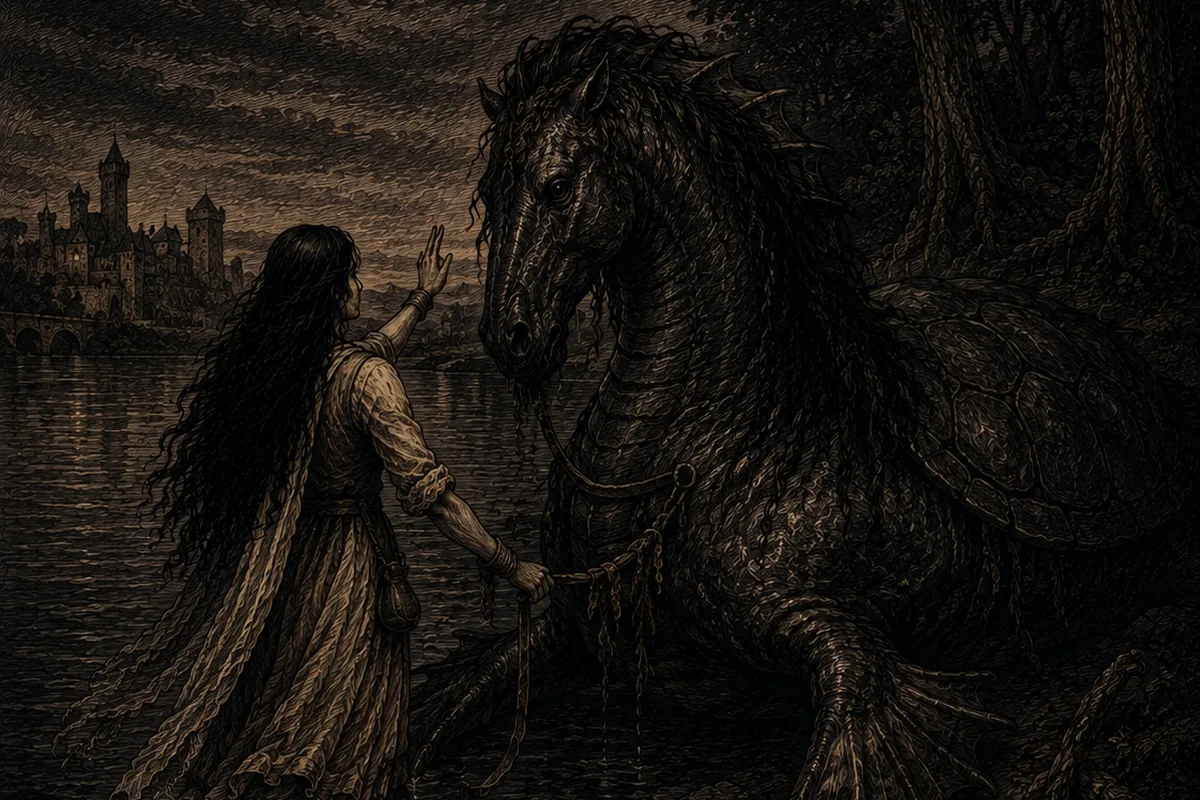
Each-uisge — Katharine Briggs calls it perhaps the fiercest and most dangerous of all the water horses.
- Variants and names
- each-uisge in Scottish Gaelic, literally water horse; each uisce or aughisky in Ireland; cabbyl-ushtey on the Isle of Man
- What is told
- Katharine Briggs calls it perhaps the fiercest and most dangerous of all the water horses. It appears as a magnificent horse and, once mounted, at the first sight of water sets off at a gallop towards the loch while its skin turns adhesive, so that the rider cannot pull free. After the drowning it devours everything except the liver, which floats back up, a diagnostic detail that in the legends allows the villagers to understand what has happened. In human form it is a handsome young man recognisable by the weed, sand or mud in his hair; it has a preference for women and is vulnerable to silver and to separation from the water.
- What it was forthe author’s reading
- As with the kelpie, but with greater emphasis on the danger of the sea and of the deep lochs in island and coastal communities, and on the risk to livestock led down to drink. The motif of the liver has a precise narrative function: it makes the danger verifiable and gives the community a legible sign.
- Where it is attested
- John Gregorson Campbell, Superstitions of the Highlands and Islands of Scotland, 1900, which systematically distinguishes the river kelpie from the loch- and sea-dwelling each-uisge; J. F. Campbell, Popular Tales of the West Highlands, 1860-62; Katharine Briggs, A Dictionary of Fairies, 1976. A recurrent and well attested local legend is that of the girls carried off on the loch, in which one little girl saves herself by cutting off the fingers that have stuck fast. Transparent etymology: each, horse, and uisge, water, the same root as whisky.
- Caution
- The connection between the water-horse traditions and the modern complex of the Loch Ness monster is retrospective and media-driven, from 1933 onwards, and not traditional: as folkloric continuity it is to be classified C. The distinction is also to be maintained, not always respected by popularising sources and already confused by Walter Scott, between the loch- and sea-dwelling each-uisge and the river kelpie.
The grade says how well the entry is documented, not how interesting it is. How the grades are assigned.