Necronomicon
Literary invention
Autore fittizio citato nel gennaio 1921 · titolo nel settembre 1922, edito febbraio 1924
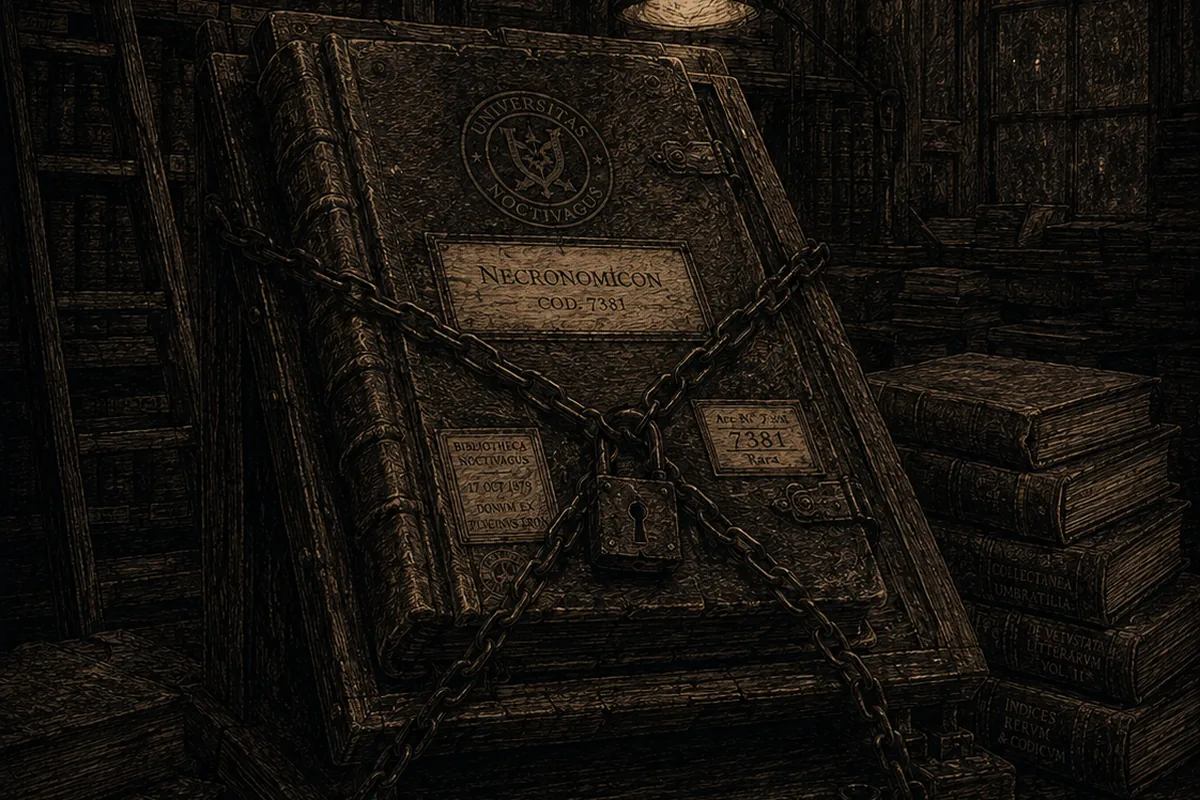
Necronomicon — the most famous forbidden book in literature, equipped with a complete and entirely invented bibliographical line of descent: an Arabic original around 730, a Greek translation of 950, a Latin translation of 1228, placement on the Index, Gothic and Spanish editions, surviving copies at Harvard's Widener, the Bibliothèque Nationale, the British Museum and the non-existent Miskatonic University.
- First appearance
- Attributed to Abdul Alhazred. False bibliographical history in History of the Necronomicon, written 1927, published posthumously 1938.
- What is told
- The most famous forbidden book in literature, equipped with a complete and entirely invented bibliographical line of descent: an Arabic original around 730, a Greek translation of 950, a Latin translation of 1228, placement on the Index, Gothic and Spanish editions, surviving copies at Harvard's Widener, the Bibliothèque Nationale, the British Museum and the non-existent Miskatonic University.
- In the corpus
- The apparatus of verisimilitude is deliberate and is the real content of the text. Lovecraft stated that he found inventing mythical books more entertaining than using genuine occult literature.
- Publication data
- The name of the fictitious author appears in The Nameless City, written in January 1921; the title of the book in The Hound, written in September 1922 and published in «Weird Tales» in February 1924.
- Caution
- «Abdul Alhazred» is not correct Arabic: it juxtaposes two incompatible definite forms. It is the invention of an anglophone boy, not a transliteration. The so-called Simon Necronomicon of 1977 is a Sumero-Akkadian pastiche with Crowleyan grafts, judged a well-constructed forgery by the historian of magic Owen Davies.
The grade says how well the entry is documented, not how interesting it is. How the grades are assigned.