Wampus cat
the United States
Southern Appalachia and the Ozarks
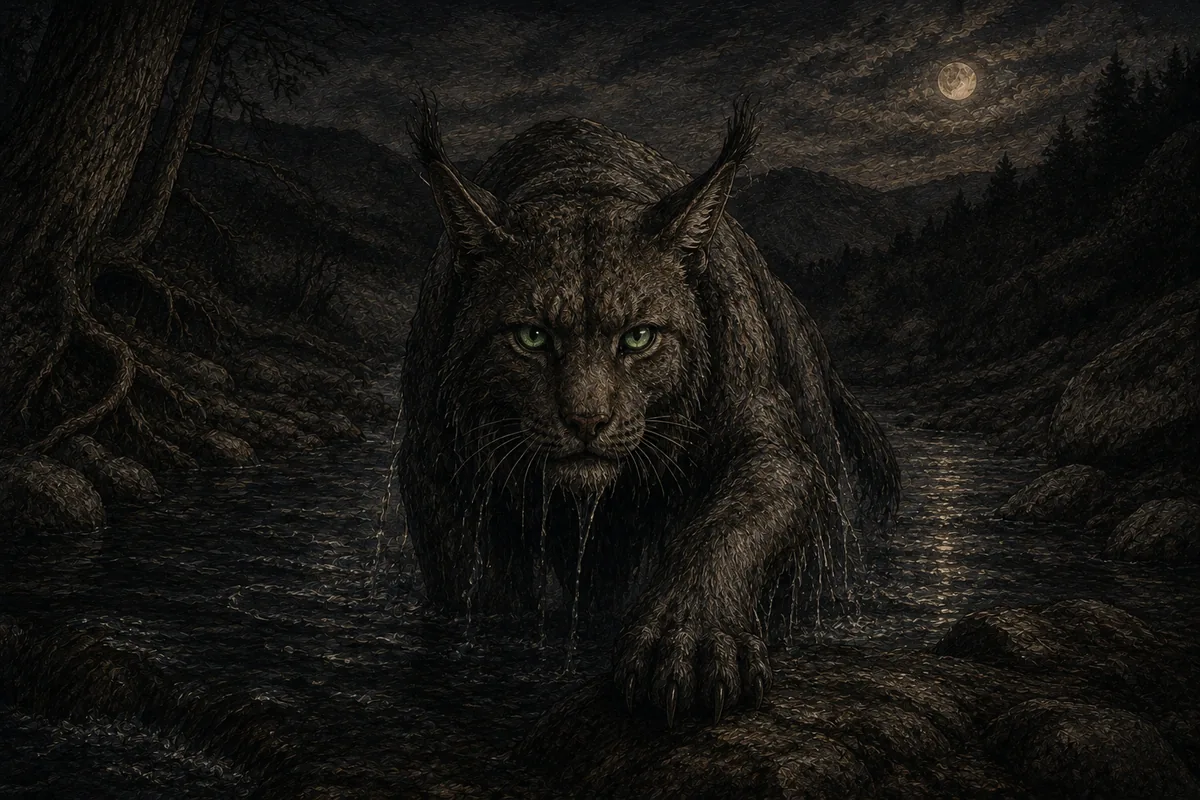
Wampus cat — an enormous cat, between a cougar and a lynx, with glowing green or yellow eyes and a scream like that of the cougar; in some versions it has six legs.
- Variants and names
- wampus cat; gallywampus in Missouri; whistling wampus in the Ozarks; catawampus and catawumpus, older forms
- What is told
- An enormous cat, between a cougar and a lynx, with glowing green or yellow eyes and a scream like that of the cougar; in some versions it has six legs. Newspaper descriptions of the 1930s go as far as several metres in length and eyes «like little moons». Vance Randolph in 1951 records it as a sort of amphibious panther that dives into the water and swims like a colossal mink, that is as material for a tall tale and not as serious belief.
- What it was forthe author’s reading
- Originally it is not a creature of belief at all: it is a generic dialect term for a frightening imaginary beast used to scare children, and it is material for the tall tale, the genre of comic frontier boasting. Only in the late twentieth century does it acquire a narrative biography within the cryptid circuit, with an identity and tourist function.
- Where it is attested
- The Oxford English Dictionary attests catawumpus as American slang of the nineteenth century, defined as «a bogy, a fierce imaginary animal»; attestations in the publications of the American Dialect Society; Vance Randolph, Ozark collections, 1951; Knoxville News-Sentinel, 1936. Conway High School in Arkansas adopts the mascot in 1922.
- Caution
- The version dominant today, that of the Cherokee woman transformed as a punishment after spying on the men's rites covered by a cougar skin, is not documentable before the end of the twentieth century and goes back to an online horror forum around 2003. It is a modern assemblage that grafts genuine Cherokee elements onto a pre-existing anglophone dialect term, and it is not to be treated as a Native tradition. The term and the bogeyman function would deserve a B, but the entry as an «Appalachian folklore creature» is C. The dating to 2003 comes from an argued reconstruction of regional history, not from a peer-reviewed study: it should be taken as indicative.
The grade says how well the entry is documented, not how interesting it is. How the grades are assigned.