Yee naaldlooshii
the United States
Navajo Nation, Colorado Plateau (north-eastern Arizona, north-western New Mexico, south-eastern Utah)
Yee naaldlooshii — this entry deliberately describes the ethnographic context and not the narrative content.
- Variants and names
- Diné bizaad yee naaldlooshii, «with it, he goes on all fours»; the wider category ánt'įįhnii, the practitioners of the Witchery Way; the English skin-walker is a late and imprecise rendering
- What is told
- This entry deliberately describes the ethnographic context and not the narrative content. In the Diné community speaking of it is an active taboo, not a narrative convention: many Diné do not utter the term and do not discuss the subject with non-Natives. This is not a creature of folklore but witchcraft, that is a real social accusation which has had and has real consequences for real people; the European equivalent is not the werewolf but the witchcraft trial. Structurally the figure is the symbolic inverse of the hataałii, the singer and healer: the same ceremonial knowledge, the opposite orientation. Analogous but distinct traditions exist among the Ute, Hopi, Apache and Pueblo and are not to be merged into a single entry.
- What it was forthe author’s reading
- A negative definition of the moral order: the figure marks what a person must not be, that is greed, violence against kin, use of ceremonial knowledge for oneself. Historically the accusation of witchcraft has also been an instrument of conflict internal to the community, with documented episodes of violence, and it should be read in that frame and not in a picturesque folkloric key.
- Where it is attested
- Clyde Kluckhohn, Navaho Witchcraft, Peabody Museum, Harvard, 1944, reprinted by Beacon Press in 1962, remains the classic ethnographic source, together with the later anthropological literature on the relationship between the Witchery Way and the ceremonial system. There are no public festivals or rites connected with it, and the question itself is badly put: the Diné ceremonies that counter it are living religious practices and not material for a folklore entry aimed at outsiders.
- Caution
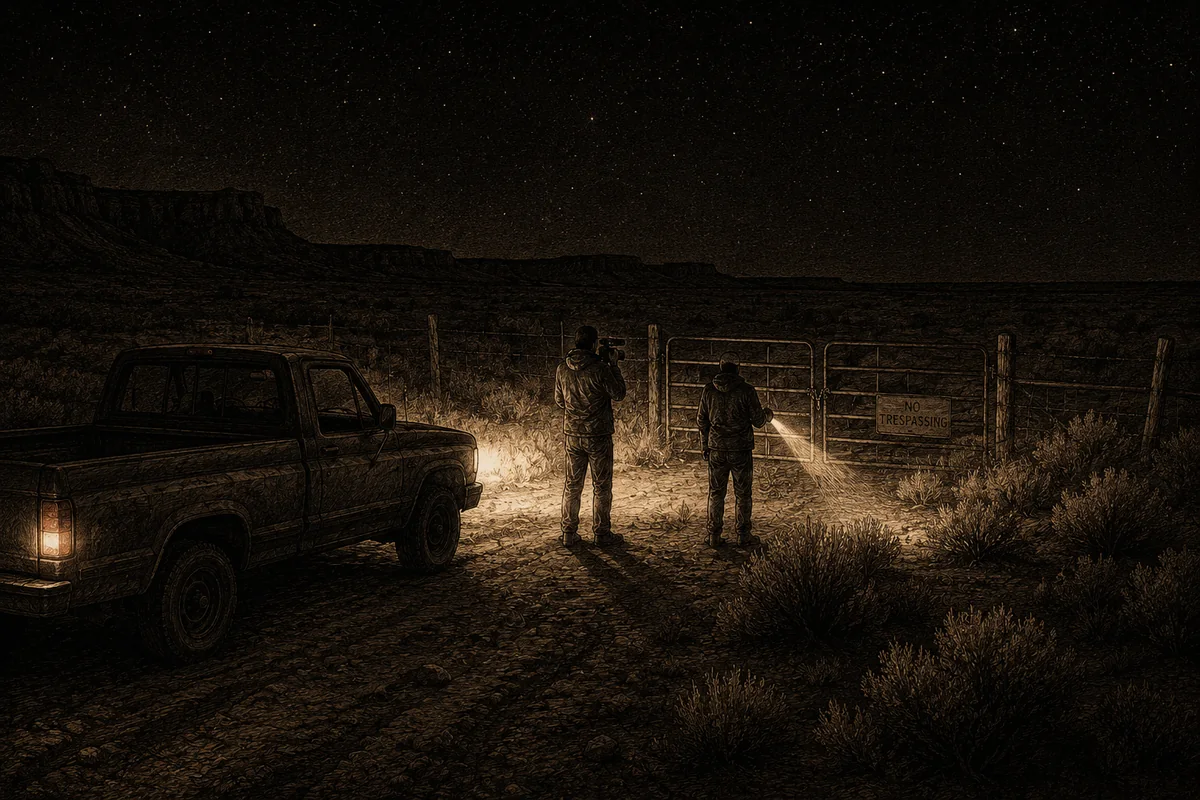
- Why this entry gives the context and not the story. It is not a choice made out of deference, it is a consequence of the method: about 95 per cent of what circulates in English is grade C. The standard format of the night-time encounter in a car does not exist in traditional Diné narrative: it is an anglophone internet genre born on forums and creepypasta and amplified by podcasts, by Skinwalker Ranch and by television. To report it would mean reporting that — not the tradition.
There is also an argued ethical position, and it is worth knowing: the Cherokee scholar Adrienne Keene maintains that spreading these stories out of context is appropriation, because outsiders lack the cultural frame in which the stories sit. I report it because it exists and is discussed, not because this site adopts it: the criterion applied here remains the usual one — what is documented is published and what is not is declared as such.
The classic ethnographic source, Clyde Kluckhohn, Navaho Witchcraft, Peabody Museum, Harvard, 1944, is to be used in the knowledge of two things: it is the work that made the complex accessible to study, and the way in which he gathered data on a subject that is an active taboo in the community is the object of methodological discussion. These are two facts, not a verdict.
Grade A would hold for the ethnographic existence of the complex alone; the entry as a whole is classified C because that is how the material presents itself in public circulation.
The grade says how well the entry is documented, not how interesting it is. How the grades are assigned.