The Misteri of Campobasso
Molise · Central Apennines and the Adriatic
Campobasso; the machines are kept in the Museo dei Misteri, via Trento
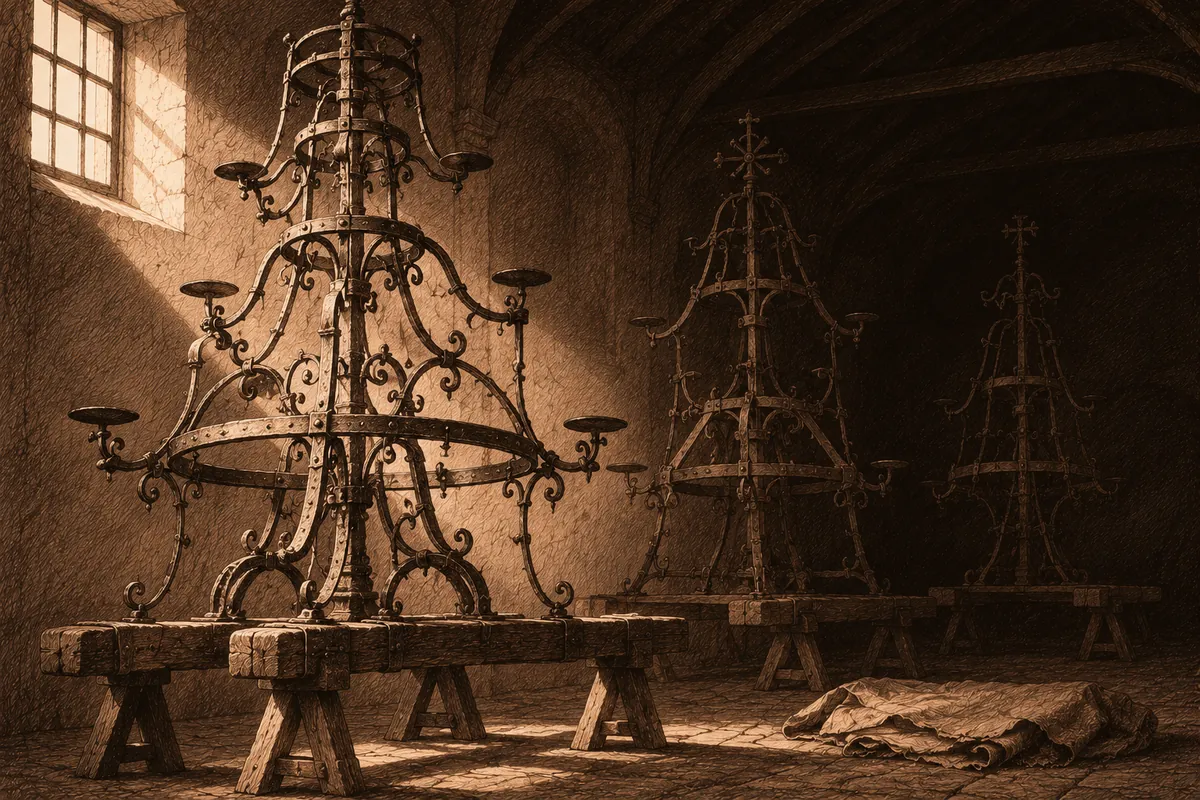
The Misteri of Campobasso — thirteen eighteenth-century wrought-iron structures with seventy-six people strapped onto them, fifty-eight of them children, plus a lamb and a dog: carried out on shoulders on Corpus Christi.
- Variants and dialect names
- the machines are called ingegni, engines, and that is the right technical word: they are load-bearing structures, not statues. Misteri is the name of the scenes they represent
- What is told
- Thirteen structures of wrought iron, designed in the eighteenth century by the Campobasso sculptor Paolo Saverio Di Zinno. On each of them stand real people, strapped to the frame and suspended in mid-air in postures that from the ground look impossible: saints, angels, devils.
In all there are seventy-six figures, and fifty-eight are children. Besides them there go up, on their own machines, a lamb and a small dog: live animals, part of the scene.
Each engine weighs, according to the men who carry it, between four and six hundred kilos, stands between four and six metres high and needs twelve to eighteen bearers. Altogether the procession puts some two hundred bearers in motion along a route of about three and a half kilometres through the streets.
They come out once a year, on Corpus Christi, which is a movable feast. The rest of the year they are in a museum. - What it was forthe author’s reading
- The Corpus Christi procession. But the reason this entry belongs in an atlas of documented folklore is a different one, and almost the opposite of what one would expect: there is nothing anonymous and nothing immemorial here. There is a designer with a first and last name, a material (wrought iron), an owner (the town of Campobasso), a museum, a liturgical calendar and two hundred people who organise themselves every year to lift half a ton apiece.
And on top of this perfectly dated and attributed object a different story has settled: that the Misteri descend from Samnite rites, that the procession continues something pre-Roman. None of the sources read supports that descent, and a doctoral thesis takes it on in order to dismantle it. The interesting fact is not the ancient origin: it is why a community should need to claim one, when it already has an author, a date and a museum. - Where it is attested
- Antonella Rubino, doctoral thesis, Università degli Studi del Molise, XXIX cycle, on the Misteri of Campobasso: read as far as p. 26, and no further. That is where the critical discussion of the supposed Samnite continuity is, and that is where this entry's caveat comes from. The rest of the thesis was not opened.
For the material description — number of engines, figures, animals, weights, heights, bearers, length of the route — the source is the documentation of those who own and organise: the town of Campobasso, which owns the machines, and the Museo dei Misteri, which keeps them. It must be said for what it is: these are the organisers' figures, not those of an independent survey, and they were not checked here by measuring. The ranges — 400-600 kg, 4-6 m, 12-18 bearers — are reported as ranges, because that is how they are given.
No commissioning document was located and no monograph on Di Zinno was opened. - Caution
- The date of construction is not written here. Everywhere one reads 1740, but the commissioning document was not located and none of the sources read cites it by shelfmark. What stands is that the engines are Di Zinno's work and of the eighteenth century; the precise year is something to be looked for in an archive, and until it is found it is not printed.
The harness is not described. How exactly the people — and above all the children — are secured to the frame is the question everybody asks, and none of the sources read documents it. Any description would be invented, so there is none.
The coordinates are those of Campobasso, not the starting point of the procession, which changes and was not surveyed.
Samnite continuity is not a minority thesis: it is a thesis without sources. It circulates in popular and tourist material. It is flagged here to warn whoever meets it, not to argue with it.
To be opened in order to improve this entry, best return first: the rest of the Rubino thesis beyond p. 26; the historical archive of the town of Campobasso for the eighteenth-century commission; and an ICCD catalogue record on the engines, if one exists — it was not looked for.
The grade says how well the entry is documented, not how interesting it is. How the grades are assigned.