The Maggio of Accettura
Basilicata · Appennino centro-meridionale
Accettura (province of Matera), Basilicata; the maggio comes from the wood of Gallipoli Cognato, the crown from a wood at the opposite end of the municipal territory
The Maggio of Accettura — it is not a planted maypole: it is a tree composed of two trees of different species, from two opposite woods, mechanically joined.
- Variants and dialect names
- il Maggio, Maggio di San Giuliano; the two parts are il maggio, a Turkey oak trunk, and la cima, a holly crown
- What is told
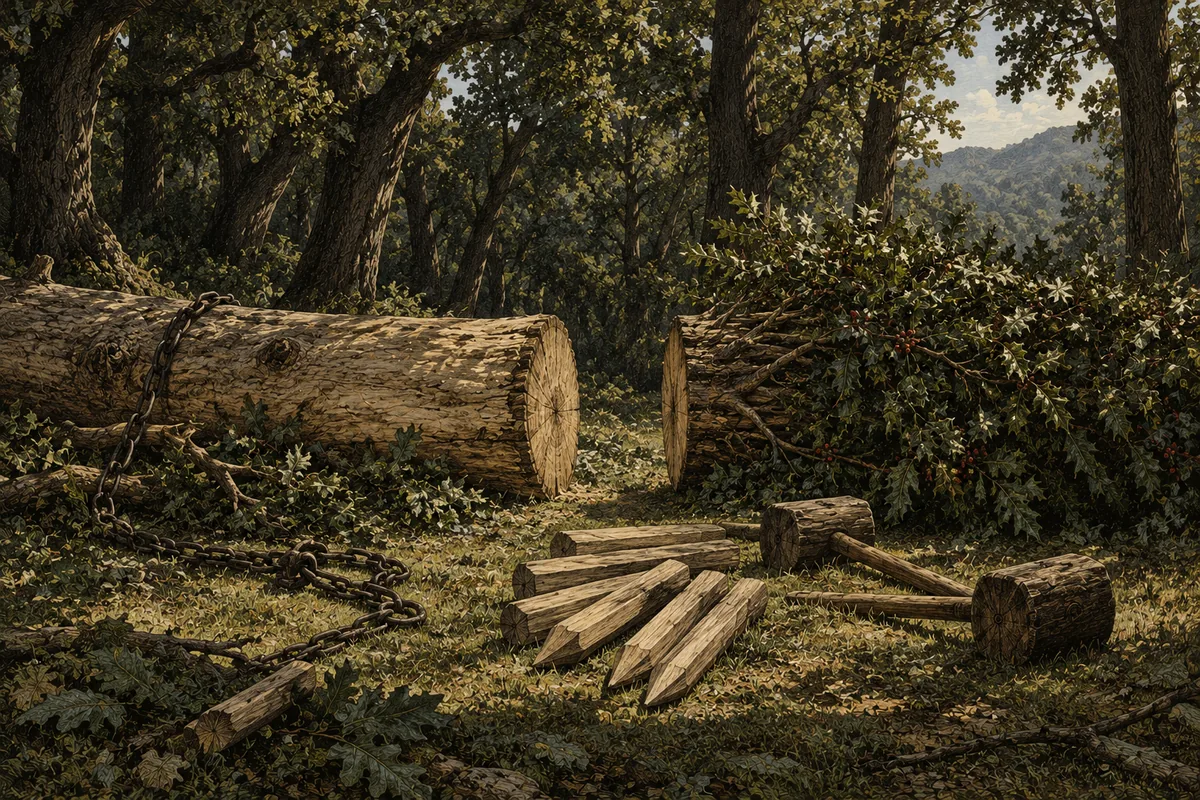
- It is not a planted maypole: it is a tree composed of two trees of different species, from two opposite woods, mechanically joined. On Ascension Thursday the oaks are felled; on Saturday oxen drag the trunks towards the village; on Sunday the holly crown is cut and carried by hand for hours; on Tuesday maggio and crown are grafted with large wooden pegs and the recomposed tree is hoisted in the square with winches, then climbed by the young men. On Corpus Christi Sunday it is auctioned and dismantled.
- What it was forthe author’s reading
- Metal tags with offerings — cheese, cured meats, live animals — were fixed to the branches, once a target for gunfire. The rite holds together two woods, two work gangs and two timescales, and ends in a sale: it is a liturgy of common possession rather than of fertility, whatever the captions say.
- Where it is attested
- Giovanni Battista Bronzini, Accettura: il contadino, l'albero, il santo, Galatina, Congedo, 1977 — and note the publisher, because a form «Dedalo 1979» circulates online and is wrong. By the same author, Tradizioni popolari in Lucania, Matera, Montemurro, 1953. Recent ethnography: Lorenzo Ferrarini and Nicola Scaldaferri, Sonic Ethnography, Manchester University Press, 2020, pp. 21-23; M. Corbella, «I suoni dell'albero», Visual Ethnography 2 (2), 2013.
- Caution
- Grade A for the convergence of independent sources — an Italian demological monograph, a British university sonic ethnography, an article in visual anthropology — but I have opened none of the three, and I have no field collection date: that is this entry's declared limit. To be discarded: the «Lombard origin» dated to the seventh century, repeated as a scholars' reading and never as a document; the «35 metres» given as a fixed measure; and above all «the marriage of the trees» as a traditional name, which from what I have read appears to have been born from a primary-school activity of 1961 and which the participants will not use.
The grade says how well the entry is documented, not how interesting it is. How the grades are assigned.