The snake handlers of Cocullo
Abruzzo · Central Apennines and the Adriatic
Cocullo (L’Aquila), at 897 metres, in the inner Abruzzo Apennine; about thirty kilometres from the Fucino
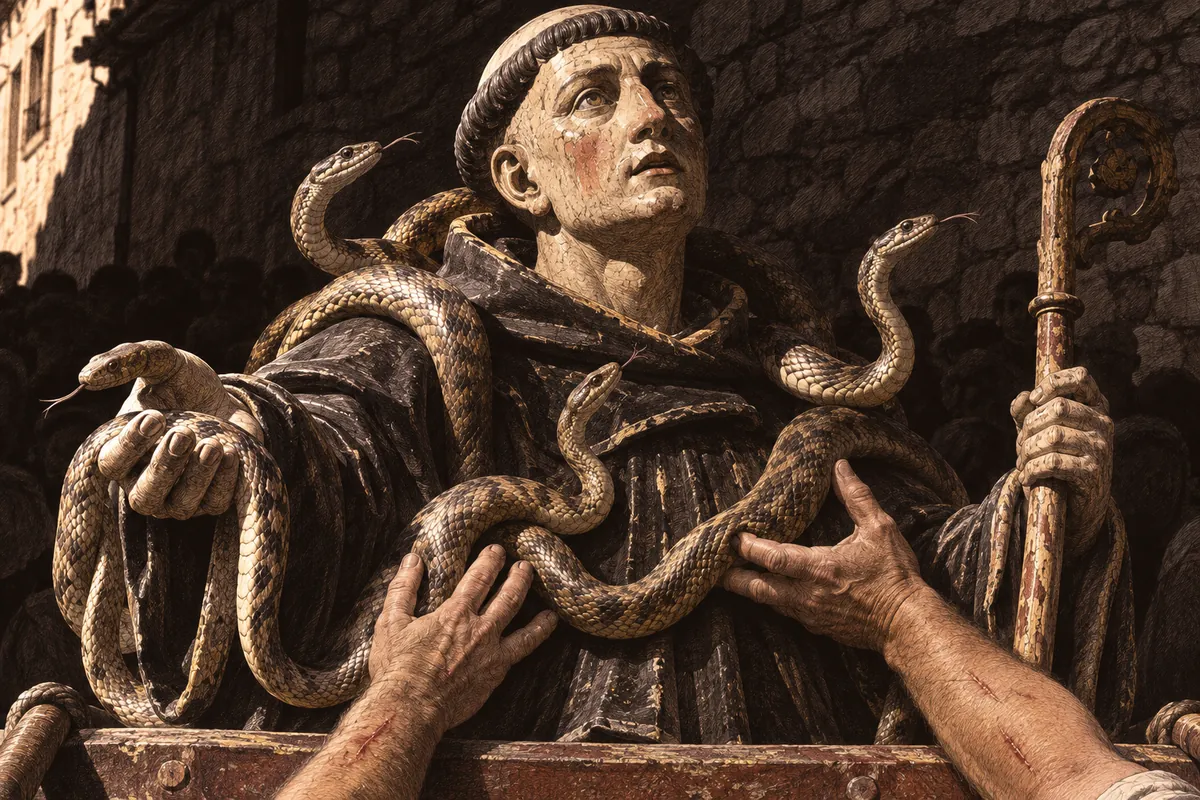
The snake handlers of Cocullo — the statue covered with live snakes, and the goddess Angitia everyone puts behind it: but in the Aeneid the charmer is Marruvian and Angitia is only a grove named in a lament.
- Variants and dialect names
- the man who carries the snakes is the serparo, plural serpari. In the state catalogue the denomination is Festa di San Domenico a Cocullo. The present date is 1 May; earlier it was the first Thursday of May, but that notice comes from a weak source
- What is told
- The statue of Saint Dominic the Abbot carried in procession, covered with live snakes that local men have collected in the preceding weeks and keep on their bodies.
The saint is Dominic of Sora, an eleventh-century abbot, and at Cocullo he is invoked against snakebite. But — and this is the point of the entry — that was not his original trade. - What it was forthe author’s reading
- The version in circulation is a straight chain: the goddess Angitia, a Marsian divinity connected with snakes, then Saint Dominic taking her place, and an unbroken continuity of three thousand years. The three scholars who have worked on this cult reject it.
And the thesis they put in its place is concrete and counter-intuitive. According to the study devoted to the problem, Saint Dominic's patronage does not arise against snakes: it arises as protection against fevers, and against rabid dogs and the wolf. The anti-bite use at Cocullo would be a secondary metamorphosis, explained by the presence of a powerful relic — a molar tooth of the saint — and not by anti-ophidian episodes in the saint's life, nor by correspondences with the Marsian cultural world.
But the most useful part requires believing no scholar at all, because it can be checked in ten minutes. The ancient source everyone invokes is the Aeneid, book VII — and it does not say what it is made to say. There:
— the snake charmer is Umbro, priest of the Marruvian people, sent by king Archippus (vv. 750-752). Marruvium, not Cocullo;
— he lulls vipers and water-snakes with song and with his hand, and eases their bites by his art (vv. 753-755);
— Angitia appears once only, and as a place, in a funeral lament, beside the Fucine lake:
«te nemus Angitiae, uitrea te Fucinus unda,» — Aeneid VII, 759.
So: the Marsian charming is attested, but it is Marruvian and Fucine; Angitia is not presented as a goddess of snakes; and of processions there is no mention at all. Cocullo is some thirty kilometres from the Fucino, in the Paelignian-Marsian border area.
The interesting fact, then, is not the ancient origin: it is that somebody built that chain, and when. - Where it is attested
- Review in AM. Rivista della Società italiana di antropologia medica, 7-8, 1999, Reviews section, pp. 390-392, open access. It is from here, and only from here, that Profeta's thesis is known: the book was not opened. The author of the review is not attributed, for the reason explained in the note.
Giuseppe Profeta, Il serpente sull'altare…, L'Aquila-Rome, Japadre, 1998, 223 pp. Not opened, and these bibliographic data come from the card inside the review, not from a library catalogue: to be confirmed on OPAC SBN before being cited again.
Virgil, Aeneid VII, 750-760, read verse by verse in the Dickinson College online commentary, edited by Christopher Francese and Meghan Reedy. It is the only source in this entry genuinely read to the letter, and the only one quoted from.
Muzio Febonio, Historiae Marsorum libri tres, in the facsimile reprint edited by Walter Capezzali and Pietro Smarrelli, L'Aquila, Fondazione Carispaq, 2012. Opened and useless for the purpose: the text layer of the PDF contains only the presentation, introduction and a biographical essay; the pages of the Historia are images and cannot be read.
Publication list of Lia Giancristofaro, University of Chieti-Pescara, institutional page: read for the bibliographic data. From it, all unopened: Cocullo. Un percorso italiano di salvaguardia urgente, Bologna, Pàtron, 2018; Il rituale dei serpari a Cocullo, with contributions by A. M. di Nola and G. Profeta, Lanciano 2007; «Il culto antimorso di s. Domenico abate nell'Appennino Centrale», Rivista Abruzzese LXV, 1 (2012), pp. 38-40; «L'Archivio A. M. di Nola a Cocullo», Rivista Abruzzese LXIII, 2 (2010), pp. 208-211.
ICCD record, MODI catalogue, denomination «Festa di San Domenico a Cocullo XXI», code 13iccd_modi_0346276630641. The record exists — title and code seen in an index — but no field was read: cataloguing body, compiler and year of compilation remain unknown. It can be said that the asset is catalogued, and nothing else. - Caution
- One quotation only is printed, verse 759 of the Aeneid, because it is short, read with its numbering and checkable by anyone. Two caveats even on that: the page uses classical u/v orthography and prints uitrea, which in normalised spelling is vitrea; and it does not declare the critical edition it takes the text from. Its glossary, moreover, writes the divinity Anguitia, a form that does not match the verse: the discrepancy is flagged rather than resolved.
All of Profeta's formulations are reported fact, not quotation. They come from the review and passed through a tool that summarises.
The review is not attributed. Its heading arrived in a form that does not hold up: it names two people, but the title names Alfonso M. di Nola, and Alfonso M. di Nola died in 1997. It is likely that the reading tool split his name between the title and the byline. Until the page is seen, the reviewer is not named.
It is not written that Febonio is the first. The attribution of the first hint of the Angitia-Cocullo link to Historia Marsorum, book II, is an encyclopedic assertion not verified, and Febonio could not be read. So all that is written is that it is an attribution whose first appearance is placed, by an unverified source, in seventeenth-century Marsian erudition, with d'Annunzio among the later vehicles. The edition's date also remains open: one source gives 1673, the facsimile gives Naples 1678.
No UNESCO. Neither «UNESCO heritage» nor «inscribed» is written. At most: the subject of an Italian request for urgent safeguarding, according to the title of a contribution by the anthropologist who followed the process; the outcome is not established, and a search of the UNESCO site returned no Cocullo element.
No numbers. Not one verified datum is held on handlers, snakes or participants. The four species one reads about — four-lined snake, Aesculapian snake, grass snake, western whip snake — come from an encyclopedic source and would need checking against a herpetological one: they are not printed here.
Two promising ethnographic details, not printable. The rite of the bell pulled with the teeth and the five loaves called ciambellani due by ancient right to the bearers: one encyclopedic source only, no confirmation.
The regional law is not cited. It exists according to a 2013 contribution, but its number, year and text are unknown.
The coordinates need rechecking. They come from an encyclopedic record that does not declare its source, and the altitude — 897 metres — with them. Before being taken as good, they should be verified against ISTAT or a gazetteer.
Unknown: where the molar tooth is kept — the relic central to Profeta's argument — and with what documentation: so it is not described. Looked for and set aside: the Perdonanza Celestiniana: the first round of searching returned almost only devotional and tourist sources, and no open edition of the 1294 bull.
The grade says how well the entry is documented, not how interesting it is. How the grades are assigned.