The stone of the Tredesin de Mars
Lombardy · The Po plain and the northern Apennines
Milan, church of Santa Maria al Paradiso, corso di Porta Vigentina; the disc is in the floor of the central nave
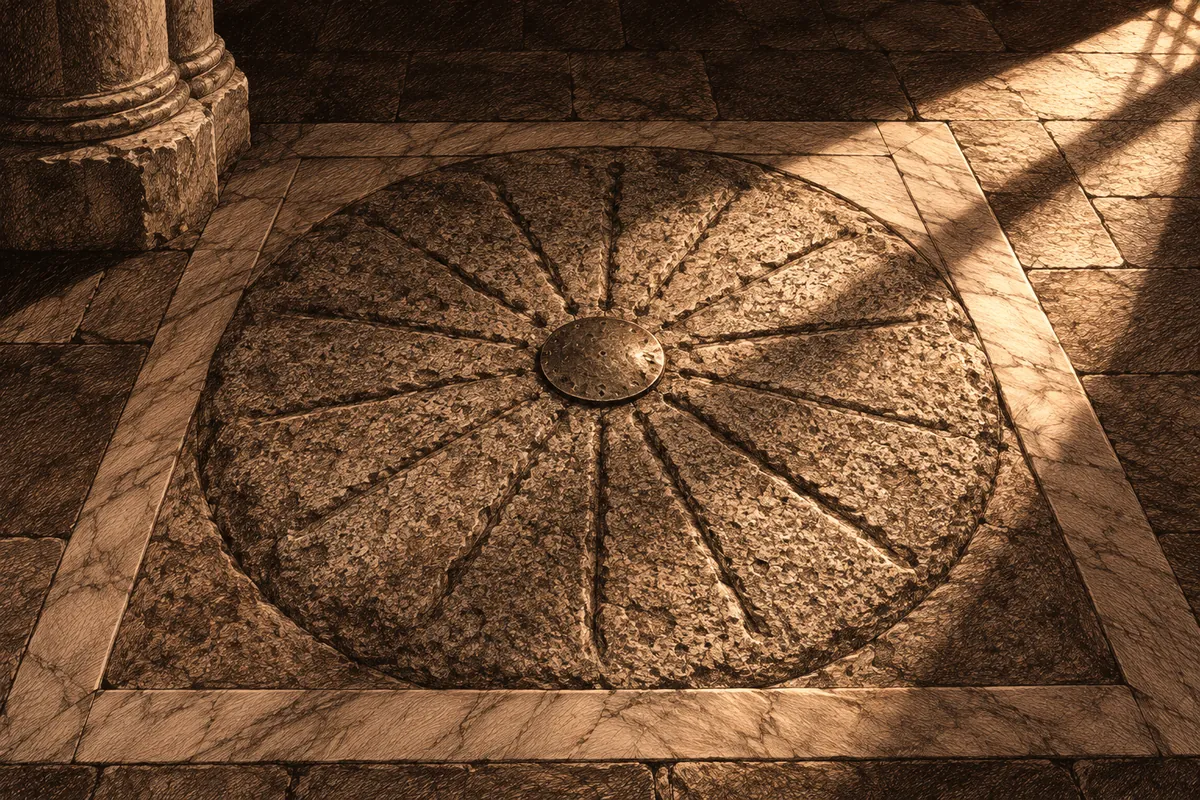
The stone of the Tredesin de Mars — a stone disc with a thirteen-rayed cross, in the floor of a Milanese church: it is called Celtic, but the two catalogue records say it was found in a cemetery and brought there in a removal of 1783.
- Variants and dialect names
- Tredesin de Mars, also Tredesin de Marz: in Milanese, the thirteenth of March. The stone is also called the stone of Saint Barnabas
- What is told
- A stone disc with a cross of thirteen rays and a hole at the centre, set into the floor of a Milanese church. The disc is 130 centimetres across and is of serizzo, a granite of the Lombard valleys. The central hole is today plugged with a cast metal element.
Around it is a marble slab with a Latin inscription recalling the preaching of Saint Barnabas to the Milanese, dated to the thirteenth of March. The name comes from that date.
The disc is not where it began. According to both catalogue records it was found in the cemetery of Porta Orientale, by the church of San Dionigi; in 1783, when the Servites left San Dionigi, they took it with them to Santa Maria al Paradiso along with the Crucifix of Aribert and a Saint Lucy. It did not reach us through unbroken devotion: it reached us in a removal. - What it was forthe author’s reading
- Today the date is the name of a flower fair. But the reason this entry exists is that here one can measure, with two public documents in hand, the distance between what an object is and what it is said to be.
What one reads about is that the disc is a Celtic funerary stele, with a hole for the passage of the soul, and that the thirteenth of March continues a spring rite of the Insubres. Neither catalogue record mentions Celts, Insubres or pre-Christian rites. Those attributions, in the pages that carry them, rest on folklore sites and blogs, and in one case on «some scholars» who are never named.
There is also a simpler error, easier to check. Online the year of the preaching is written «51 BC». But the inscription on the slab says anno Domini: that is, 51 after Christ, not fifty-one before. It is the difference between an apostle and a century in which there were not yet any apostles. - Where it is attested
- ICCD, SIGECweb, record OA, general catalogue number 03268555 (region code 03), cataloguing body S287. Object: slab, Milanese ambit. Compiled 2018 by Laura Facchin and Andrea Spiriti; scientific referent Luigi Pedrini; responsible official Raffaella Bentivoglio-Ravasio; photograph by Sandro Soldati, November 2018. From this record come: the 130 centimetres, the serizzo, the metal element in the hole, the dating 1915-1940 of the marble slab, the transfer «probably in 1783» and the bibliographic reference to Latuada.
Regione Lombardia, SIRBeC, record A, LMD80-00324, «Chiesa di S. Maria al Paradiso»; compiler Robert Ribaudo, drafted after a site visit in 2011. From here: the find in the cemetery of Porta Orientale and the Servites' return in 1783. The bibliography field of this record is empty: the funerary reading of the hole that appears in it has no references.
Graziano Alfredo Vergani, «Da Milano a Galliano…», pp. 403-424, in the institutional repository of the University of Macerata: it confirms 1783 for the Crucifix of Aribert leaving San Dionigi. It must be cited for what it is: the text states that it was intended for a publication that never appeared, so it is an author's typescript in a repository, not a refereed article.
Not opened, and it is the reference on which the historical part of the ICCD record depends: Serviliano Latuada, Descrizione di Milano, vol. V, Milan 1738, p. 276. Only an opening fragment of the Descrizione could be read on Internet Archive, and p. 276 was not reached. Also never opened: the volume of Forcella's inscriptions of the Milanese churches covering this church, the Ambrosian liturgical books for the date of 13 March, and the entry Tredesin in Cherubini's Milanese dictionary. - Caution
- No quotation is printed in this entry. The readings passed through a tool that summarises and truncates, and the Latin inscription arrived with two forms that look like typographic errors. So the inscription is not transcribed: only its robust content is reported, the date of 13 March and the anno Domini. Whoever wants the text should read it on the record or, better, on the stone.
The disc is not dated. The only certified dating, 1915-1940, concerns the marble slab that frames the disc, not the disc. On the disc the ICCD record itself wavers between a reused ancient piece and a Carolingian object, perhaps of the episcopate of Angilbert II (824-859). Anyone who reads «the stone is of the twentieth century» has misread the record.
The two records contradict each other, and the contradiction is reported. SIRBeC 2011 reads the disc as a funerary slab and calls the hole the «gate of liberation», through which the soul of the dead would pass — with no bibliography at all. ICCD 2018 gives no funerary reading and says nothing of a soul-hole. There is nothing to decide between them.
Two minor discrepancies, useful to anyone going there. The address: ICCD gives corso di Porta Vigentina 14, SIRBeC reports via Vigentina 12. And the same SIRBeC record says the church was built in 1590 for the Franciscan Third Order, while the whole later history it recounts is of Servites.
The history of the fair is not written. No dated attestation of the fair emerged, neither nineteenth-century nor earlier: only popular pages and an association's event, held on the Sunday nearest 13 March. Until Cherubini or a Milanese almanac is read, of the fair one can only say that today it exists.
No archival shelfmark. For the suppression of 1783 no inventory was checked, so no fonds is cited. Unknown: who laid the present slab and when, the text of the two half-effaced lines, and whether the inscription was already there in 1892.
The grade says how well the entry is documented, not how interesting it is. How the grades are assigned.