The game of Diana
Emilia-Romagna · The Po plain and the northern Apennines
Mirandola and its district, in the lower Modena plain
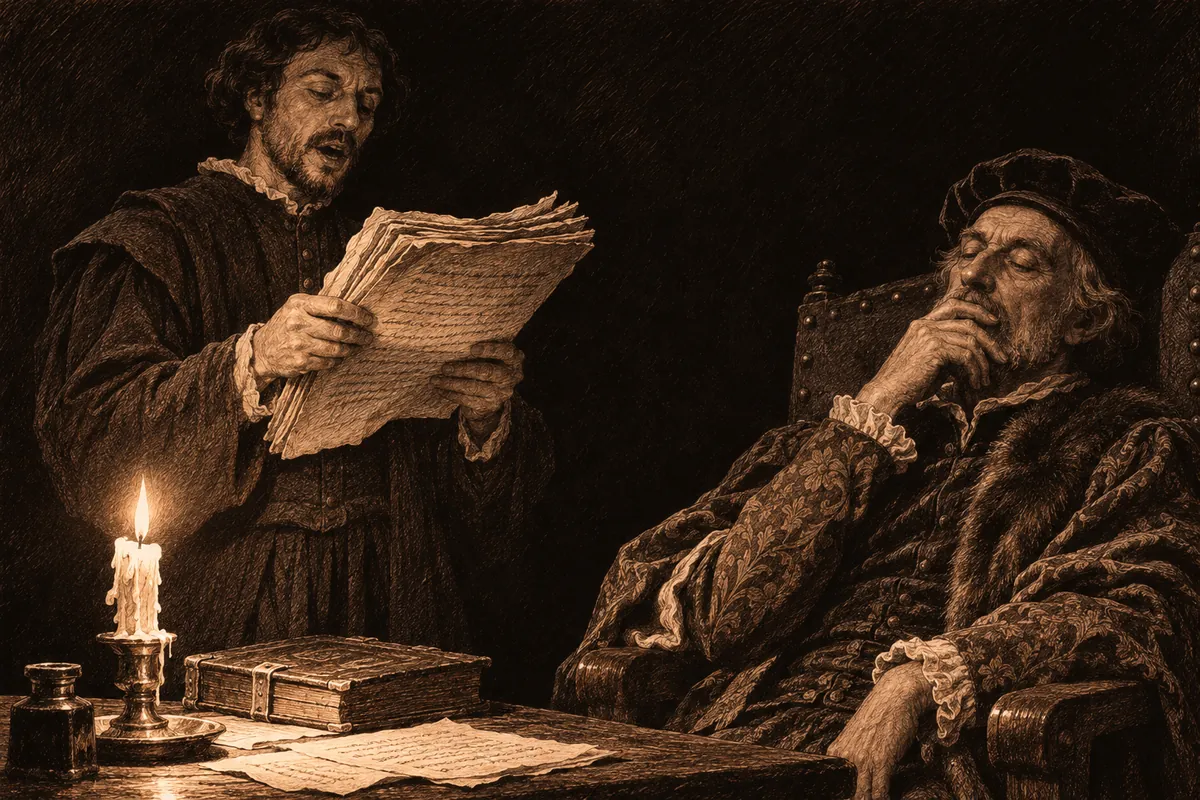
The game of Diana — in 1523 the lord of Mirandola had the witch-trial records read aloud to him and wrote down the vernacular name of the night assembly: «al giuoco di Diana», today called going on the course.
- Variants and dialect names
- in the text the name is «al giuoco di Diana», with the gloss in brackets «(oggi detto l’andare in corso)», today called going on the course. Later in the same book one reads also «i giuochi, e i balli di Diana con le Ninfe sue compagne», the games and the dances of Diana with her companion nymphs
- What is told
- In 1523 Giovan Francesco Pico della Mirandola — lord of the place and nephew of the more famous Giovanni Pico — published a Latin dialogue, the Strix, in which four characters argue over whether witches exist. The dialogue grew out of trials held in his own district.
What makes the text a source for folklore and not only for demonology is one line of the preface. Pico writes that the women went «al giuoco di Diana», to the game of Diana, and at once adds in brackets the living form, the one in use as he wrote: «(oggi detto l’andare in corso)». And he remarks that it is «cosa certo nel nome diversa da quella antica impietà», a thing certainly different in its name from that ancient impiety — that is, he notices for himself that the new name is not the old one.
Inside the dialogue the name returns several times, always in the same form: «quando si dice che son portate al giuoco di Diana», when it is said that they are carried to the game of Diana. - What it was forthe author’s reading
- For Pico, to prove a case. He was convinced that witches existed and that the trials were just, and he wrote the dialogue to persuade those who doubted it. He is not a neutral witness: he is the prosecution. This entry uses him as a source not because he is reliable about the facts, but because he reports a word, and says where he got it.
And he says it strongly. In the preface: «parte ho vista con gli stessi occhi, e parte udita con questi orecchi, mentre che mi si leggevano i processi» — part I saw with these same eyes, and part I heard with these ears, while the trial records were being read to me. The lord of the place had the acts read aloud to him, and from the acts he took the turn of phrase. It is the same mechanism as at Triora and in Valcamonica: popular vocabulary enters history because an inquisitor writes it down, and when the acts are lost only the man who read them is left. - Where it is attested
- Giovan Francesco Pico della Mirandola, La strega, ovvero degli inganni de’ demoni. Dialogo, Milan, Daelli, 1864. Read directly in the complete Project Gutenberg transcription, ebook no. 30839. Both quotations from the preface — the game of Diana with its gloss, and the trial records read aloud — stand in the section «Al suo Mainardo», the author's preface. It is cited by section and not by page because the transcription carries no page numbers: there is no marker of the kind [p. 12], and the only bracketed items are the author's own references such as «[Ovidio]». The dialogue has no division into books: it has the speakers' names, Apistio, Fronimo, Strega, Dicaste.
On the Latin original, two independent and concordant confirmations: the editor's notice of 1864 quotes Tiraboschi, who dates the Strix to 1523, in-4; and the Glasgow University Library catalogue record describes the princeps as «Bononiae, a Hieronymo de Benedictis, 1523; quarto».
Not opened: the Latin Strix of 1523; Leandro Alberti's Italian translation (1524, in-4); the Pescia printing of 1555 with Turino Turini's translation. For all three dates the source is the same quotation from Tiraboschi reported by the 1864 editor. - Caution
- The vernacular name passes through four hands, and it is not known in which of them it was born. The chain is: Pico writes in Latin in 1523; Turino Turini translates into Italian, printed at Pescia in 1555; Daelli reprints in 1864 stating in the notice «Noi alla nostra ristampa ci siamo valsi della traduzione del Turini», for our reprint we have used Turini's translation; Project Gutenberg transcribes the reprint. From which follows something that must be said and cannot be settled here: «al giuoco di Diana (oggi detto l’andare in corso)» are Turini's words, not Pico's. The gloss may translate a Latin gloss of 1523, or it may be an addition by the Tuscan translator of 1555. Without the Latin text alongside there is no deciding, and the Latin text was not opened. Anyone wanting to close the question must collate the Bologna princeps of 1523 on this passage of the preface: it is half a day's work, and it would change this entry's grade.
The years of the trials are not written here. Online they are everywhere given as «1522-1525», but Pico gives no date at all: he writes only that the events happened «pochi mesi sono nel nostro distretto», a few months ago in our district. In the 1864 text the only nearby date is 1533, and it concerns Galeotto's attack on the Mirandola court, not the trials. Until a source that dates them is seen, they stay without a year.
The trial records have not been located. One thesis assigns them to the Archivio di Stato di Modena, Inquisizione, b. 283, but the shelfmark does not match: in the official guide to the fonds that box contains «Libri» of 1602-1695, material from eighty years later. The right shelfmark was not found, and the wrong one is not copied. It is possible that the acts no longer exist: in that case Pico's dialogue is the only trace left, which is exactly why this entry is here.
One reservation about the reading. The Gutenberg transcription was gone through for about 86 per cent of its length; the last part of the dialogue was not checked line by line. Both quotations used here fall within the part that was read.
The grade says how well the entry is documented, not how interesting it is. How the grades are assigned.