The fake ox of Offida
the Marche · Central Apennines and the Adriatic
Offida (Ascoli Piceno): it starts from the borgo dei Cappuccini, the main phase is in piazza del Popolo
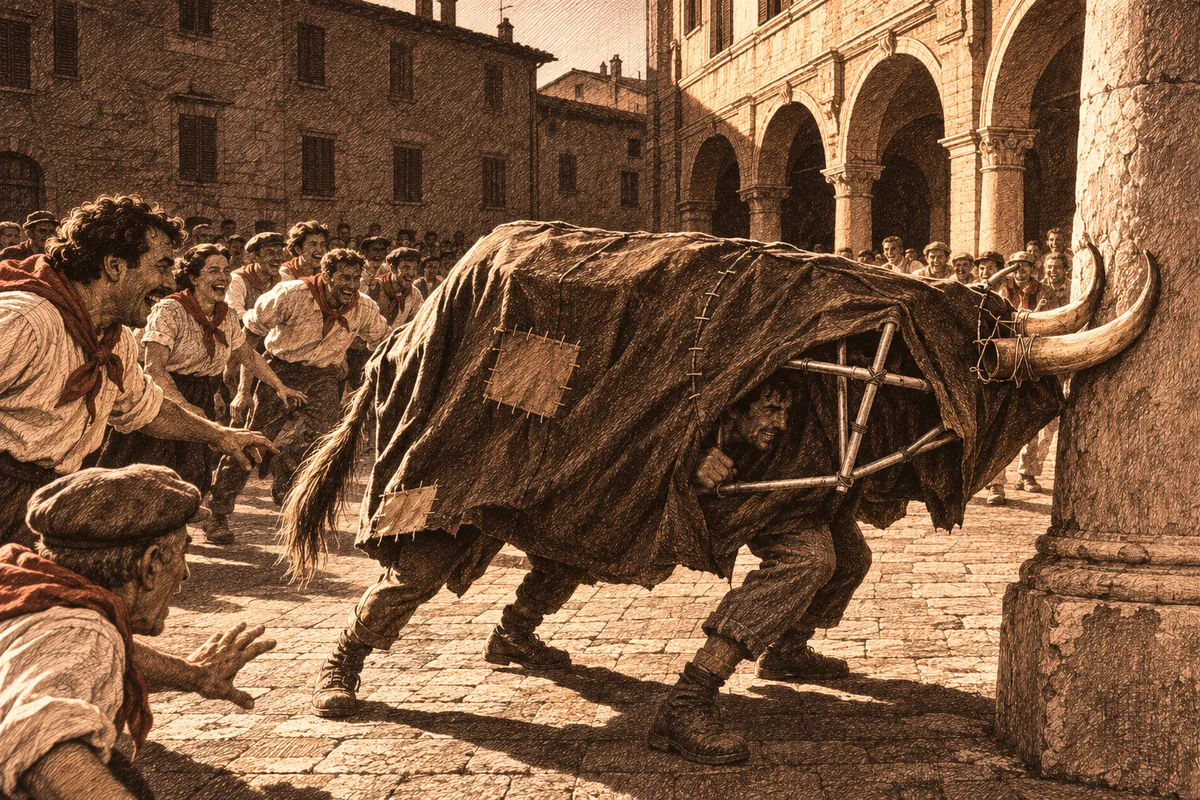
The fake ox of Offida — an aluminium effigy of an ox with real horns and tail, chased by the whole town on the Friday of carnival: the state record calls it ancient without citing sources, the only peer-reviewed study calls it early twentieth century.
- Variants and dialect names
- in the state catalogue the denomination is Carnevale di Offida: #lu bov fint#, the hash marks being the ICCD convention for flagging a dialect term. The lit bundles of cane and straw that close the cycle are called #vlurd#
- What is told
- An effigy of an ox chased by the whole town. The frame is of aluminium covered with cloth, with real horns and tail, and two people carry it.
It comes out of the borgo dei Cappuccini in the early afternoon of the Friday of carnival. The main phase is in piazza del Popolo, where the horns come to touch a column of the town hall. At sunset the ox is symbolically killed, and then carried in procession. The crowd is dressed in white and red.
It is not an isolated day: the Offida carnival cycle begins on 17 January, at Saint Anthony's, and closes on Shrove Tuesday with the procession of the vlurd. - What it was forthe author’s reading
- It is a game. And the thing to know is how old it is, because on this the two available sources say incompatible things.
The state catalogue record, of 2016, offers two hypotheses: bullfights of the Spanish period, or the memory of bull-killing rites said to be documented until the beginning of the nineteenth century. For that documentation it cites no source at all.
The only peer-reviewed study devoted to this game says the opposite. Its abstract calls the fake ox «a recent invention appearing at the beginning of the twentieth century», at a time when modern sport was taking shape in Italy. In the same summary the game is placed within a European legacy of bull sports of which it is, however, «more recent than might appear».
The point, for this atlas, is not to decide who is right: it is that the received story of antiquity does not circulate only in tourist material — it circulates in the state's own catalogue record, and without a reference. A hundred-year-old sporting game is one thing; a survival of ancient bull rites is another; and whoever goes looking for the second finds it written by an institution. - Where it is attested
- ICCD, MODI record «Carnevale di Offida: #lu bov fint#», module code ICCD_MODI_8754158568541, region code 11 (Marche), access profile 1; categories «festa-cerimonia» and «rappresentazione-spettacolo», ethno-anthropological field of protection. Research and drafting Rosa Anna Di Lella, compiled 2016, within the ICCD project Inventario del Patrimonio Culturale Immateriale / «500 giovani per la cultura»; coordination Fabrizio Magnani and Luisa Vietri. The survey is dated to about 2007 and the surveyor is not named. Read in full in the print version; the twin page in the general Catalogue returned an error on two attempts and was not opened.
The record declares attached audiovisual documentation: photograph PCI_Marche_RD_F0006 (a still from video) and two video extracts PCI_Marche_RD_V0006a and V0006b, taken from La storia del bov fint di Offida, 23 September 2007. None of these files was opened, and it is worth reporting that the record itself warns that the soundtrack of the videos does not match the images.
Lia Giancristofaro, «An Innocent Catharsis? Internal Logics of the Fake Ox Game in Offida, Italy», Journal of Festive Studies 6, 1 (2024), pp. 46-68, ISSN 2641-9939, publisher H-Net, DOI 10.33823/jfs.2024.6.1.198, published 1 December 2024. The full text was NOT opened: the DOI and three journal addresses answered with an error or a refusal. What was read is the IRIS record of the University of Chieti-Pescara, with abstract and metadata, from which come the page range and the single quotation in this entry.
Not opened: Maurizio Del Ninno, «Fuochi d'artificio», in Culture e mutamento sociale. Per Carla Bianco, Montepulciano 2002, pp. 211-221; Vitale Travaglini, Il carnevale storico della città di Offida, Ascoli Piceno 1997 (the ICCD record cites it without pages); and the historical town archive of Offida, which would be needed to verify or disprove the ICCD's statement about bull killings until the early nineteenth century. Of that archive no shelfmark is held and none is invented. - Caution
- One quotation only is printed in this entry, the eleven English words of the abstract, because they are short and verified. Everything else is attributed fact, not word: the readings passed through a tool that summarises and truncates, so the description of the effigy, the route and the dates comes from the ICCD record but is not a transcription of it. The only strings given in exact form are the field values #lu bov fint# and #vlurd# and the inventory codes.
The twentieth-century dating is not verified at the root. It is known that the article argues it, because its abstract says so; it is not known on what sources it rests — newspapers, council minutes, oral testimony, archives: the abstract does not say and the text was not opened. That is the first thing to go and read.
Three bibliographic discrepancies, reported. The pages: the IRIS record gives 46-68 (firstpage and lastpage fields), a DOAJ record gives 46-69, noting that it derives them from format metadata. The title: IRIS gives it with a colon and without «in Offida, Italy», the journal with a question mark and with the place; the journal's form is used here, with the declaration that its page was not opened. And DOAJ itself invites verification of the DOI string.
The year of first attestation remains unknown.
No pre-Christian origin. No open academic source asserts one, and none is written here even tentatively. The link with Spanish bullfights is a hypothesis of the record, without a reference. And the existence of nineteenth-century documents on bull killings at Offida must be treated as an unsourced assertion, not as a fact.
No numbers. No verified data are held on participants, weight or measurements of the effigy, nor exact times.
The coordinates are those of piazza del Popolo, taken from the geography of the place: the ICCD record has no georeferencing field. The borgo dei Cappuccini, the starting point, was not located.
Looked for and not written: the Cavalcata dell'Assunta of Fermo. It was the first candidate for this region. The searches returned only tourist material and local news: no dated statutory mention, no confirmation of the recurring 1182 and 1375, no datum on the year of the twentieth-century revival. To reopen it one needs the edition of the Fermo statutes and the inventory of the town's historical archive. There also exists a digital TEI edition of the Ascoli statutes of 1377 (printed 1496), presented at a conference in 2026, whose addresses are not reachable from here: a good lead for next time.
The grade says how well the entry is documented, not how interesting it is. How the grades are assigned.