The landzette of the Coumba Freida
the Aosta Valley · The Alpine arc
The Great St Bernard valley, in Franco-Provençal the Coumba Freida, the cold valley: Allein, where the carnival museum is, Doues, Saint-Rhémy-en-Bosses
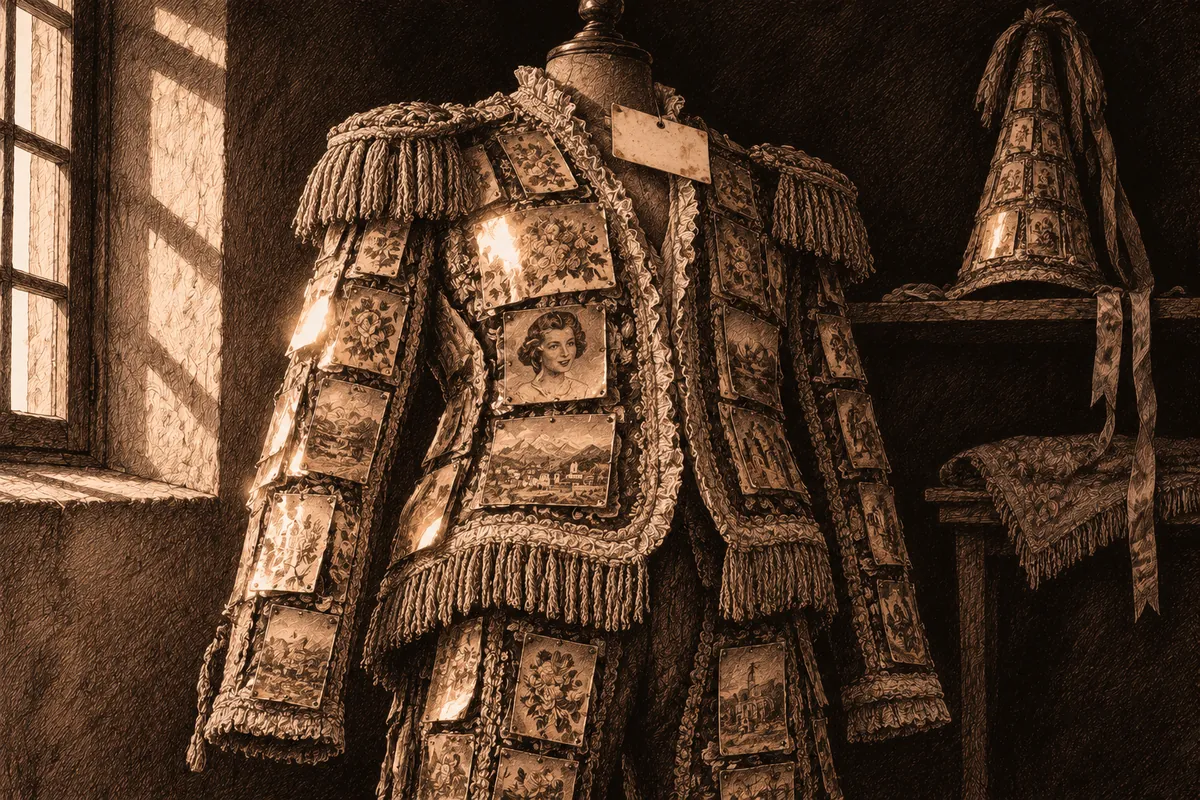
The landzette of the Coumba Freida — the masks of the Great St Bernard valley wear the helmet crosswise «in Napoleon's manner» — but no costume is older than the twentieth century, and the oldest on show dates from 1963.
- Variants and dialect names
- landzette, the masks; the gueudda is the one who leads the procession and calls the masks to order; each village has its own benda, its company. The valley's name, Coumba Freida, is also written Comba Frèida
- What is told
- A high-valley carnival in which the masks go from village to village in long tailed coats covered with sequins and mirrors, under a tall headdress. Each company has its colour and its way of wearing it, and the difference is territorial, not individual: the landzette of Doues and Allein are known because the costume is all red and the helmet is worn crosswise — «a la magnii de Napoléón», in Napoleon's manner.
And it is precisely that «in the manner of» that the entry is about, because the phrase describes a resemblance and is read as an origin. - What it was forthe author’s reading
- To carry a uniform around the valley, and to argue for two centuries about which one. The declared function is that of any Alpine carnival — the procession, the noise, the questing, the waking of the bear that Chantal Certan studies separately — but the thing the Coumba Freida does better than others is to keep inside the object the proof of its own age.
Because the costumes are not old. The oldest preserved are from the second half of the twentieth century, and the Allein museum shows a two-tailed jacket of 1963. And on the back of some mirrors there is a serial motif of ice axe and boot against mountains, which is the iconography of the post-war tourist boom. A dating detail inside an object presented as immemorial. - Where it is attested
- Alexis Bétemps, «Lo Carnaval de la Comba Frèida», in Valdostan Franco-Provençal, transcription by the Guichet Linguistique published on patoisvda.org, spelling updated October 2013. Two versions circulate: one marked «Tiré de: VILLENEUVE», with no year and labelled «texte inédit», and one marked «Liaison, Bibliothèque de Charvensod, 2012». Neither is paginated: they are cited by section. From them come the gueudda, the village bende, the red of Doues and Allein and the phrase «a la magnii de Napoléón».
Chantal Certan, «Les animaux entre la réalité et l'imaginaire: le réveil des animaux de la léthargie», bulletin À l'ombre de Cerlogne, Centre d'études francoprovençales «René Willien», 4 October 2007, pp. 48-55, notes p. 56. Note: these pages are about the waking of the bear and the dompteur, and Napoleon appears in them only as the title of a footnote.
Autonomous Region of Aosta Valley, lovevda database: record «Carnevale storico della Coumba-Frèida», Valpelline, id. 27335, and the record of the carnival museum at Allein, id. 1519.
Anna Maria Colombo, «Tutti i colori delle Landzette», Nos Alpes, 22 February 2025: this is journalism, not research, and that must be said — but it is the source of the two material facts that hold the entry up, the dating of the surviving costumes and the mirrors with the ice axe.
Three things were not opened, and they are the ones that would take the entry to grade A: Stefano Torrione, Le maschere di Napoleone, 2002, which appears as note 6 on p. 56 of Certan and whose publisher could not even be found; Giovanni Kezich, Carnevale re d'Europa, Priuli & Verlucca, 2015, ch. 25, p. 238, of which only the table of contents was read; and the catalogue of the exhibition «Quand l'ours se réveille… Le Carnaval en Vallée d'Aoste de 1900 à 1970», with the AVAS photographic collection. - Caution
- The Napoleonic origin does not hold as a historical fact, and it is worth seeing how it comes apart.
The Region gives it as tradition: the Valpelline record says that «tradition links the birth of the carnival to Napoleon's passage» over the Great St Bernard in May 1800, and speaks of uniforms «echoed», never documented. Bétemps, the ethnologist, is cautious in both texts and writes «selón eunna sertèin-a tradechón», according to a certain tradition: he reports, he does not endorse.
The only empirical basis found is a single oral testimony: a woman from Saint-Rhémy-en-Bosses, recorded by Chantal Certan in 2003-2004, speaks of uniforms brought home by veterans of the Russian campaign of 1812. Which gives two incompatible dates — 1800 against 1812 — one informant two centuries later, no costume older than the twentieth century and no archival source at all. It is written as an attribution, not as an origin.
And one thing this entry does not know. Who assigns the roles, how one becomes gueudda, how the roles pass on: not one line was found in any source opened, and there exists, so far as could be seen, neither a thesis nor an academic article devoted to this carnival. That is the difference from the mamuthones, where the structure is described. Here the gap is declared.
The grade says how well the entry is documented, not how interesting it is. How the grades are assigned.