The Baio of Sampeyre
Piedmont · The Alpine arc
Sampeyre, val Varaita (Cuneo); four distinct processions, from Piasso, Chalchesio, Rore and Villar
The Baio of Sampeyre — the five-yearly carnival of val Varaita, said to commemorate the expulsion of the Saracens around the year 1000: the oldest document is of 1698 and is a village quarrel over certain privileges.
- Variants and dialect names
- la Baìo is the local Occitan form; the bibliography also has Bahìo, the spelling used in the title of De Angelis's 1987 volume. The names of the offices vary between sources and are given here as attested variants, not normalised: Abà and Abà Majour, Tenent, Capitani, Portobandiero and Sout-portobandiero, Segretari, Tezourìe (elsewhere Tezourie), Uzouart, Granatìe, Serazine, Arlequin, Magnìn
- What is told
- A carnival that is not held every year. Four processions set out from the four hamlets — Piasso, Chalchesio, Rore, Villar — with a hierarchy of uniformed offices; it opens on the evening of Epiphany and closes on Shrove Thursday.
The central scene is a trial. The Tezourìe, the treasurer, is tried and condemned; he attempts to flee and the Uzouart, guards armed with muskets, recapture him. At Villar the sentence is carried out by the Granatìe.
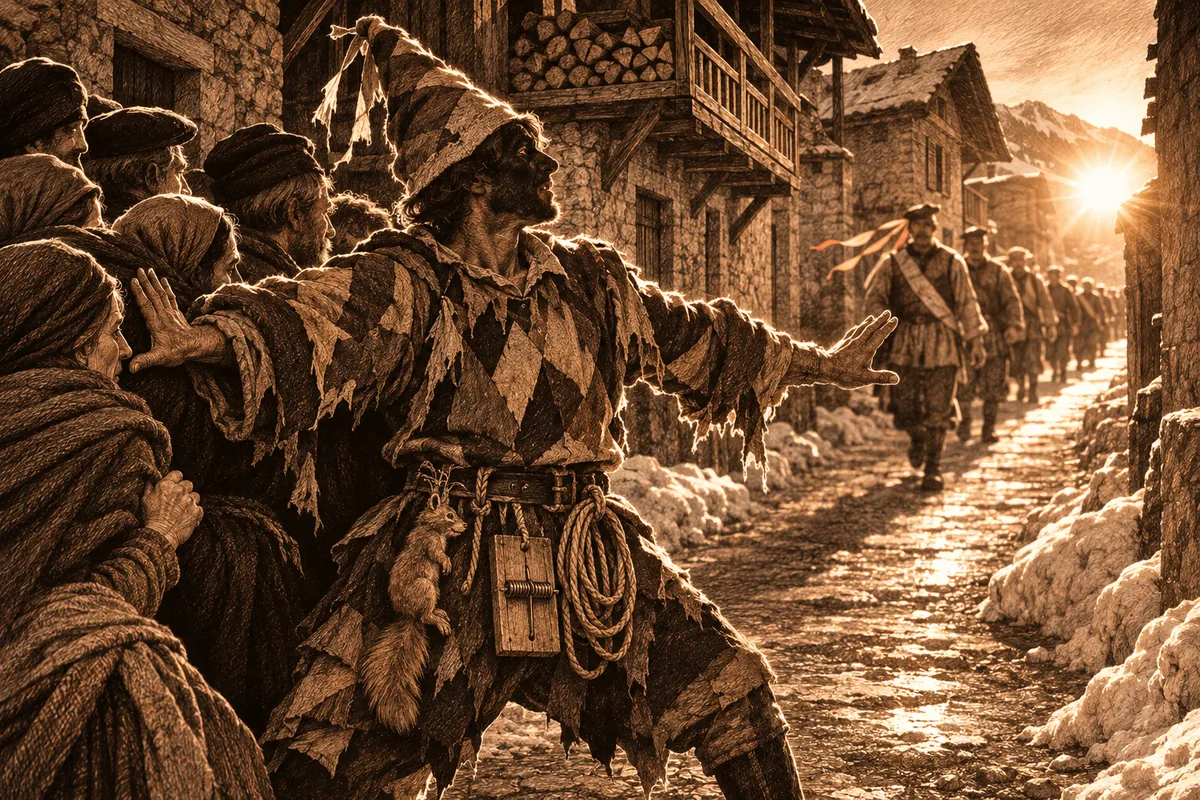
Two marginal figures are worth the entry on their own. The Arlequin, whose costume has a practical and not a symbolic function — it serves to hold the crowd back —: face often blackened with charcoal and objects that change at will, a rubber snake, an animal's tail, a stuffed squirrel, a mousetrap; at Calchesio he wears a woman's skirt. And the Magnìn of Rore, a kind of anti-Baìo who comes out at dawn on the day after the last day.
There was also a procession from Becetto, which existed until the end of the nineteenth century. - What it was forthe author’s reading
- The version one reads everywhere is that the Baìo commemorates the expulsion of the Saracens from the valley, and the Ministry's record goes so far as to specify that it would have happened around 975 or 980.
The oldest known document on the Baìo is of 1698, and it does not mention the Saracens. It is a petition of the town council of Sampeyre to the Marquis Porporato concerning the head of the Abbadia and his lieutenant, who claimed certain privileges — among them that of escorting brides to the beat of a drum — which the council disputed. In 1698 the Baìo is a matter of the abbadia: a business of offices, prerogatives and village friction. Not a military re-enactment.
And there is an explanation, proposed by the scholar who found the datum, of why the Saracen frame was put there: it would have served to make the festival acceptable, the uniforms to the State and the expulsion of the infidels to the Church. A cover, not a memory.
The same scholar also dismisses as a historical forgery the ius primae noctis sometimes invoked to explain the escorting of brides. - Where it is attested
- Gianluca Olcese, «Le tradizioni come identità: la Baìo di Sampeyre», Studia Romanica Posnaniensia XXXVII/1, 2010, pp. 69-84, DOI 10.2478/v10123-010-0006-2, open access. It is the load-bearing source. Read in two independent passes, concordant on the data; the page numbers come from the PDF's running heads. From it: the 1698 document and the absence of the Saracens (p. 73), the absence of documentary support for the historical reading and the thesis of a frame applied after the fact (pp. 73-74), the offices and the figures (p. 71 ff.), the ius primae noctis as a historical forgery (p. 73).
Gianluca Olcese, La Baìo di Sampeyre. Aspetti antropologico-comparativi del carnevale, Wrocław, Società Dante Alighieri Editore, 2023, ISBN 978-83-945213-3-2, DOI 10.53248/SDA521332. Read only as far as p. 60: the chapter on the Baìo and the final bibliography were not read. From what was read: the five-year cadence is a recent choice (pp. 16-17), and the author's position on the origin has changed (see the note).
Record «La Baìo di Sampeyre», site Rievocazioni storiche, Istituto Centrale per il Patrimonio Immateriale, Ministry of Culture: author Maria Elena Buslacchi, scientific lead Valeria Trupiano, last modified 1 July 2023. It is not an ICCD record and must not be called one: a MODI record in the ICCD catalogue for the Baìo was not found.
Not opened, and it is the source everything depends on: A. De Angelis, I documenti della Bahìo conservati nell'archivio comunale di Sampeyre (1698-1962), Sampeyre, Solestrelh, 1987, with the precise reference for 1698 at p. 22. The reference is the one in Olcese's bibliography; the author's full first name was not verified and the volume was not found in any catalogue. Nor was the inventory of the historical archive of the town of Sampeyre opened; it is a summary inventory by large divisions drawn up in the early 1960s and is not available online. - Caution
- No quotation is printed: the readings passed through a tool that summarises and truncates, and what came back — even where concordant across two passes — is not a collation. The facts are attributed, the words are not.
No shelfmark. Of the 1698 document it can be said that it is in the town archive of Sampeyre and is published in De Angelis 1987, p. 22, according to Olcese 2010. The shelfmark was not checked against the inventory of the fonds and so it is not written.
Olcese against Olcese, and it is reported. In the 2010 article the Saracen frame is a pretext with no documentary support, resting on a questionable reading of texts. In the 2023 book the same author is more cautious: he writes that the scarcity of documents allows neither confirming nor denying the thesis, and reports without distancing himself that for the inhabitants the festival is more than a thousand years old. 2010 is sharper than 2023, and this entry stands on 2010 while saying that 2023 exists.
The cadence is not «always every five years». The Ministry's record gives the periodicity as «variable», specifying that recently it is held every five years; Olcese 2023 says that earlier it depended on the men and the means available.
No pre-Christian origins. None of the open sources asserts a Celtic, pagan or pre-Roman origin: whoever writes it writes it without a source. The author's comparative readings — the old year, generative death, the references to Bakhtin, Sanga, Toschi, Eliade — are interpretation, not dating.
The Occitan question is contested. Tourist material presents the Baìo as an Occitan festival; Olcese 2010 reports the opposite position of Piero Dematteis, for whom it is an Alpine and not an Occitan festival, and reads the identity theme as an economic and media lever.
On the Piedmont subject held in reserve, a negative result. The critical edition of the trials of the masche of Rifreddo and Gambasca of 1495 (OPAC SBN TO01326122) remains unopened, and the details circulating online still come from popular pages and a blog: they are not written. One useful thing was established for whoever goes looking: the historical archive of the town of Rifreddo runs 1524-1900, with a single loose act of 1524. The acts of 1495 are not there. Where they are is not known, and is not written.
Unknown: any number of participants or spectators — the figures in circulation come from the organisers or the local press —, the reasons for the interruption after 1935 and the revival in 1952, and the date of the next edition.
The grade says how well the entry is documented, not how interesting it is. How the grades are assigned.