Zugarramurdi and the auto de fe of Logroño
Spain
Navarre: the accused come from Zugarramurdi, Urdax and other places in the Baztan; the tribunal is at Logroño, in another region, and the auto de fe is held there
Zugarramurdi and the auto de fe of Logroño — the largest witch trial in Spanish history, and the document that takes it apart: it was one of the three inquisitors, Alonso de Salazar Frías, who proved from inside that the sect did not exist.
- Variants and names
- the word the trial hands over to Castilian is aquelarre, in Basque akelarre, from aker «he-goat» and larre «meadow»; before 1609 it is attested only as a field name — aquerrlarea at Ituren in 1525, aquerlarrea in an inquiry at Araiz of 1595, with spellings that wobble («Aguer lurra» 1510, «Aquelurra» 1573)
- What is told
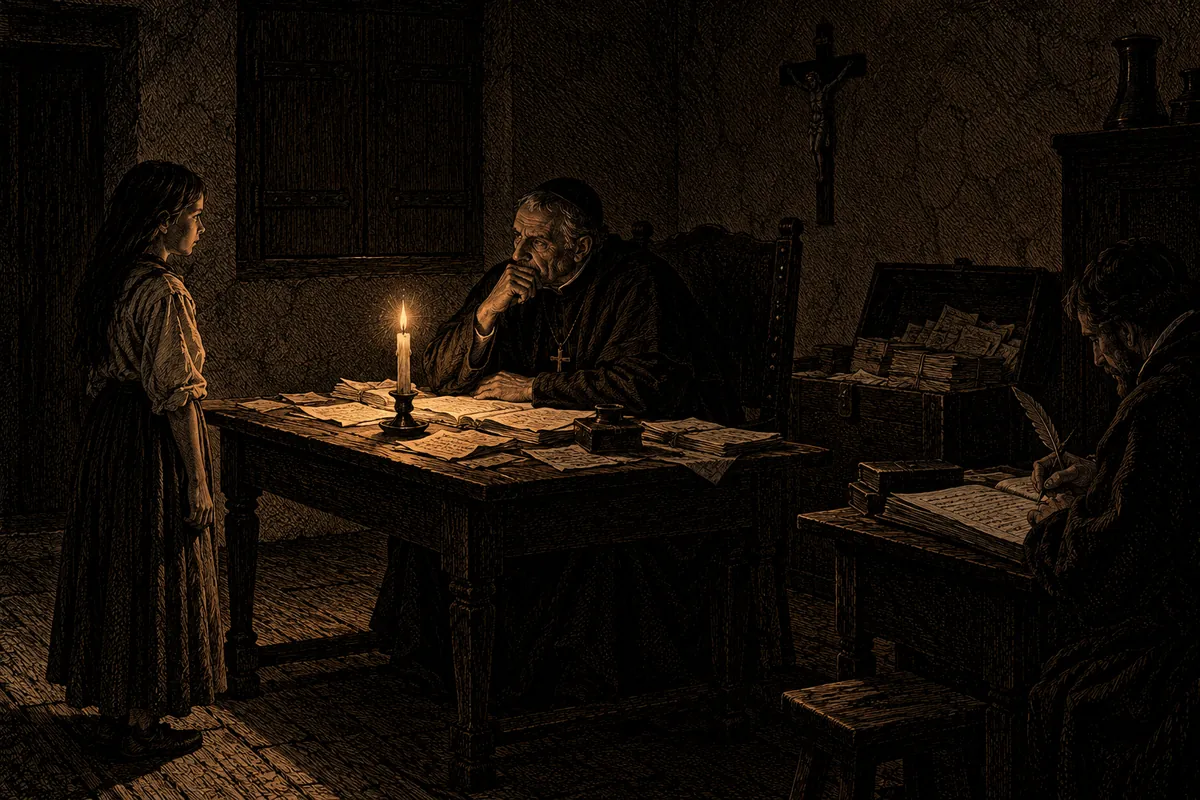
- Between December 1608 and November 1610 a denunciation brought from across the border becomes the largest witch trial in Spanish history. On the 7th and 8th of November 1610, at Logroño, fifty-two offenders of every kind mount the scaffold; eleven are handed to the secular arm, and of these six in person — the others in effigy, having died in gaol. The crowd, according to Henningsen, may have reached thirty thousand.
Then comes the thing that makes this trial unlike any other: one of the three inquisitors, Alonso de Salazar Frías, who had voted against the death sentence of the chief accused, travels the region with the edicto de gracia of 1611, gathers 1,802 presentations — of which 1,384 from girls under twelve and boys under fourteen — and concludes that the sect does not exist. He takes the trial apart from inside, with the instruments of the institution. - What it was forthe author’s reading
- The case serves the atlas for one precise reason: it is the place where one can measure how a mass belief is born. Salazar does not argue that the devil does not exist — he could not, and he is an inquisitor: he argues that the proofs do not hold, that the children's confessions contradict one another, and that the phenomenon grows in proportion to how much is said about it. The remedy he proposes in the second memorial is not a new edict: it is silence.
- Where it is attested
- Gustav Henningsen, «La brujería y la Inquisición», Príncipe de Viana 278, 2020, pp. 1013-1031, and «Los documentos de Alonso de Salazar Frías. Una polémica sobre la brujería en España, 1610-1614», ibid., pp. 947-968, plus «De la caza de brujas al culto de brujas», ibid., pp. 969-974: three texts by the editor of the records himself, in open access. Bárbara Santiago Medina, «Los memoriales como fuente para el estudio de la Inquisición en el Tribunal de Navarra (1609-1621)», Príncipe de Viana 279, 2021, pp. 247-274, for the dates of the seven memorials, the figures of the edict and the archival references. Juainas Paul Arzak, «El aquelarre, una invención afortunada», Gerónimo de Uztariz 23/24, pp. 9-40, for the history of the word. Eva Lara Alberola, Revista de Humanidades 30, 2017, pp. 43-74, for the printed relación.
Salazar's sentence, which goes from memory through the whole historiography, is here collated: «No hubo brujos ni embrujados hasta que se comenzó a tratar y escribir de ellos» — Henningsen, PV 278, p. 1029, who in a note cites it as Doc. 12.71 of his own edition The Salazar Documents, Brill 2004. It is the most one can have without opening Brill: not a second-hand citation, but the editor of the records citing his own document number.
Archive: AHN, Inquisición, leg. 1683, exp. 1 for Salazar's memorials; lib. 361, ff. 66v-67r for his appointment, 23 March 1609. No seventeenth-century primary source has been opened for this entry: neither Mongastón's relación of 1611, nor the memorials on Brill, nor Lancre, nor Pedro de Valencia. That is the reason for grade B. - Caution
- The sentence, in the forms in which it circulates. I have found it in three different readings, and two out of three have no primary reference: one with «brujas» in the feminine and «se habló y se escribió de ello», referred to a handbook; one with «hasta que no se comenzó», with no note at all. Only Henningsen's carries the document number. And it should be said that it is brujos, masculine, and that «in the village» is not there: that is an addition of repetition. Which of the seven memorials is Doc. 12, and with what date, I do not know: I do not invent it.
The number of victims. The solid core is eleven relajados, six in person. Any figure with three or four zeros given as executions confuses those burned with the 1,802 who presented themselves under the edict, or with the thirty thousand onlookers: that is exactly where the inflation comes from.
And the count of effigies does not add up, inside the best source. On the same page of Henningsen stand «thirteen died during the trial and went out in effigy» and, in a note, «eight dead», while eleven relajados minus six living make five. Three incompatible figures. I do not smooth them over: whoever writes «five in effigy» is doing a subtraction, not citing a document.
The cave. The cuevas de Zugarramurdi, with the stream now called Infernuko erreka, are the site people visit. None of the sources opened for this entry names them, and the etymology itself points elsewhere: larre is a meadow, and the word named first the place and then the assembly. The identification of the cave as the site of the sabbath is to be treated as later until an act is found that says so. The village museum is an institution of popularisation: it is not a source, and its panels are not cited.
Salazar as a «modern sceptic». No: he was an inquisitor who partly won an internal controversy. The Instrucciones of the Suprema of 29 August 1614 take up fourteen of the twenty articles of his seventh memorial almost word for word, but reject his two most radical requests — removing the article on witchcraft from the edicto de fe, and prosecuting the priest of Vera and two commissaries. And he was not the first: a junta at Granada had already produced sceptical instructions in 1526.
«From 1614 the Spanish Inquisition burned no more witches.» It is a tendency, not a switch: in 1621 eight alleged witches were burned, and Salazar wrote a report after that fact.
A chronology to be reformulated. The received account derives Zugarramurdi from Pierre de Lancre's persecution in the Labourd, dated 1609. But the Spanish denunciation is of December 1608 and is brought by María de Ximildegui, who came from Ciboure, where the hunt was already under way. The contagion crosses the border before Lancre's commission as it is usually dated. The French side I have not opened: I flag it as a problem, I do not solve it.
The grade says how well the entry is documented, not how interesting it is. How the grades are assigned.