Giuseppe Bellucci's Umbrian amulets
Umbria · Appennino centro-meridionale
Umbria: Magione, Papiano, Montemelino, Pila, Civitella d'Arna, Collepepe di Collazzone, Passignano, Perugia, Bevagna, Gualdo Tadino–Santa Lucia, Norcia
Giuseppe Bellucci's Umbrian amulets — a complex of amulets and remedies recorded in Umbria at the end of the nineteenth century.
- Variants and dialect names
- the source describes the objects and does not give their dialect names: until a source supplies them, the entry keeps an Italian title
- What is told
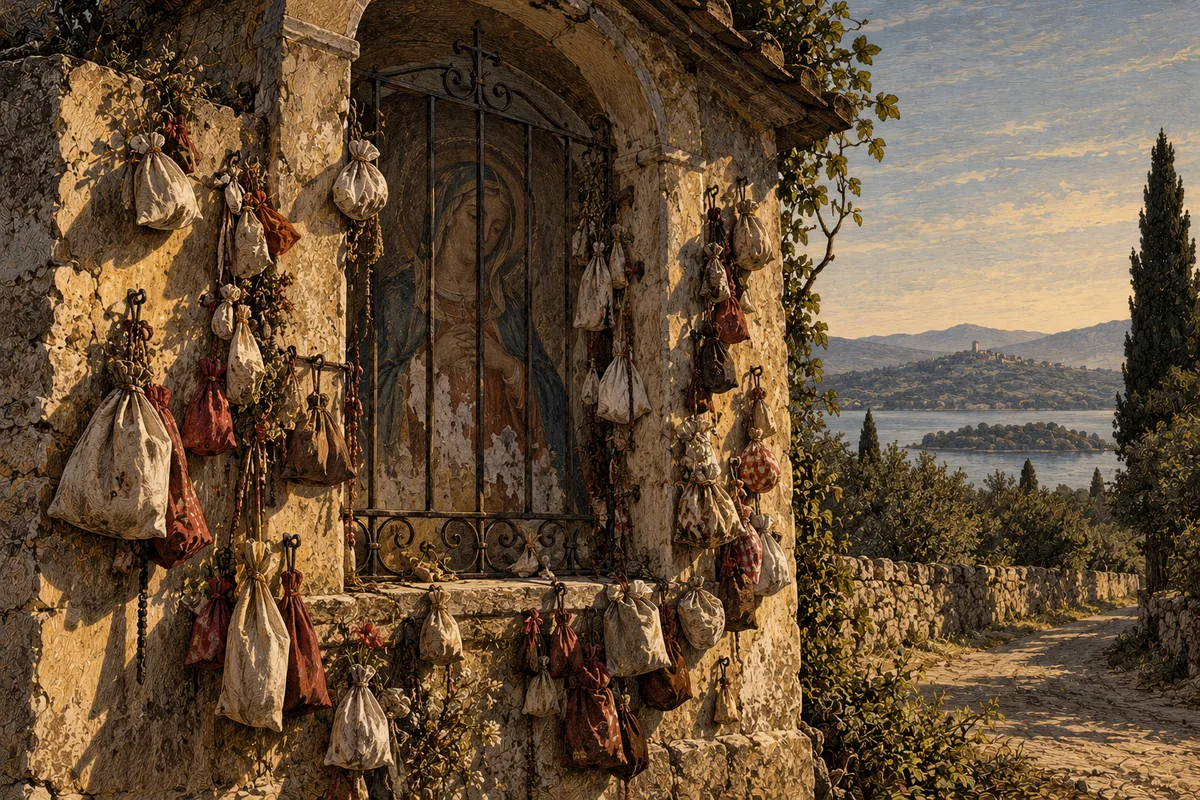
- A complex of amulets and remedies recorded in Umbria at the end of the nineteenth century. The piece that holds the entry up is Magione: lime is scraped from the painted Madonna of a wayside shrine, enclosed in a little bag the sick person wears so that it «draws out» the illness, and once healing has come the bag is given back to the image, which accumulates many. The remedy is taken from the image and returned to it: a loan, not an offering. Around it: polished serpentine pebbles that draw the venom of snakes and scorpions and lose their power if worked with iron; a hawk's bone against the evil eye; a fragment of human skull against epilepsy; shells for people and beasts; a womb-stone held on the left arm in pregnancy.
- What it was forthe author’s reading
- To heal and to protect with objects rather than with figures. It is the atlas's first entry that speaks neither of a creature nor of a collective rite but of material culture, and the only one in which the reader can go and look at the thing instead of the story: the objects are still there.
- Where it is attested
- Giuseppe Bellucci, Il feticismo primitivo in Italia e le sue forme di adattamento, Perugia, Unione Tipografica Cooperativa, 1907, with 74 illustrations — full scan consulted. Magione at pp. 59-60; Perugia p. 36; Collepepe p. 37; Papiano p. 37; Montemelino p. 38; Pila p. 39; Civitella d'Arna p. 46; Passignano pp. 51-52; Bevagna p. 32; Gualdo Tadino–Santa Lucia p. 25; coral at Norcia and Perugia pp. 23-24. The collection, some 3,500 amulets, is in the Museo Archeologico Nazionale dell'Umbria in Perugia, which keeps the inventories with each object's provenance; the display is curated by the anthropologist Giancarlo Baronti.
- Caution
- Bellucci gives provenances down to the hamlet but not the dates of the individual records and not the names of the informants: the A grade rests on the collector, on the places and on the fact that the objects are inventoried in a state museum, not on a chain of interviews. The page numbers come from a scan with noisy OCR and must be re-checked against the original. To be discarded: that the amulets are «Etruscan» — the prehistoric continuity is Bellucci's evolutionist thesis of 1907, not a datum —, the collection figures given as «over 5,000» or «over 2,000», and the attribution to Bellucci of questionnaire surveys, which the pages I read do not document.
The grade says how well the entry is documented, not how interesting it is. How the grades are assigned.