Mazapégul
Emilia-Romagna · The Po plain and the northern Apennines
Romagna: Forlì-Cesena, Ravenna, Rimini, with an Apennine core
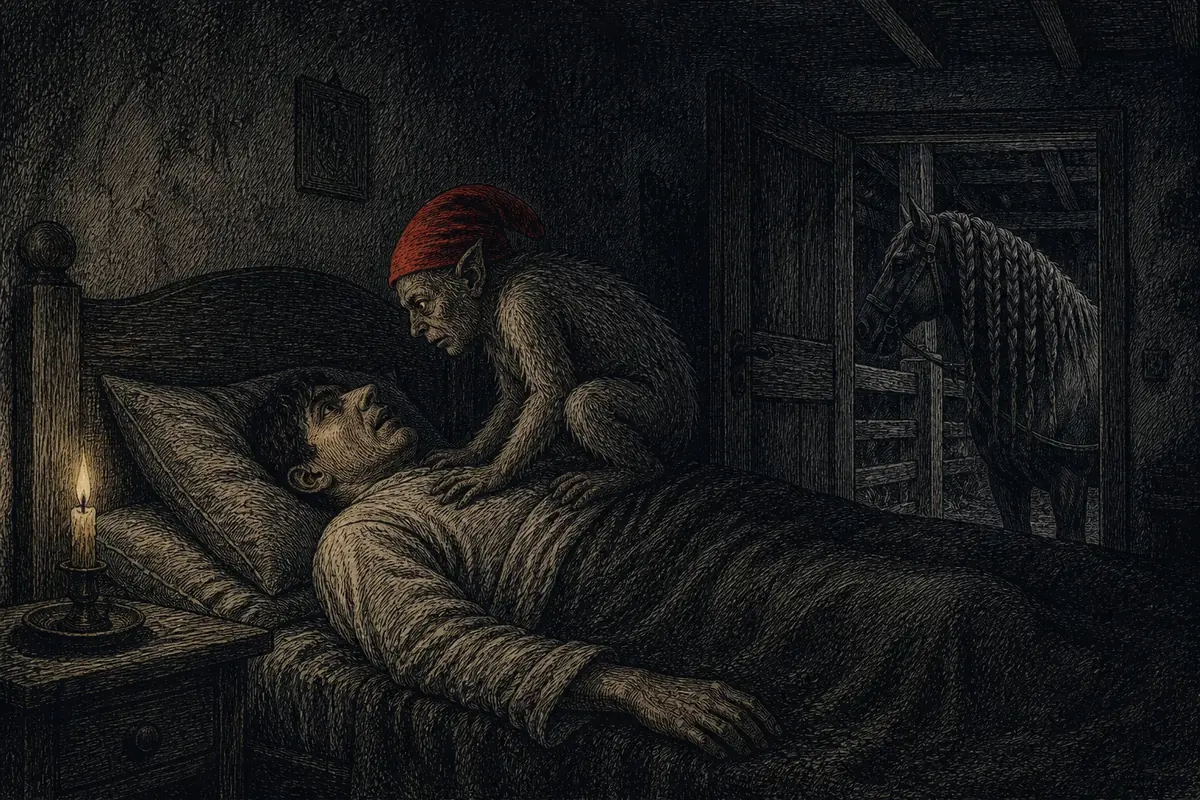
Mazapégul — little man with feline features, grey fur, wearing a red cap indispensable to his powers: whoever takes it from him holds him in his power.
- Variants and dialect names
- Mazapégul, mazapedar, mazapigur, caicarel, cheicatrèpp («belly-squasher»), cheicabìgul («navel-squasher»), sprivìnkle
- What is told
- Little man with feline features, grey fur, wearing a red cap indispensable to his powers: whoever takes it from him holds him in his power. He causes nightmares, sleep paralysis and a sense of suffocation; he plaits the tails and manes of horses.
- What it was forthe author’s reading
- Explanation of hypnagogic paralysis; control of young women's sexuality — the night visit is the socially acceptable explanation of disturbance, of the erotic dream and, in some variants, of unexplained pregnancy.
- Where it is attested
- Antonio Morri, Vocabolario romagnolo-italiano, Faenza 1840, p. 476, entry mazzapedar: «That oppression, and almost suffocation, which one sometimes feels when sleeping on one's back». Michele Placucci, Usi, e pregiudizj de' contadini della Romagna, Forlì 1818, considered by the Dizionario Biografico degli Italiani the first systematic description of the customs and beliefs of an Italian region. Baldini and Bellosi, 1989.
- Caution
- The headword in Morri is printed mazzapedar, without a diaeresis: the spelling with the diaeresis that circulates online does not correspond to the original. The attribution of the first mention to the Cesena chronicle of Fantaguzzi, late 15th century, I have not verified against the critical edition.
The grade says how well the entry is documented, not how interesting it is. How the grades are assigned.