Gostanza da Libbiano
Tuscany · The Po plain and the northern Apennines
San Miniato (province of Pisa), where the trial was held; the accused came from Libbiano, a hamlet of Peccioli, in the Valdera
Gostanza da Libbiano — she is not a creature: she is a real woman, and the trial concerning her is preserved.
- Variants and dialect names
- in the trial records monna Gostanza; old Tuscan form of Costanza. In the literature also «the witch of San Miniato»
- What is told
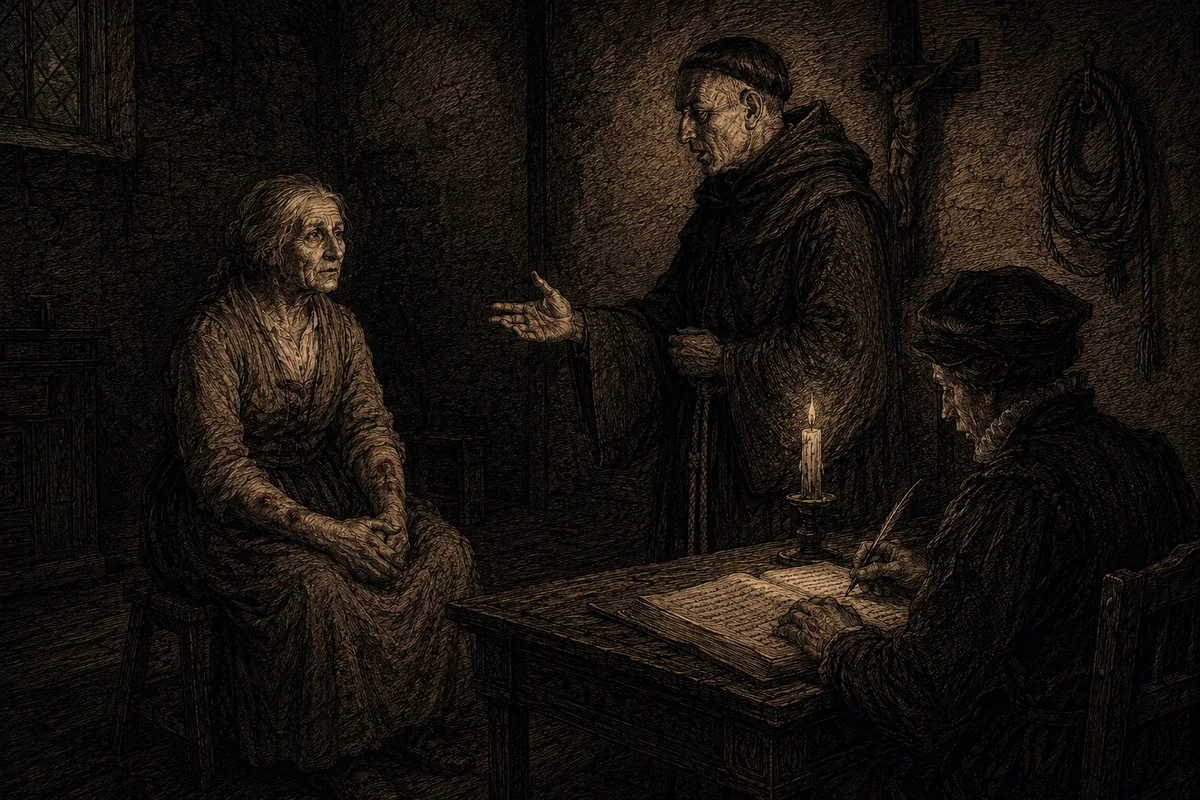
- She is not a creature: she is a real woman, and the trial concerning her is preserved. Born in Lucca around 1535, a widow, moved to Libbiano, she worked as a spinner, a midwife and a healer — sought out by the community and at the same time feared as a possible worker of maleficia. In November 1594 the episcopal vicar of San Miniato has her arrested. Under the rope torture she confesses to the sabbath, to couplings with the devil, to the flights, to transformation into animals. One detail of her depositions is worth the entry on its own: the sabbath is not held under a walnut tree nor in a wood, but in a city «more beautiful than Florence, where everything is laid in gold». She never confesses to apostasy, which for the inquisitors was the gravest charge. Then she retracts everything, and ascribes the confessions to the torments.
- What it was forthe author’s reading
- It is the case in which one sees at work, at first hand, the machine that manufactures witches: a village healer, a social demand for care, village suspicion, a local judge with a ready-made demonological model in his head, and the rope that makes it fit reality. The documentary value does not lie in the confessions — which describe no cult — but in showing how they were produced.
- Where it is attested
- Trial records, 1594, Archivio Vescovile di San Miniato. Critical edition: Franco Cardini (ed.), transcription by Marilena Lombardi, afterword by Adriano Prosperi, Gostanza, la strega di San Miniato. Processo a una guaritrice nella Toscana medicea, Roma-Bari, Laterza, 1989. The case is discussed by Michaela Valente, Witch Hunting and Prosecuting in Italy, «Religions», 14 (2023), art. 610.
- Caution
- Three things that are read everywhere and that the trial records contradict. She was not burnt: she was acquitted and released on 28 November 1594, forbidden to practise the healer's art and required to leave the area. She was not a nun, as one reads even in English-language entries: she was a lay widow. And above all she was not «persecuted by the Inquisition»: the trial was conducted by the local episcopal vicar, and it was the inquisitor of Florence, father Dionigi di Costacciaro, who intervened, who established that that «poor old woman» had confessed only because of the torments, and who annulled the outcome. It is the exact reversal of the cliché, and it is one of the cases on which rests the historiographical thesis that the Italian central tribunals restrained the excesses of local justice. Paolo Benvenuti's film of 2000, though based on the trial records, is a dramatic reconstruction and should not be used as a source.
The grade says how well the entry is documented, not how interesting it is. How the grades are assigned.